What Is Polysorbate? Chemistry, Uses and Safety Notes
Understand polysorbate chemistry, micelles, formulation roles and safety, with practical notes on polysorbate 20 versus 80 and medicine label checks.
By Sophie Bergmann, MSc13 min read
Reviewed by Medical Review Team ·
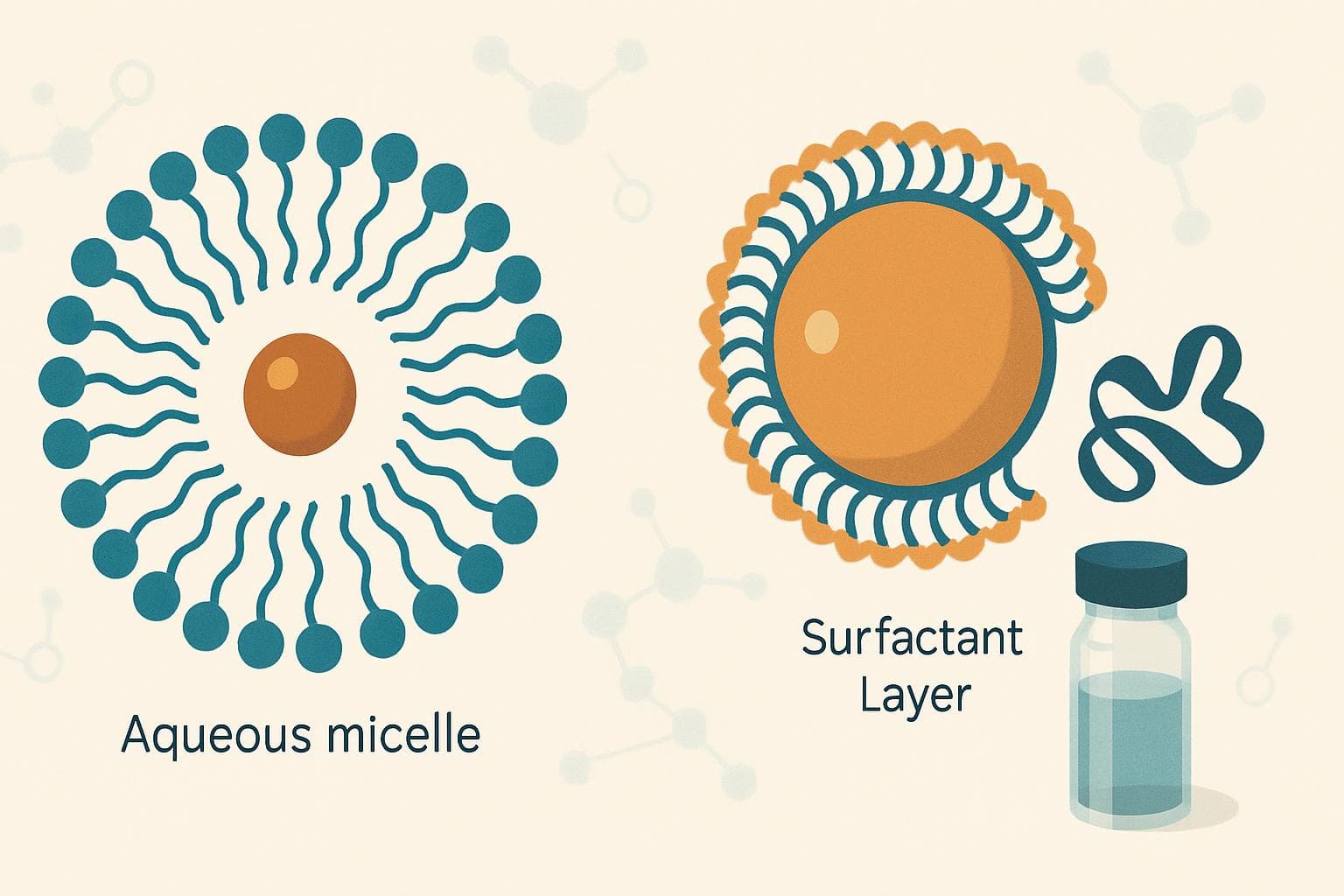
Polysorbate is a family of nonionic surfactants used mainly as excipients—supporting ingredients that help medicines mix, dissolve or remain stable. Polysorbate 20 and polysorbate 80 are common examples; their effects and safety depend on the formulation, amount, route of administration and patient.
These study notes connect chemistry with pharmacy practice. They are educational only, not advertising for any company's product; compare medicine options with a pharmacist rather than choosing by ingredient alone.
Quick Answer / Overview
Polysorbates have water-attracting and oil-attracting regions within the same molecular structure. That combination lets them collect at boundaries between water, oil, air and solid surfaces, where they can reduce interfacial tension and protect a formulation from physical instability.
They are not interchangeable with soap. Nor are they usually the ingredient treating the disease. A small excipient change can still alter product performance, particularly in injectable protein medicines.
Key Definitions
- Excipient: An ingredient included for manufacturing, stability, delivery or acceptability rather than the medicine's principal therapeutic effect.
- Surfactant: A substance that collects at interfaces and lowers surface or interfacial tension.
- Nonionic: Not carrying a formal electrical charge in its hydrophilic group under usual formulation conditions.
- Amphiphilic: Having both water-attracting and oil-attracting regions.
- Micelle: A dynamic cluster of surfactant molecules with a relatively water-repelling interior in an aqueous system.
- Critical micelle concentration, or CMC: The concentration region above which appreciable micelle formation occurs under specified conditions.
- Hydrophilic–lipophilic balance, or HLB: An empirical guide to how strongly a surfactant favors water versus oil.
- Interfacial adsorption: Accumulation at a boundary, such as an oil–water or air–water interface; this is different from absorption into the body.
Chemical Structure: What the Name Actually Means
Polysorbates are ethoxylated sorbitan fatty-acid esters. Sorbitol, a sugar alcohol, supplies the starting framework; dehydration produces sorbitan-related structures, fatty acids provide lipophilic portions, and polyoxyethylene chains provide much of the hydrophilic character.
The commercial ingredient is a mixture. It is not perfectly uniform molecule.
Pharmaceutical material contains distributions of ethoxylation, fatty-acid composition and esterification states, so a textbook drawing represents the family rather than every molecule inside a container.
In traditional descriptions such as polyoxyethylene (20) sorbitan monooleate, the parenthetical 20 indicates an approximate average number of oxyethylene units across the molecule. By contrast, the 80 in polysorbate 80 is a grade designation—not 80% strength or 80 oxyethylene units.
Important differences between common polysorbates
| Excipient | Predominant fatty-acid identity | Useful formulation distinction |
|---|---|---|
| Polysorbate 20 | Lauric acid, predominantly saturated C12 | Relatively hydrophilic; used for wetting, solubilization and protein stabilization |
| Polysorbate 40 | Palmitic acid, predominantly saturated C16 | Used as a hydrophilic emulsifier in suitable systems |
| Polysorbate 60 | Stearic acid, predominantly saturated C18 | Used in emulsion systems, often with other emulsifiers |
| Polysorbate 80 | Oleic acid, predominantly unsaturated C18 | Widely used in pharmaceutical solubilization and biologic formulations |
These are predominant identities, not guarantees of a chemically pure single ester. Compendial specifications govern acceptable composition and quality.
STICKY NOTE — Important point: Polysorbate 20 is not diluted polysorbate 80. Their fatty-acid profiles differ, and substitution requires formulation assessment.
How Polysorbates Work in a Formulation
Lowering interfacial tension
Water does not readily spread over every hydrophobic powder. Polysorbate can adsorb particle surfaces, improve wetting and help liquid displace trapped air. This supports dispersion; it does not guarantee that the drug dissolves completely.
At an oil–water boundary, the lipophilic region associates with oil while hydrated polyoxyethylene regions extend toward water. The resulting interfacial layer can help prevent droplets from merging, usually alongside suitable processing and other formulation components.
Forming micelles
Above the CMC, additional surfactant increasingly enters micellar aggregates. Poorly water-soluble molecules may partition into their less polar regions, increasing the total amount accommodated in the liquid.
The free drug concentration may differ. A laboratory assay reporting total dissolved drug does not automatically tell you how much is immediately available to cross a membrane or leave the carrier.
Simple formulation flowchart:
Hydrophilic regions + lipophilic regions → interfacial adsorption → improved wetting or droplet stabilization; above the CMC → micellar association → possible drug solubilization.
Temperature, salts, other excipients and the drug itself can change aggregation behavior. The CMC is therefore not a universal concentration to copy into every preparation.
Protecting protein medicines
Proteins can adsorb at air–liquid interfaces or containers, then unfold and aggregate. Polysorbates can compete for these interfaces and reduce surface-related damage during handling, although protection is product-specific and does not eliminate all aggregation pathways.
Shaking still matters. A surfactant-containing injection is not automatically safe to shake vigorously.
Pharmaceutical Uses and Clinical Significance
Polysorbates have formulation roles, not disease indications in the usual prescribing sense.
- Biologic injections: They may reduce interface-related aggregation of monoclonal antibodies and other therapeutic proteins.
- Other injectables: Selected formulations use them to solubilize poorly water-soluble active ingredients.
- Oral liquids: They can improve wetting, dispersion or solubilization, depending on the product.
- Creams and lotions: They help construct oil-in-water emulsions, often with a more lipophilic co-emulsifier.
- Ophthalmic preparations: Certain products use polysorbates for formulation support; some eye products identify polysorbate 80 as an active lubricant or demulcent under local rules.
- Vaccines and other specialized products: Some contain polysorbate as an excipient, but many do not.
Route changes the question. An ingredient suitable for a cream cannot be assumed suitable for injection, because sterility, endotoxins, impurity control and exposure requirements are fundamentally different.
Outside pharmacy, polysorbates also appear in foods and cosmetics. Food use does not establish suitability for a sterile medicine.
PK/PD: Why a Standard Drug Profile Does Not Fit
Pharmacokinetics, or PK, describes absorption, distribution, metabolism and elimination; pharmacodynamics, or PD, describes biological effects. Neither should be presented as universal drug-style profile for all polysorbates.
These mixtures behave differently across exposure routes. Oral exposure involves gastrointestinal processing, including potential ester hydrolysis; injected material bypasses that barrier, and its disposition cannot be inferred from dietary exposure.
There is no routine therapeutic plasma target. Likewise, a single half-life would be misleading without specifying the material, route and measurement method.
For formulation scientists, the more useful question is whether the surfactant changes drug solubilization, release, protein stability or tolerability in the finished product—not whether the excipient has its own therapeutic dose.
Degradation: A Small Excipient Can Create a Large Problem
Two pathways deserve attention: oxidation and hydrolysis.
Oxidation can affect polyoxyethylene regions and, especially where present, unsaturated fatty-acid regions. Oxygen exposure, light, heat, trace metals and pre-existing peroxides may contribute. Some degradation products can damage sensitive active ingredients, including proteins.
Hydrolysis breaks ester bonds and releases free fatty acids. In certain biologic formulations, residual host-cell enzymes can contribute to this process even when the amount of residual enzyme is small.
Visible particles are not always protein. Released fatty acids may form particles or interact with the formulation, while loss of intact surfactant may reduce protection against protein aggregation.
That creates a useful investigation principle: when particles increase, assess the protein, excipient and manufacturing residues rather than assuming the active ingredient has failed.
Quality testing may therefore examine composition, peroxide-related attributes, free fatty acids, particles and functional stability. A single total-polysorbate result cannot describe every relevant change.
REMEMBER — Stability insight: More surfactant is not always better. Additional polysorbate may improve aspect of stability while increasing the burden of degradable material.
Follow labeled storage conditions. Hot transport conditions do not justify freezing a medicine unless its instructions specifically permit it; freezing can introduce different physical stresses.
Dose and Concentration: Do Not Treat This as a Supplement
There is no general patient dose for polysorbate. Manufacturers select its concentration for a particular product, route, active ingredient and shelf-life requirement, then assess the finished formulation.
For study purposes, always distinguish concentration from exposure. A percentage describes composition; the amount received also depends on administered volume and frequency. Where quantitative excipient information is available, calculate exposure using consistent units rather than comparing percentage figures alone.
The FDA Inactive Ingredient Database provides regulatory precedent for listed ingredients in approved products. It is not permission to use any listed amount by any route, and its entries are not universal patient-specific safety limits.
Confirm the medicine's dose, route, dilution and administration instructions on the approved label and with a doctor or pharmacist. Never add household, cosmetic or food-grade polysorbate to an injection, eye preparation or prescribed medicine.
Side Effects, Allergy and Precautions
Most people tolerate the polysorbate present in approved products, but tolerance is not guaranteed. Local irritation or hypersensitivity can occur, and clinically significant reactions require assessment of the complete product rather than automatic blame on excipient.
Immediate reactions to polysorbate-containing products have been reported. Some may involve allergy; others may involve non-IgE pathways, including complement activation in particular formulation settings. The mechanism cannot be diagnosed from symptoms alone.
Seek emergency care for breathing difficulty, throat or tongue swelling, collapse or rapidly progressing symptoms after medicine administration. During an infusion, alert staff immediately; they should stop the infusion and follow the emergency protocol.
Do not deliberately retry a suspected trigger. For a mild localized reaction, contact the dispensing pharmacist or prescriber before another application or dose, particularly if symptoms recur.
Polyethylene glycol, or PEG, and polysorbates share polyoxyethylene-related structural features. Possible cross-reactivity has been reported, but PEG allergy does not prove polysorbate allergy, and the reverse is also untrue. Specialist evaluation may be needed.
A known reaction deserves particular attention before injections or vaccines. For neonates, pregnancy and breastfeeding, assess the actual medicine and exposure; neither a blanket ban nor blanket reassurance is appropriate.
IMPORTANT — Allergy records: Record the exact product, manufacturer when available, route, timing, symptoms and treatment. “Allergic to additives” is too vague to guide safe dispensing.
Pharmacy Practice: Read Beyond the Active Ingredient
Start with the current leaflet or prescribing information. Check inactive ingredients, the administration route and any product-specific warnings. For food labels, polysorbate 80 may appear as E433 and polysorbate 20 as E432; labeling conventions differ by country.
An ingredient list may omit quantities. If the amount matters clinically, the pharmacist may need manufacturer information rather than an estimate from another product.
For a patient with a suspected excipient reaction, build a product-by-product timeline that includes previously tolerated medicines. This can guide investigation without unnecessarily labeling an entire drug class as unsafe.
Switching requires care. Products containing the same active ingredient can have different excipients and delivery characteristics, so clinician-guided substitution is safer than assuming an alternative is equivalent in every respect.
Common Mistakes and Confusions
Polysorbate is not PEG itself. The structures share features, but the materials are not identical.
Nonionic does not mean nonreactive or nonallergenic. It describes electrical charge, not a guarantee of biological safety.
Micelles are not emulsion droplets. Micelles are surfactant aggregates; an emulsion contains droplets of liquid dispersed in another.
A clear solution is not necessarily stable. Chemical degradation and subvisible particles may develop before obvious cloudiness appears.
HLB is a starting tool, not a formulation verdict. Polysorbates generally favor oil-in-water systems, but compatibility and stability testing remain necessary.
An excipient is not automatically inert. It may influence drug performance and contribute to adverse reactions despite lacking the principal therapeutic role.
Quick Pharm D Notes
- Definition: Polysorbates are mixtures of ethoxylated sorbitan fatty-acid esters.
- Classification: Nonionic, amphiphilic surfactants used mainly as pharmaceutical excipients.
- Process: Interfacial adsorption supports wetting and stabilization; micellar association can support solubilization.
- Examples: Polysorbate 20 is predominantly laurate-based; polysorbate 80 is predominantly oleate-based.
- Clinical significance: Excipient identity matters in stability assessment and suspected hypersensitivity.
- Exam distinction: Improved apparent solubility does not automatically establish improved bioavailability.
- Quality point: Oxidation and hydrolysis can compromise function and generate degradation products.
- Administration point: Follow the finished medicine's label; do not extrapolate between routes.
Frequently Asked Questions
Is polysorbate a medicine or an inactive ingredient?
It is usually an excipient that supports a medicine's formulation. Some ophthalmic products list polysorbate 80 as an active lubricant or demulcent; check the specific label and local classification.
What is the difference between polysorbate 20 and 80?
Their predominant fatty-acid components differ: lauric acid for polysorbate 20 and oleic acid for polysorbate 80. This affects formulation behavior. The numbers do not represent strengths.
Is polysorbate 80 safe in vaccines?
Where present, it is assessed within the vaccine formulation. Most recipients tolerate it, but known severe allergy to a component requires product-specific review under current vaccination guidance.
Does PEG allergy mean I must avoid all polysorbates?
Not automatically. Possible cross-reactivity warrants evaluation, especially before an injectable product. Do not conduct a home exposure test or discontinue essential treatment without an alternative plan.
Can I replace polysorbate 80 with polysorbate 20?
Not without assessing the formulation. A replacement may change solubilization, protein protection and stability, even when both ingredients belong to the same surfactant family.
Does polysorbate cause cancer or damage the gut?
These cannot be answered reliably without specifying exposure and evidence. Laboratory and animal findings about emulsifiers do not by themselves establish clinical harm from the amount in a particular medicine. Discuss the actual product rather than avoiding needed treatment based on ingredient headlines.
Last-Minute Revision
- Polysorbates contain hydrophilic polyoxyethylene regions and lipophilic fatty-acid regions.
- Commercial grades are mixtures, not single pure molecules.
- Wetting, emulsification and micellar solubilization are related but distinct functions.
- Protein protection and surfactant degradation can occur in the same formulation.
- Route, exposure, product quality and allergy history determine the practical safety question.
References
- Handbook of Pharmaceutical Excipients, Pharmaceutical Press: polysorbate monographs and formulation properties.
- United States Pharmacopeia–National Formulary: applicable polysorbate monographs and quality standards.
- US Food and Drug Administration: Inactive Ingredients in Approved Drug Products Search.
- US National Library of Medicine: DailyMed, for current product-specific ingredient lists and administration information.
- European Food Safety Authority: scientific opinion, Re-evaluation of polyoxyethylene sorbitan monolaurate (E 432), monooleate (E 433), monopalmitate (E 434), monostearate (E 435) and tristearate (E 436) as food additives.
Important Medical Disclaimer
This article is for general educational purposes and is not a substitute for advice from a qualified doctor or pharmacist. Always consult your doctor/pharmacist before using any medicine, changing a dose, or starting treatment.
Related reading
If this article on What Is Polysorbate? Chemistry, Uses and Safety Notes was helpful, explore these related guides for more practical information on similar topics.
- Solid Dosage Formulation Principles — Binders, disintegrants, and compression science for tablet development.
- Amino Acids & Modernaminos — Learn amino acid chemistry, metabolism, and clinical uses, plus how to assess a Modernaminos label before considering any supplement or r…
- Ascard Tablet Overview: Uses, Dosage and Safe Use Tips — Understand what Ascard contains, why doctors prescribe it, and how to avoid bleeding risks, missed-dose mistakes and unsafe tablet substi…
- I Am a Gen Z Woman. How Does CeraVe Compare to The Ordinary in Terms of Skincare Effectiveness? — I Am a Gen Z Woman. How Does CeraVe Compare to The Ordinary in Terms of Skincare Effectiveness? Okay, real talk — if you've spent any tim…
- Apoptosis Defined: Mechanisms and Pharm-D Study Notes — Define apoptosis with clear pathways, morphology, clinical examples and exam distinctions, plus practical safety notes on apoptosis-targe…
- CHROMATOGRAPHY — Complete & Easy Notes — Theek hai, koi masla nahi! Ab main un saari 9 images se har topic cover karte hue ek complete, easy-words mein comprehensive note bana de…