Opium Alkaloids and Their Chemical Structures: A Complete Guide
Introduction Opium is one of the oldest medicines known to humans, and it is also the starting point for one of the most important drug classes in medicine: the opioids. Opium itself is not a single chemical — it is a
By Dr. Khalid Mehmood, MD14 min read
Introduction
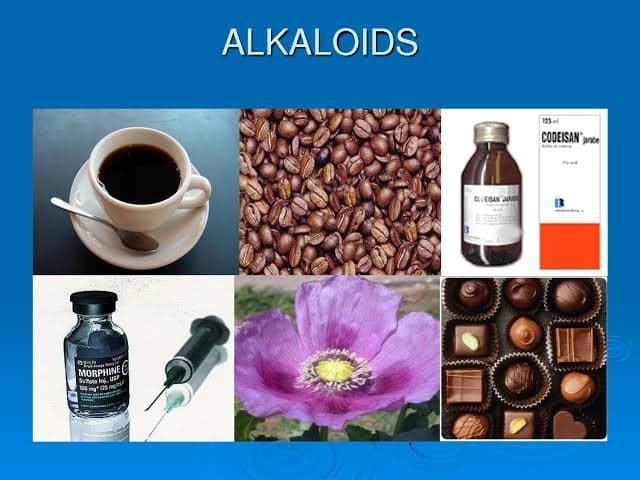
Opium is of the oldest medicines known to humans, and it is also the starting point for of the most important drug classes in medicine: the opioids. Opium itself is not a single chemical — it is a mixture of more than 40 different alkaloids (nitrogen-containing, plant-derived compounds with pharmacological activity).
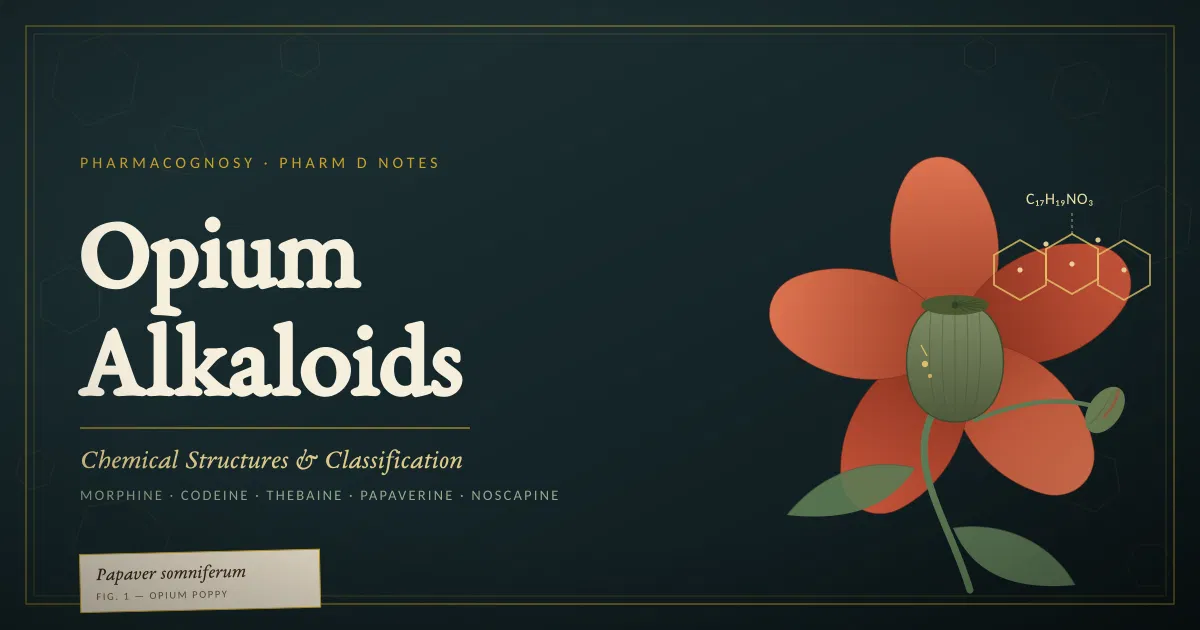
Opium alkaloids are naturally occurring nitrogen-containing compounds obtained mainly from the latex of the opium poppy, Papaver somniferum. They are important in pharmacognosy, medicinal chemistry, and pharmacology because several members of this group have significant therapeutic effects.
The best-known opium alkaloid is morphine, a powerful opioid analgesic. Other important alkaloids include codeine, thebaine, papaverine, and noscapine (narcotine).
Opium comes from the latex (milky sap) of the unripe seed capsule of Papaver somniferum, the opium poppy. Its alkaloids fall into two chemically distinct groups:
- Phenanthrene alkaloids — morphine, codeine, and thebaine. These share a rigid, multi-ring "morphinan" skeleton. Morphine and codeine are narcotic analgesics (painkillers); thebaine is not used as a medicine itself but is the raw material for making several other opioid drugs.
- Benzylisoquinoline alkaloids — papaverine, noscapine, and narceine. These have a simpler, more flexible structure with two ring systems joined by a single bridge. They are non-narcotic — no significant pain relief, no opioid addiction potential.
Classification of Opium Alkaloids
Pharmacognosy textbooks classify opium alkaloids chemically into two families, and this chemical classification lines up almost perfectly with their pharmacological behavior.
📝 STICKY NOTE
Important point: Of the six major opium alkaloids, morphine, codeine, and thebaine are placed under international narcotic control (under the 1961 Single Convention on Narcotic Drugs). Papaverine, noscapine, and narceine are not — they have essentially no analgesic or addictive activity because their chemical structure cannot fit the opioid receptor the way the phenanthrene alkaloids can.
The Phenanthrene (Morphinan) Alkaloids
These three alkaloids share the same basic five-ring "morphinan" skeleton — a partly hydrogenated phenanthrene nucleus fused with an oxygen bridge and a nitrogen-containing (piperidine) ring. What separates them is almost entirely a matter of a few substituent groups.
Morphine (C₁₇H₁₉NO₃; molecular weight ≈285.3 g/mol; PubChem CID 5288826)
Morphine's structure has four features that matter enormously for its biological activity:
- A free phenolic -OH group at carbon 3 (on the aromatic ring).
- A secondary alcoholic -OH group at carbon 6.
- An oxygen bridge connecting carbons 4 and 5, which locks part of the molecule into a rigid, cup-shaped 3-D arrangement.
- A tertiary nitrogen carrying an N-methyl (N-CH₃) group, part of a six-membered piperidine-type ring.
- One carbon–carbon double bond, between C7 and C8.
- Five points of fixed 3-D orientation (stereocenters) — the natural spatial arrangement is active at opioid receptors; its mirror-image form is not.
This rigid, oxygen-bridged, phenol-bearing shape fits precisely into the mu-opioid receptor, which is why morphine is of the most potent naturally occurring analgesics.
Codeine (C₁₈H₂₁NO₃; MW ≈299.4 g/mol; PubChem CID 5284371)
Codeine is chemically 3-O-methylmorphine — identical to morphine except that the free phenolic -OH at C3 has been converted to a methyl ether (-OCH₃). Everything else (the C6 -OH, the oxygen bridge, the C7-C8 double bond, the N-methyl group) stays the same.
Because the free phenolic -OH is essential for strong opioid-receptor binding, masking it with a methyl group makes codeine a much weaker direct opioid agonist than morphine. Much of codeine's analgesic and antitussive (cough-suppressing) effect actually depends on the liver enzyme CYP2D6 slowly converting a portion of a codeine dose back into morphine.
💡 REMEMBER Codeine = morphine + methyl group on the phenolic oxygen. That single structural change is the entire chemical difference — and it's the reason codeine is a much milder drug than morphine.
Thebaine (C₁₉H₂₁NO₃; MW ≈311.4 g/mol; PubChem CID 5324289)
Thebaine takes the same modification a step further: both the C3 and C6 oxygens are methylated (a dimethyl ether), and the molecule carries two carbon–carbon double bonds instead of one. This combination changes the molecule's shape and electronic character enough that thebaine barely interacts with opioid receptors in a useful way.
⚠️ IMPORTANT A very common student mix-up: thebaine is not a weaker version of morphine in the way codeine is. It is essentially inactive as an analgesic and can even be stimulant/convulsant in overdose rather than sedating. Thebaine is never used as a medicine by itself. Its real importance is as the industrial starting material from which several other opioid drugs — including oxycodone, oxymorphone, hydrocodone, naloxone, naltrexone, and buprenorphine — are manufactured through further chemical modification.
The Benzylisoquinoline Alkaloids
These alkaloids look almost nothing like morphine when you compare their structures side by side, even though the poppy plant makes them from the same biochemical starting materials.
Papaverine (C₂₀H₂₁NO₄; MW ≈339.4 g/mol; PubChem CID 4680)
Papaverine consists of an isoquinoline ring (a two-ring aromatic system containing nitrogen) joined by a single -CH₂- bridge to a separate dimethoxy-substituted benzene ring. In total it carries four methoxy (-OCH₃) groups — two on each ring system. There is no phenolic -OH, no oxygen bridge, and no rigid multi-ring cage the way morphine has.
Because its shape and functional groups are so different, papaverine does not bind opioid receptors in any clinically meaningful way. Instead, it acts mainly as a non-selective phosphodiesterase inhibitor, relaxing smooth muscle in blood vessels and the gastrointestinal tract — which is why it is used as a vasodilator/antispasmodic rather than a painkiller.
Noscapine (also called narcotine) (C₂₂H₂₃NO₇; MW ≈413.4 g/mol; PubChem CID 275196)
Noscapine belongs to a subgroup of benzylisoquinoline alkaloids called phthalideisoquinolines. Structurally it is more complex than papaverine: it has a fused five-membered lactone (cyclic ester) ring attached to a tetrahydroisoquinoline portion, plus a methylenedioxy (-O-CH₂-O-) bridge and additional methoxy groups on the aromatic rings. It also has two stereocenters, so four stereoisomeric forms are chemically possible.
Noscapine has no phenanthrene/morphinan skeleton at all, so it produces no significant analgesia, sedation, respiratory depression, or addiction — despite coming from the same plant. It is used clinically as a cough suppressant (antitussive), working through a central mechanism that is still not completely understood. (Ongoing research into noscapine's anti-tubulin, anticancer potential is an active but still emerging area — not an established clinical use.)
Narceine (C₂₃H₂₇NO₈; MW ≈445.5 g/mol; PubChem CID 8564)
Narceine is a minor benzylisoquinoline-type alkaloid, structurally related to noscapine but with the lactone ring opened into a free carboxylic acid, plus a dimethylaminoethyl side chain — making it amphoteric (able to act as both a weak acid and a weak base). It has weak, largely historical pharmacological interest (mild sedative activity) and essentially no modern clinical use.
📝 STICKY NOTE Important point: Papaverine and noscapine are chemically closer to each other than either is to morphine — both are benzylisoquinolines. That's why they share the "non-narcotic" label, even though is a smooth-muscle relaxant and the other is a cough suppressant.
Structure–Activity Relationship (SAR) — the "Morphine Rule"
Medicinal chemistry textbooks often summarize the key structural requirements for strong opioid activity in the morphinan series as follows:
- A free phenolic -OH at C3 greatly increases receptor affinity; methylating it (as in codeine) markedly reduces potency.
- A basic tertiary nitrogen, typically bearing an N-methyl group, is required for agonist (pain-relieving) activity. Replacing the N-methyl group with a bulkier substituent (such as N-allyl) is the classic structural change used to convert an opioid agonist into an antagonist — the chemical principle behind antagonist drugs like naloxone and naltrexone.
- The rigid, oxygen-bridged 3-D shape of the morphinan skeleton positions the molecule precisely for receptor binding; flattening or opening the ring system (as happens in the benzylisoquinoline alkaloids) essentially abolishes opioid activity.
- Converting both the C3 and C6 -OH groups to esters increases lipid solubility and speeds entry into the brain — the chemical basis for why acetylated derivatives of morphine act faster than morphine itself.
💡 REMEMBER A good way to picture the whole family: morphine is the "reference" structure. Change oxygen → codeine. Change both oxygens plus add a double bond → thebaine. Change the entire ring system → you leave the phenanthrene family altogether and land in the benzylisoquinoline family (papaverine, noscapine).
📚 Quick Pharm D Notes
Definition: Opium alkaloids are the pharmacologically active nitrogenous constituents of the dried latex of Papaver somniferum.
Classification (by chemical skeleton):
- Phenanthrene (morphinan) alkaloids: morphine, codeine, thebaine
- Benzylisoquinoline alkaloids: papaverine, noscapine (narcotine), narceine
Biosynthetic origin: All derive from the amino acid tyrosine via the intermediate reticuline; phenanthrene and benzylisoquinoline alkaloids branch off from related pathway stages.
Key structural facts:
- Morphine: C₁₇H₁₉NO₃ — free phenolic -OH (C3), alcoholic -OH (C6), oxygen bridge (C4–C5), C7–C8 double bond, N-CH₃.
- Codeine: C₁₈H₂₁NO₃ — 3-O-methylmorphine.
- Thebaine: C₁₉H₂₁NO₃ — 3,6-dimethyl ether of a morphine-type diene; not therapeutically used; precursor for other opioids.
- Papaverine: C₂₀H₂₁NO₄ — benzylisoquinoline, four -OCH₃ groups, no ring bridge.
- Noscapine: C₂₂H₂₃NO₇ — phthalideisoquinoline; antitussive, non-narcotic.
- Narceine: C₂₃H₂₇NO₈ — amphoteric benzylisoquinoline; weak, minor alkaloid.
Clinical significance: Morphine and codeine are used as analgesics/antitussives; thebaine is a chemical precursor only; papaverine is a smooth-muscle relaxant/vasodilator; noscapine is a non-narcotic antitussive.
Exam points to remember:
- Only morphine, codeine, and thebaine are internationally scheduled narcotic alkaloids.
- Codeine's activity partly depends on hepatic conversion to morphine via CYP2D6.
- The oxygen bridge and free phenolic -OH are the structural features most responsible for morphine's potency.
- Papaverine and noscapine act through non-opioid mechanisms (phosphodiesterase inhibition and a central antitussive site, respectively).
Comparison Tables
Table 1: Chemical Classification of Major Opium Alkaloids
| Alkaloid | Chemical Class | Molecular Formula | Approx. MW (g/mol) | Narcotic/Analgesic? |
|---|---|---|---|---|
| Morphine | Phenanthrene (morphinan) | C₁₇H₁₉NO₃ | 285.3 | Yes — strong |
| Codeine | Phenanthrene (morphinan) | C₁₈H₂₁NO₃ | 299.4 | Yes — mild |
| Thebaine | Phenanthrene (morphinan) | C₁₉H₂₁NO₃ | 311.4 | No (precursor only) |
| Papaverine | Benzylisoquinoline | C₂₀H₂₁NO₄ | 339.4 | No |
| Noscapine (narcotine) | Benzylisoquinoline (phthalideisoquinoline) | C₂₂H₂₃NO₇ | 413.4 | No |
| Narceine | Benzylisoquinoline | C₂₃H₂₇NO₈ | 445.5 | No (weak sedative only) |
Table 2: Structural Differences Among Morphine, Codeine, and Thebaine
| Feature | Morphine | Codeine | Thebaine |
|---|---|---|---|
| C3 oxygen | Free phenolic -OH | Methyl ether (-OCH₃) | Methyl ether (-OCH₃) |
| C6 oxygen | Free alcoholic -OH | Free alcoholic -OH | Methyl ether (-OCH₃) |
| Number of C=C double bonds (in the ring system) | One (C7–C8) | One (C7–C8) | Two |
| Relative analgesic potency | Reference (strong) | Much weaker; partly a prodrug | Essentially none (not used as analgesic) |
| Main use | Analgesic | Analgesic/antitussive | Industrial precursor for other opioids |
Table 3: Papaverine vs. Noscapine
| Feature | Papaverine | Noscapine |
|---|---|---|
| Structural subgroup | Simple benzylisoquinoline | Phthalideisoquinoline |
| Extra ring feature | None (simple methylene bridge) | Fused lactone (phthalide) ring |
| Main pharmacological action | Smooth-muscle relaxant, vasodilator (phosphodiesterase inhibition) | Antitussive (central mechanism) |
| Analgesic activity | None | None |
| Addiction potential | None | None |
    Phenanthrene ("narcotic") alkaloids — Morphine, Codeine, Thebaine:
"My Cousin Thebaine" → Morphine, Codeine, Thebaine.
- Benzylisoquinoline ("non-narcotic") alkaloids — Papaverine, Noscapine, Narceine: "Please, No Narcotics!" → Papaverine, Noscapine, Narceine — a handy reminder that this whole group is the non-narcotic one.
Clinical / Practical Relevance
- Morphine remains a gold-standard analgesic for moderate-to-severe pain, including cancer pain and post-surgical pain, used under strict controlled-substance regulations.
- Codeine is used for mild-to-moderate pain and as a cough suppressant; because its effect depends partly on CYP2D6-mediated conversion to morphine, patients who are "ultra-rapid metabolizers" at this enzyme can experience unexpectedly strong effects, while "poor metabolizers" may get little benefit — a point regulatory agencies such as the FDA have issued specific safety warnings about, particularly regarding codeine use in children.
- Thebaine has no direct clinical use but is industrially essential as the raw material for manufacturing oxycodone, oxymorphone, hydrocodone, naloxone, naltrexone, and buprenorphine.
- Papaverine is used (including by intracavernosal injection) for conditions such as vasospasm and, historically, erectile dysfunction, as well as for visceral/intestinal spasm.
- Noscapine is used in some countries as an over-the-counter or prescription cough suppressant; it is not approved everywhere, and some regulators have raised caution around its use in pregnancy.
Common Mistakes and Confusions
- Confusing "opiate" with "opioid." Opiates are natural alkaloids derived directly from opium (morphine, codeine); "opioid" is the broader umbrella term that also includes semisynthetic and fully synthetic drugs (e.g., oxycodone, fentanyl) that act on the same receptors.
- Assuming thebaine is simply "weak morphine." It is not used as an analgesic at all — its role is almost entirely as a chemical precursor.
- Forgetting that codeine needs to be metabolized. Students sometimes describe codeine as acting purely on its own; in reality, a meaningful part of its effect depends on hepatic conversion to morphine.
- Assuming all opium alkaloids are addictive/controlled. Papaverine and noscapine are not narcotics and are not under the same international control as morphine, codeine, and thebaine.
- Mixing up noscapine and narceine. Both are minor benzylisoquinoline alkaloids, but noscapine has an established clinical use (antitussive); narceine is pharmacologically minor.
Important Differences (Summary Table)
| Comparison | Key Distinguishing Point |
|---|---|
| Morphine vs. Codeine | Free phenolic -OH (morphine) vs. methylated ether (codeine) at C3 |
| Codeine vs. Thebaine | Thebaine has both oxygens methylated and an extra double bond |
| Phenanthrene vs. Benzylisoquinoline alkaloids | Rigid, oxygen-bridged multi-ring cage (narcotic) vs. flexible, two-ring structure joined by a single bridge (non-narcotic) |
| Papaverine vs. Noscapine | Noscapine has an additional fused lactone ring; papaverine does not |
| Opiate vs. Opioid | Opiate = naturally derived; opioid = any receptor-active compound, natural or synthetic |
FAQ
Q1: Why is morphine more potent than codeine if they are so structurally similar? Because morphine has a free phenolic -OH group at C3, which binds opioid receptors much more effectively than codeine's methylated version of the same position.
Q2: Is thebaine dangerous? Thebaine is not used therapeutically and is reported to have low analgesic activity with stimulant/convulsant effects in overdose rather than typical opioid sedation; it is handled as a controlled industrial precursor rather than a medicine.
Q3: Are papaverine and noscapine addictive like morphine? No. Their chemical structure (benzylisoquinoline) is very different from the phenanthrene/morphinan skeleton, so they do not produce meaningful opioid-receptor activity, analgesia, or addiction.
Q4: What does "phenanthrene alkaloid" actually mean? It means the alkaloid's core ring system is built on (a modified, partly hydrogenated version of) the three-fused-ring phenanthrene skeleton, technically called a morphinan skeleton in this context.
Q5: Why is thebaine still important if it isn't used as a drug? Because its extra reactive double bond makes it a useful chemical starting material from which several other important opioid medicines (like oxycodone and naloxone) are industrially manufactured.
Q6: Does noscapine have any analgesic effect? No established analgesic effect. Its clinical use is as a cough suppressant, and research into other potential uses (such as anticancer activity) is still investigational, not an approved clinical indication.
Q7: How many alkaloids are actually in opium? More than 40 individual alkaloids have been identified, but about six — morphine, codeine, thebaine, papaverine, noscapine, and narceine — are considered pharmacologically or economically significant.
Q8: Is codeine considered a "prodrug"? It's often described that way because a portion of its effect depends on conversion to morphine, though codeine also has some direct activity of its own — so "partial prodrug" is a more accurate description than a pure prodrug.
⚡ Last-Minute Revision
- Opium = dried latex of Papaver somniferum; contains 40+ alkaloids, but ~6 matter clinically/academically.
- Two chemical families: phenanthrene (morphinan) — morphine, codeine, thebaine — and benzylisoquinoline — papaverine, noscapine, narceine.
- Morphine (C₁₇H₁₉NO₃): free phenolic -OH (C3), alcoholic -OH (C6), oxygen bridge, double bond, N-CH₃.
- Codeine (C₁₈H₂₁NO₃) = 3-O-methylmorphine → weaker; needs CYP2D6 conversion for part of its effect.
- Thebaine (C₁₉H₂₁NO₃) = dimethyl ether + extra double bond → not used as a drug; precursor for oxycodone, naloxone, buprenorphine, etc.
- Papaverine (C₂₀H₂₁NO₄): benzylisoquinoline, smooth-muscle relaxant, non-narcotic.
- Noscapine (C₂₂H₂₃NO₇): phthalideisoquinoline, antitussive, non-narcotic.
- Narceine (C₂₃H₂₇NO₈): minor amphoteric alkaloid, weak sedative.
- Only morphine, codeine, and thebaine are internationally scheduled narcotics.
- SAR rule: free phenolic -OH + rigid oxygen-bridged ring + N-methyl = potent opioid activity.
References
- PubChem, National Center for Biotechnology Information, U.S. National Library of Medicine — compound records for Morphine (CID 5288826), Codeine (CID 5284371), Thebaine (CID 5324289), Papaverine (CID 4680), Noscapine (CID 275196), and Narceine (CID 8564). https://pubchem.ncbi.nlm.nih.gov/
- United Nations Office on Drugs and Crime (UNODC), Bulletin on Narcotics, 1953, Issue 3 — classification and control status of opium alkaloids. https://www.unodc.org/unodc/en/data-and-analysis/bulletin/bulletin_1953-01-01_3_page005.html
- National Center for Biotechnology Information (NCBI) Bookshelf — "Exposure Characterization: Opium Consumption," IARC/WHO monograph data on opium alkaloid composition. https://www.ncbi.nlm.nih.gov/books/NBK586388/
- Wikipedia contributors — entries on Morphine, Codeine, Thebaine, Papaverine, Noscapine, and Narceine (used for cross-checking nomenclature and general pharmacological summaries). https://en.wikipedia.org/
- Standard pharmacognosy textbooks: Trease and Evans' Pharmacognosy and Kokate's Pharmacognosy and Phytochemistry — for general classification and biosynthesis of opium alkaloids (consult current editions for full detail).
- Standard medicinal chemistry references (e.g., Foye's Principles of Medicinal Chemistry) — for structure–activity relationship principles of the morphinan series (consult current editions for full detail).
This article is for educational purposes for Pharm D students and general readers. It is not medical advice, and it does not describe extraction, isolation, or synthesis procedures. Handling, prescribing, and dispensing of opioid substances are governed by national and international drug-control regulations.