Tropane Alkaloids: Atropine, Hyoscyamine, Scopolamine & Cocaine
Tropane alkaloids are a group of naturally occurring alkaloids that contain a characteristic tropane ring system in their chemical structure. The tropane nucleus is a bicyclic nitrogen-containing ring with the formula
By Dr. Khalid Mehmood, MD7 min read
Introduction to Tropane Alkaloids
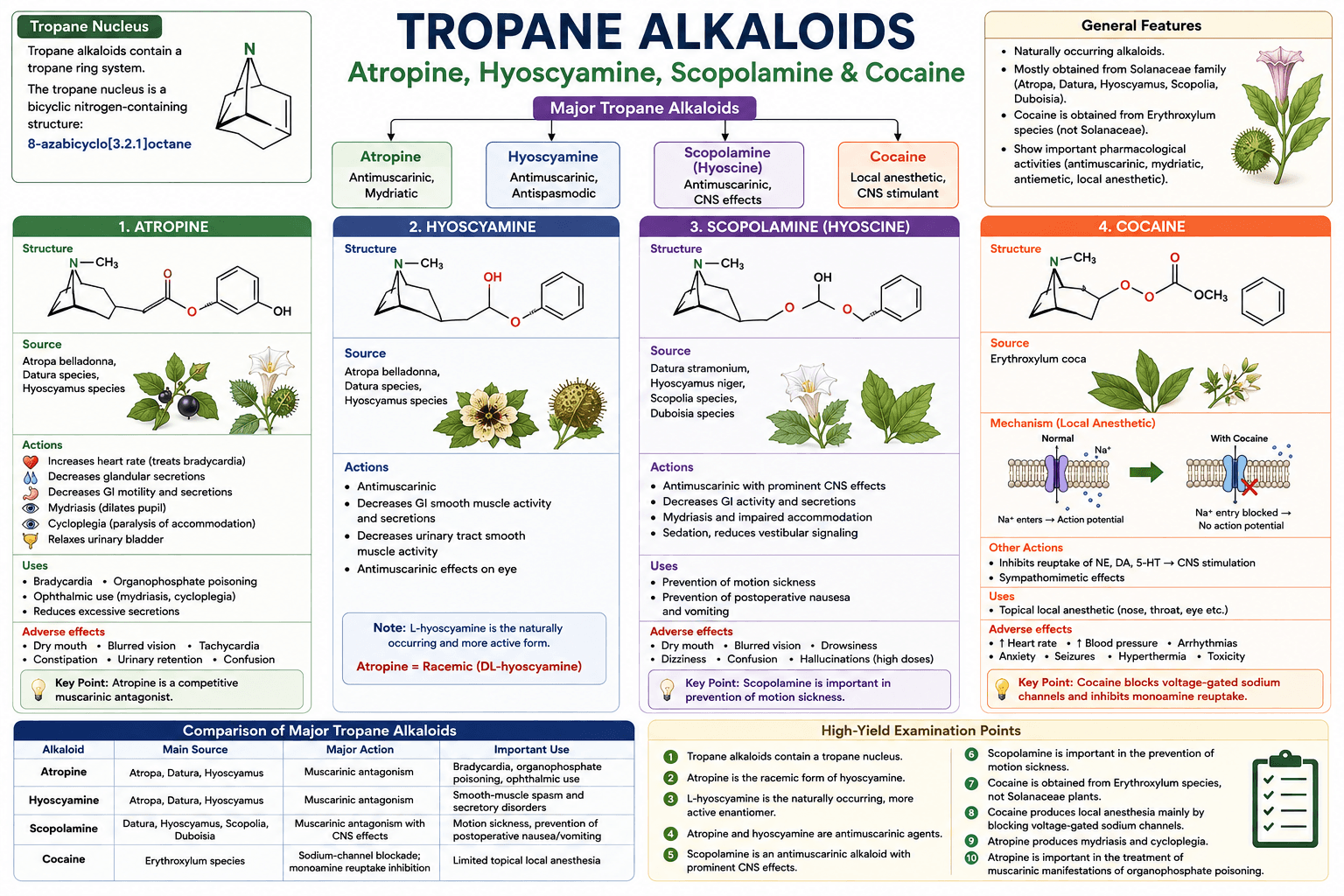
Tropane alkaloids are a group of naturally occurring alkaloids that contain a characteristic tropane ring system in their chemical structure. The tropane nucleus is a bicyclic nitrogen-containing structure known as 8-azabicyclo[3.2.1]octane.
Most important naturally occurring tropane alkaloids are obtained from plants belonging to the Solanaceae family, particularly Atropa belladonna, Datura species, Hyoscyamus species, and Scopolia species. However, cocaine is an important exception because it is obtained from Erythroxylum species.
Tropane alkaloids are important in pharmacognosy because they possess significant pharmacological activities, particularly antimuscarinic, mydriatic, antispasmodic, antiemetic, and local anesthetic effects.
Major Tropane Alkaloids
The important tropane alkaloids discussed in this article are:
- Atropine
- Hyoscyamine
- Scopolamine (Hyoscine)
- Cocaine
1. Atropine
Biological Source
Atropine is associated with tropane-alkaloid-containing plants of the Solanaceae family, especially:
- Atropa belladonna
- Datura species
- Hyoscyamus species
Atropine is formed naturally through the racemization of hyoscyamine, particularly during processing and extraction.
Chemical Nature
Atropine is the racemic mixture of d- and l-hyoscyamine and is commonly described as DL-hyoscyamine.
The naturally occurring L-hyoscyamine is pharmacologically more active than the D-isomer.
Relationship Between Hyoscyamine and Atropine
L-hyoscyamine → racemization → atropine (DL-hyoscyamine)
Therefore, atropine and hyoscyamine are closely related tropane alkaloids.
Mechanism of Action
Atropine acts as a competitive and reversible antagonist at muscarinic acetylcholine receptors.
It prevents acetylcholine from activating muscarinic receptors and therefore reduces many parasympathetic effects.
Basic Mechanism
Acetylcholine → Muscarinic receptor → Parasympathetic response
Atropine → Blocks muscarinic receptor → Decreased parasympathetic response
At therapeutic concentrations, atropine primarily blocks muscarinic receptors rather than nicotinic acetylcholine receptors.
People Also read Purine Alkaloids: Caffeine, Theophylline & Theobromine
Pharmacological Actions of Atropine
Cardiovascular System
Atropine blocks cardiac muscarinic receptors and can increase heart rate, particularly when excessive vagal activity contributes to bradycardia.
Respiratory System
It decreases bronchial glandular secretions and can reduce excessive airway secretions.
Gastrointestinal Tract
Atropine decreases gastrointestinal secretions and reduces intestinal motility and smooth-muscle activity.
Eye
Atropine produces:
- Mydriasis — dilation of the pupil
- Cycloplegia — paralysis of accommodation
Because atropine has a relatively prolonged ocular effect, it can be useful when sustained mydriasis or cycloplegia is required.
Urinary Tract
Atropine can reduce detrusor muscle contraction and promote relaxation of the bladder.
Therapeutic Uses of Atropine
Important clinical uses include:
- Symptomatic bradycardia in appropriate clinical situations
- Treatment of muscarinic manifestations of organophosphate poisoning
- Production of mydriasis and cycloplegia in ophthalmology
- Reduction of excessive secretions in selected clinical situations
Adverse Effects of Atropine
Excessive muscarinic blockade may cause:
- Dry mouth
- Dilated pupils
- Blurred vision
- Tachycardia
- Reduced sweating
- Constipation
- Urinary retention
- Confusion or delirium, particularly with significant systemic exposure
Key Point
Atropine = Competitive muscarinic antagonist
A simple memory aid is:
Atropine blocks parasympathetic muscarinic activity.
2. Hyoscyamine
Biological Source
Hyoscyamine is a naturally occurring tropane alkaloid found mainly in plants of the Solanaceae family, including:
- Atropa belladonna
- Datura species
- Hyoscyamus species
Chemical Nature
Hyoscyamine is an ester of tropine and tropic acid.
The naturally occurring form is predominantly L-hyoscyamine, which is more pharmacologically active than the D-isomer.
Relationship Between Hyoscyamine and Atropine
An important relationship is:
L-hyoscyamine → racemization → atropine
Thus, atropine is the racemic form of hyoscyamine.
Mechanism of Action
Hyoscyamine produces its main effects through antimuscarinic activity.
It competes with acetylcholine at muscarinic receptors and decreases parasympathetic stimulation.
Pharmacological Actions
Its effects mainly include:
- Reduced gastrointestinal smooth-muscle activity
- Reduced gastrointestinal secretions
- Decreased urinary tract smooth-muscle activity
- Reduction of certain glandular secretions
- Antimuscarinic effects on the eye
Clinical Importance
Hyoscyamine preparations may be used for the symptomatic treatment of conditions involving gastrointestinal or genitourinary smooth-muscle spasms and excessive secretions, depending on the formulation and clinical indication.
Hyoscyamine vs Atropine
Feature| Hyoscyamine| Atropine
Natural form| Mainly L-hyoscyamine| Racemic form
Composition| Predominantly L-isomer| D- and L-isomers
Pharmacological activity| L-isomer is more active| Racemic mixture
Main action| Antimuscarinic| Antimuscarinic
Key Point
L-hyoscyamine is the naturally occurring and more pharmacologically active form, while atropine is the racemic mixture.
3. Scopolamine (Hyoscine)
Biological Sources
Scopolamine is found in several plants of the Solanaceae family, including:
- Datura stramonium
- Hyoscyamus niger
- Scopolia species
- Duboisia species
Chemical Nature
Scopolamine is a tropane alkaloid structurally related to atropine and hyoscyamine.
Its structure contains a tropane portion esterified with a tropic-acid-derived moiety.
Mechanism of Action
Scopolamine acts primarily as a muscarinic acetylcholine receptor antagonist.
Unlike some peripheral antimuscarinic drugs, scopolamine can cross the blood-brain barrier, allowing it to produce important central nervous system effects.
This central action is particularly important for its effectiveness in motion sickness.
Pharmacological Effects
Scopolamine can produce:
- Decreased gastrointestinal activity
- Reduced glandular secretions
- Pupil dilation
- Impairment of accommodation
- Reduced vestibular signaling involved in motion sickness
- Sedation or drowsiness
Compared with atropine, scopolamine generally produces more prominent central nervous system effects.
Therapeutic Uses
Motion Sickness
Scopolamine is widely used for the prevention of motion sickness.
Prevention of Postoperative Nausea and Vomiting
It may also be used in appropriate patients to help prevent postoperative nausea and vomiting.
Adverse Effects
Common anticholinergic effects include:
- Dry mouth
- Blurred vision
- Dilated pupils
- Drowsiness
- Dizziness
Higher exposure may cause:
- Confusion
- Agitation
- Hallucinations
- Delirium
Key Point
Scopolamine = Antimuscarinic alkaloid with prominent CNS effects
It is particularly important for the prevention of motion sickness.
---
4. Cocaine
Biological Source
Cocaine is a naturally occurring tropane alkaloid obtained from the leaves of coca plants belonging to the genus Erythroxylum.
The best-known source is:
- Erythroxylum coca
Important Point
Unlike atropine, hyoscyamine, and scopolamine, cocaine is not primarily obtained from Solanaceae plants.
Chemical Nature
Cocaine is a benzoylmethylecgonine and contains a tropane nucleus.
It is an ester derivative containing an ecgonine-based tropane structure.
Mechanism of Local Anesthetic Action
Cocaine produces local anesthesia mainly by blocking voltage-gated sodium channels in nerve membranes.
Normally:
Sodium-channel activation → Na⁺ entry → Action potential → Nerve impulse
With cocaine:
Sodium-channel blockade → Reduced Na⁺ influx → Failure of action-potential propagation → Local anesthesia
Therefore, sensory nerve transmission from the treated area is temporarily interrupted.
Other Pharmacological Actions
Cocaine also inhibits the reuptake of norepinephrine, dopamine, and serotonin at nerve terminals.
This increases the concentration of these neurotransmitters and contributes to its:
- Central nervous system stimulation
- Sympathomimetic effects
- Cardiovascular effects
Clinical Importance
Cocaine has a limited medical role as a topical local anesthetic, particularly in selected procedures involving the nose and upper airway.
Its medical use is restricted because of its significant potential for toxicity, dependence, and abuse.
Adverse Effects
Important toxic effects may include:
- Increased heart rate
- Increased blood pressure
- Cardiac arrhythmias
- Anxiety and agitation
- Seizures
- Hyperthermia
- Severe cardiovascular toxicity in poisoning
Key Point
Cocaine = Sodium-channel blocker + Monoamine reuptake inhibitor
Its important clinical pharmacological action is local anesthesia, rather than muscarinic receptor blockade.
---
5. Comparison of Major Tropane Alkaloids
Alkaloid| Main Source| Major Pharmacological Action| Important Use
Atropine| Atropa, Datura, Hyoscyamus| Muscarinic antagonism| Bradycardia, organophosphate poisoning, ophthalmic use
Hyoscyamine| Atropa, Datura, Hyoscyamus| Muscarinic antagonism| Smooth-muscle spasm and secretory disorders
Scopolamine| Datura, Hyoscyamus, Scopolia, Duboisia| Muscarinic antagonism with prominent CNS effects| Motion sickness, postoperative nausea/vomiting
Cocaine| Erythroxylum species| Sodium-channel blockade; monoamine reuptake inhibition| Limited topical local anesthesia
---
6. High-Yield Examination Points
1. Tropane alkaloids contain a characteristic tropane nucleus.
2. Most important tropane alkaloids are obtained from Solanaceae plants, while cocaine is obtained from Erythroxylum species.
3. Atropine is the racemic form of hyoscyamine.
4. L-hyoscyamine is the naturally occurring and more pharmacologically active form.
5. Atropine and hyoscyamine are antimuscarinic agents.
6. Scopolamine is an antimuscarinic alkaloid with prominent CNS effects.
7. Scopolamine is especially important in the prevention of motion sickness.
8. Cocaine is obtained from Erythroxylum species rather than Solanaceae plants.
9. Cocaine produces local anesthesia mainly by blocking voltage-gated sodium channels.
10. Atropine produces mydriasis and cycloplegia.
11. Atropine is important in the treatment of muscarinic manifestations of organophosphate poisoning.
Quick Memory Summary
Atropine → Antimuscarinic → Bradycardia + Organophosphate poisoning + Mydriasis
Hyoscyamine → Antimuscarinic → Smooth-muscle relaxation
Scopolamine → Antimuscarinic + CNS action → Motion sickness
Cocaine → Sodium-channel blocker → Local anesthetic
Alkaloids: Definition, Characteristics, Classification
Related reading
If this article on Tropane Alkaloids: Atropine, Hyoscyamine, Scopolamine & Cocaine was helpful, explore these related guides for more practical information on similar topics.
- Extraction Methods of Alkaloids — Extraction Methods of Alkaloids: A Simple Pharm D Guide Introduction If you've studied pharmacognosy even a little, you already know alka…
- Plant-Derived Alkaloids: Is Kratom Itself an Alkaloid? — From isolation to therapeutic application — a structured review for pharmacy curricula.
- Understanding Drug–Drug Interactions in Clinical Pharmacy Practice — A practical overview of clinically significant interactions.