Flomax: Uses, Dosage and Safety for Pharm-D Revision
Study Flomax's mechanism, dosing and key interactions, with practical guidance on dizziness, cataract surgery and when urinary symptoms need urgent care.
By Luca Moretti, PharmD12 min read
Reviewed by Medical Review Team ·
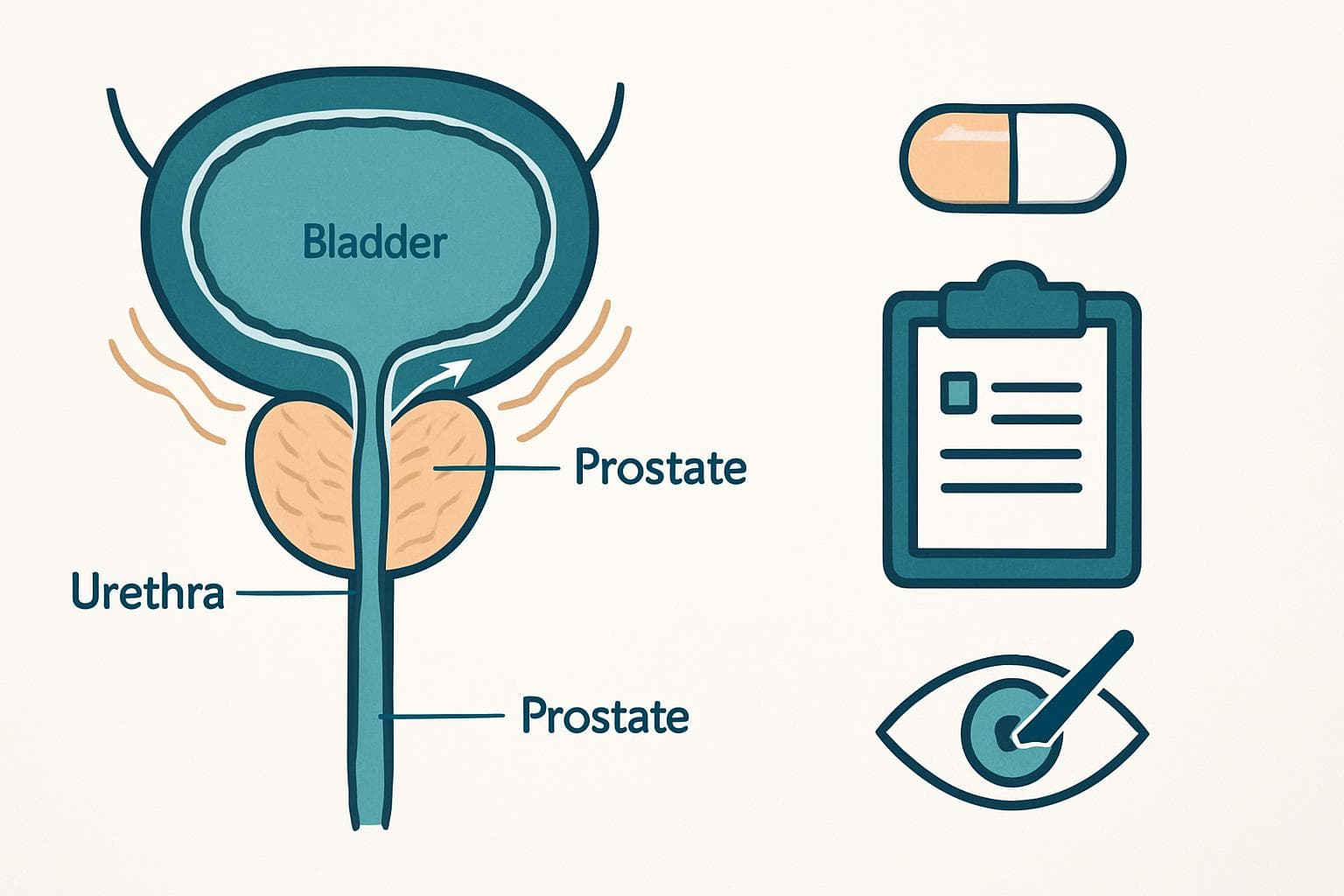
Flomax is a brand of tamsulosin, an alpha-1 adrenergic receptor blocker used to relieve urinary symptoms associated with benign prostatic hyperplasia (BPH), or noncancerous prostate enlargement. It relaxes smooth muscle in the prostate and bladder outlet; it does not shrink the prostate or treat prostate cancer.
These Pharm-D study notes connect pharmacology with dispensing decisions and patient counseling. They are educational, not advertising for any company's product. Compare generic tamsulosin and other treatment options with a pharmacist, including formulation, suitability and local labeling.
Quick Answer / Overview
The best-known presentation is an oral 0.4 mg capsule, although formulations and instructions differ between countries. Check the actual product.
- Main role: Improve weak stream, hesitancy and other BPH-related lower urinary tract symptoms.
- Expected benefit: Easier urination, with response developing over days to weeks.
- Main limitations: It does not reliably prevent prostate growth, urinary retention or future surgery.
- Safety priorities: Dizziness, postural hypotension, ejaculatory changes, interactions and cataract-surgery precautions.
A weak stream is not automatically BPH. Infection, urethral narrowing, bladder dysfunction and malignancy can produce overlapping symptoms and require a different approach.
Key Definitions
| Term | Plain-language meaning |
|---|---|
| Lower urinary tract symptoms (LUTS) | Storage, voiding or post-urination problems, such as urgency, hesitancy or incomplete emptying. |
| BPH | Noncancerous growth of prostate tissue; enlargement and symptom severity do not always match. |
| Alpha-1 antagonist | A medicine that blocks receptors involved in smooth-muscle contraction. |
| Uroselectivity | Preferential effects on the urinary tract rather than blood vessels; this does not eliminate blood-pressure effects. |
| Orthostatic hypotension | A blood-pressure fall after standing that may cause dizziness, faintness or falls. |
| Intraoperative floppy iris syndrome (IFIS) | An iris behavior change that can complicate cataract surgery. |
Keep symptoms and diagnosis separate. LUTS describes what the patient experiences, whereas BPH describes prostate tissue changes that may contribute to those symptoms.
Mechanism: Relieving the Dynamic Obstruction
Prostatic obstruction has both a static component, related to tissue bulk, and a dynamic component, related to smooth-muscle tone. Tamsulosin mainly addresses the dynamic component by blocking alpha-1 receptors in the prostate and bladder neck.
Tamsulosin has greater affinity for alpha-1A and alpha-1D receptors than for alpha-1B receptors. This receptor preference helps explain its urinary effects and generally smaller blood-pressure effect compared with less uroselective agents, but clinically important hypotension remains possible.
The mechanism is not diuresis. A patient may pass urine more easily without producing more urine overall.
Alpha-1 receptor blockade
 ↓
Reduced prostate and bladder-neck smooth-muscle tone
 ↓
Lower resistance at the bladder outlet
 ↓
Improved urinary flow and symptoms in responsive patients
STICKY NOTE — Important point: Better flow does not prove that the prostate has become smaller or that future retention risk has disappeared.
Pharmacokinetics: Why Food and Interactions Matter
Tamsulosin undergoes hepatic metabolism, mainly through CYP3A4 and CYP2D6, enzymes that help clear many medicines. It is extensively protein bound, and metabolites are predominantly eliminated in urine.
Its apparent elimination half-life is roughly 9–15 hours in studied populations, influenced by the formulation's absorption characteristics and patient group. Once-daily administration is standard for commonly used products.
Food changes capsule exposure. For the US-labeled Flomax capsule, administration approximately 30 minutes after the same meal each day reduces variability compared with switching between fasting and fed dosing.
Modified-release tablets available elsewhere may have different instructions. The active ingredient alone does not establish that two formulations have identical absorption or are interchangeable without checking their labeling and substitution status.
Indications and Boundaries of Use
BPH-associated symptoms
The US indication is treatment of BPH signs and symptoms in men. Assess benefit through the patient's symptom burden, function and quality of life, not simply through whether the prescription was collected.
The International Prostate Symptom Score (IPSS) can support baseline assessment and follow-up. Frequency and nocturia deserve particular attention because diabetes, sleep apnea, edema, diuretics and excessive evening fluid intake may contribute independently of obstruction.
Ureteric stones: an off-label application
Clinicians sometimes prescribe tamsulosin as medical expulsive therapy, meaning medicine intended to help a ureteric stone pass. This is off-label under US labeling, and recommendations differ by guideline and jurisdiction. Evidence of benefit is strongest for selected distal ureteric stones, particularly those larger than 5 mm.
It is not a stone-dissolving medicine. Fever with an obstructed urinary tract, uncontrolled pain or deteriorating renal function requires urgent assessment rather than continued observation with tablets.
Uses it should not be confused with
Tamsulosin is not an antibiotic, erectile-dysfunction treatment or approved hypertension treatment. It is not indicated for pediatric use under US labeling. Selected use in women for stones or voiding dysfunction requires a specific clinical rationale rather than automatic application of BPH guidance.
Dosage and Administration: Label-Based Study Points
The following figures summarize US Flomax capsule labeling for adult BPH, not a personalized prescription:
| Situation | Educational label-based guidance |
|---|---|
| Usual initial dose | 0.4 mg daily, approximately 30 minutes after the same meal each day. |
| Inadequate response | A prescriber may increase to 0.8 mg daily after 2–4 weeks at 0.4 mg. |
| Interruption for several days | Labeling directs restarting at 0.4 mg daily, including after a previous 0.8 mg regimen. |
| Capsule handling | Swallow whole; do not crush, chew or open the capsule. |
Confirm the dose, formulation, meal timing and any restart plan with the prescribing doctor or pharmacist. Local product instructions may differ.
Never double a dose. Follow the pack's missed-dose instructions; generally, take a forgotten dose when remembered unless the next dose is nearly due, then skip it.
Restarting deserves its own question at the counter: “When did you last take this?” A refill may actually represent a new exposure after a treatment gap, particularly when someone stopped because of dizziness or ran out while traveling.
No adjustment is generally required for studied mild-to-moderate renal impairment or moderate hepatic impairment. End-stage renal disease and severe hepatic impairment have not been adequately studied; do not extrapolate routine dosing automatically.
REMEMBER — Restart safety: Several missed days are not equivalent to missed capsule. Check the restart instructions before resuming a previous higher dose.
Adverse Effects: Separate Nuisance From Danger
Dizziness, headache, nasal symptoms and abnormal ejaculation are recognized adverse effects. Ejaculatory changes may include reduced or absent semen release; they are not necessarily the same as erectile dysfunction.
Ask about sexual effects directly. Patients may otherwise stop treatment silently, especially when fertility is a current concern. Do not assume every ejaculatory change represents retrograde ejaculation, because mechanisms can differ.
Dizziness and falls
Orthostatic symptoms can occur after starting, increasing or restarting treatment. Advise patients to sit or lie down if lightheaded, rise gradually and avoid driving or hazardous work until their response is known.
Heat and dehydration can amplify symptoms. For someone working outdoors during a hot Karachi summer, review fluid losses and other blood-pressure-lowering medicines, while respecting any prescribed heart-failure or kidney-disease fluid restrictions.
When urgent care is needed
Seek emergency help for facial or throat swelling, breathing difficulty, a prolonged erection lasting four hours or more, or fainting with injury, chest pain or persistent weakness. Do not take further doses after suspected serious allergy until assessed.
Complete inability to urinate, especially with a painful swollen lower abdomen, is also urgent. Taking an extra capsule is not an appropriate rescue measure for acute retention.
Precautions: The Eye-Surgery Question Matters
Previous serious hypersensitivity to tamsulosin or its ingredients is a contraindication. A history of severe sulfonamide allergy warrants caution and discussion; it does not mean that everyone labeled “sulfa allergic” will react to tamsulosin.
Ask about cataract surgery early. Current or previous tamsulosin exposure is associated with IFIS, and the ophthalmic surgeon needs that history even if treatment ended some time ago.
Stopping may not remove the risk. Patients should not stop treatment independently before surgery; the surgeon and prescriber should coordinate because the benefit of preoperative discontinuation is uncertain.
Older adults, people with previous falls and patients taking several antihypertensives need closer review. Evaluate suspected BPH appropriately because prostate cancer and BPH can coexist, and symptom relief does not exclude malignancy.
IMPORTANT — Surgical handover: Include past tamsulosin use in the medication history sent to the cataract team, not just medicines currently being taken.
Interactions Worth Checking Before Dispensing
| Combination | Practical concern |
|---|---|
| Strong CYP3A4 inhibitors, such as ketoconazole | Can substantially increase exposure; US labeling says tamsulosin should not be used with strong CYP3A4 inhibitors. |
| CYP2D6 inhibitors, such as paroxetine | Can increase exposure; caution is needed, particularly with higher doses or additional metabolic inhibition. |
| Moderate CYP3A4 inhibitors, such as erythromycin | Require caution and a product-specific interaction check. |
| Other alpha blockers | Additive hypotension; US labeling advises against concurrent use. |
| PDE5 inhibitors, such as sildenafil or tadalafil | Can cause symptomatic hypotension when combined; review stability, indication and monitoring. |
| Other antihypertensives or alcohol | May worsen dizziness or blood-pressure lowering in susceptible patients. |
Do not check prescription lists alone. Ask about erectile-dysfunction medicines obtained privately, short antibiotic courses and newly prescribed antifungals, because these may never appear on the usual repeat-prescription record.
Some guidelines permit selected alpha-blocker/PDE5-inhibitor combinations. That does not make self-combination safe or cancel label-specific precautions.
Important Differences Between BPH Medicines
The alternatives are not interchangeable.
| Generic option | Main contribution | Important limitation |
|---|---|---|
| Tamsulosin | Relaxes outlet smooth muscle with relative uroselectivity. | Ejaculatory effects, orthostasis and IFIS remain relevant. |
| Alfuzosin | Another alpha blocker that improves symptoms without shrinking the prostate. | Blood-pressure effects and its own interaction, cardiac and formulation precautions require review. |
| Doxazosin | Alpha blockade with effects on both urinary symptoms and blood pressure. | Dose titration and orthostatic precautions are particularly important. |
| Finasteride or dutasteride | Reduce dihydrotestosterone, gradually shrinking an enlarged prostate and lowering progression risk in suitable patients. | Benefit takes months; sexual adverse effects and altered PSA interpretation matter. |
Combination treatment may suit patients with bothersome symptoms and demonstrable enlargement or progression risk. Tamsulosin itself does not meaningfully lower prostate-specific antigen (PSA); 5-alpha-reductase inhibitors change PSA interpretation, an important distinction in examination questions and medication reviews.
Pharmacy Practice: Measure Benefit and Harm Separately
A useful review asks two different questions: “Is urination easier?” and “Are you steadier on your feet?” favorable answer does not cancel an unfavorable one.
Record baseline symptoms, blood pressure where appropriate, falls history and medicines that can worsen urinary retention, including some anticholinergic medicines and decongestants. Review treatment response after initiation or adjustment according to the clinical plan.
Persistent nocturia is not automatic treatment failure. Ask whether the patient wakes because of urgency or urinates because something else woke them; that distinction can uncover sleep problems rather than persistent outlet obstruction.
If benefit is poor, verify adherence and meal timing before suggesting escalation. Check for constipation, infection symptoms, hematuria and retention, and arrange reassessment rather than repeatedly renewing an ineffective medicine.
Quick Pharm D Notes
- Definition: Tamsulosin is a relatively uroselective alpha-1 antagonist.
- Classification: Symptomatic BPH therapy, not a prostate-shrinking agent.
- Mechanism: Reduced smooth-muscle tone lowers bladder-outlet resistance.
- Pharmacokinetics: CYP3A4/CYP2D6 metabolism makes inhibitor screening clinically relevant.
- Examples: Alfuzosin and doxazosin share the alpha-blocker class but have different prescribing considerations.
- Clinical significance: Track urinary benefit alongside orthostasis, falls and sexual effects.
- Exam distinction: Symptom relief is not equivalent to reduced disease progression.
Common Mistakes and Confusions
Do not advise routine bedtime dosing without checking the formulation: the US capsule instruction is tied to the same meal, not simply to the clock.
Do not describe this medicine as “flushing the kidneys.” It neither increases urine production as a diuretic would nor treats the cause of every urinary complaint.
Do not promise zero hypotension because it is uroselective. Finally, do not treat a brand-to-generic change as a reason for automatic dose escalation; check strength, release characteristics and approved substitution arrangements first.
Frequently Asked Questions
How long does Flomax take to work?
Some improvement may occur within days, but assess the fuller response over several weeks. Seek reassessment if symptoms worsen rather than waiting indefinitely.
Does it shrink the prostate?
No. It relaxes smooth muscle; finasteride and dutasteride are examples of medicines that can shrink an enlarged prostate over time.
Can I stop when urination improves?
Discuss stopping with the prescriber because symptoms may return. If treatment has already been interrupted for several days, check the restart plan before resuming.
Can women take tamsulosin?
Sometimes clinicians prescribe it off-label for selected urinary conditions, including ureteric stones. That is different from its approved BPH indication and requires individualized assessment.
Can I take it with sildenafil?
Both can lower blood pressure. A prescriber should assess the combination, including other medicines and previous dizziness; separating doses does not guarantee safety.
Will it affect sexual function?
Reduced or absent ejaculation can occur. Report bothersome changes or fertility concerns so treatment can be reviewed rather than stopping and restarting without guidance.
Last-Minute Revision
- Tamsulosin treats dynamic outlet resistance, not prostate size.
- US capsule dosing is meal-linked.
- Several days off treatment triggers restart considerations.
- Uroselectivity does not eliminate orthostatic hypotension.
- Past exposure matters before cataract surgery.
- Fever with obstruction or acute retention requires urgent assessment.
References
- DailyMed: Flomax/tamsulosin prescribing information: US indications, dosing, interactions and warnings.
- NICE CG97: Lower urinary tract symptoms in men: Assessment and treatment principles.
- European Association of Urology: Urolithiasis guideline: Medical expulsive therapy and urgent stone-management considerations.
Important Medical Disclaimer
This article is for general educational purposes and is not a substitute for advice from a qualified doctor or pharmacist. Always consult your doctor/pharmacist before using any medicine, changing a dose, or starting treatment.
Related reading
If this article on Flomax: Uses, Dosage and Safety for Pharm-D Revision was helpful, explore these related guides for more practical information on similar topics.
- What Is Zofran? Uses, Mechanism and Pharm-D Safety Notes — Understand ondansetron’s mechanism, approved uses, dosing principles and QT risks, with practical counseling and high-yield Pharm-D revis…
- Celbex Tablet Uses: Check the Ingredient and Use Safely — Check Celbex’s active ingredient before use, then learn about celecoxib pain relief, stomach and heart risks, interactions, and when to s…
- Nims Tablet Uses: Pain Relief, Dose and Liver Safety — Learn what Nims tablets may treat, how to check the ingredient, and when to stop. Practical guidance on dosing, liver risks and safer pai…
- Ascard Tablet Overview: Uses, Dosage and Safe Use Tips — Understand what Ascard contains, why doctors prescribe it, and how to avoid bleeding risks, missed-dose mistakes and unsafe tablet substi…
- Calpol Syrup Uses: Fever, Pain and Safer Dosing Tips — Learn when Calpol syrup helps fever and pain, how to check its strength, and which dosing mistakes or symptoms need urgent attention in c…
- Deltacortril Tablet Uses: Benefits, Risks and Safe Use — Learn why prednisolone is prescribed, which Deltacortril label details to check, and when side effects or stopping treatment need medical…