Calpol Syrup Uses: Fever, Pain and Safer Dosing Tips
Learn when Calpol syrup helps fever and pain, how to check its strength, and which dosing mistakes or symptoms need urgent attention in children.
By Dr. Amina Rahman, PharmD13 min read
Reviewed by Medical Review Team ·
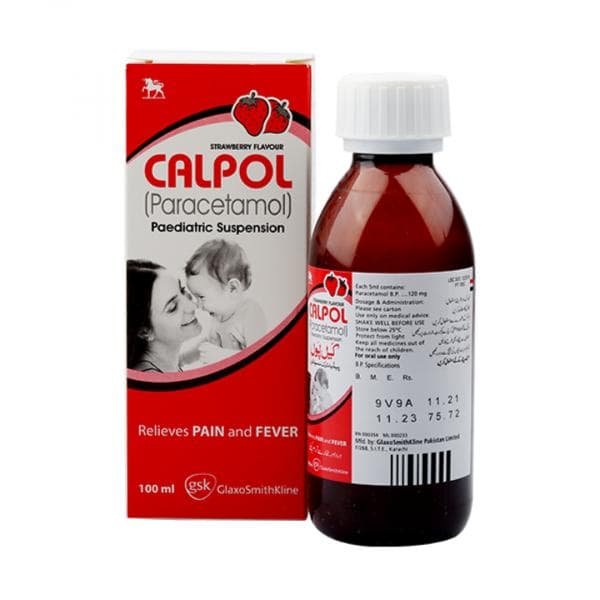
Calpol syrup contains paracetamol, a painkiller and fever reducer used to relieve mild-to-moderate pain and help an uncomfortable child with fever. It does not treat the underlying infection, and safe use depends on checking the bottle strength, measuring correctly, and avoiding other medicines containing paracetamol.
This guide is educational, not advertising for any company. Calpol and other paracetamol products should be compared with a pharmacist, particularly when changing concentrations or treating a young child in Pakistan.
Quick Information
| Information | Details |
|---|---|
| Generic name | Paracetamol, also called acetaminophen |
| Brand name(s) | Calpol; Panadol also has paracetamol products—check each formulation |
| Drug class | Analgesic and antipyretic: painkiller and fever reducer |
| Main uses | Fever-related discomfort and mild-to-moderate pain |
| Available forms | Oral liquids; paracetamol also comes as tablets, suppositories and hospital injections |
| Common strengths | Examples include 120 mg/5 mL and 250 mg/5 mL; local products vary |
| Route | By mouth for syrup or suspension |
| Prescription / OTC | Often available without prescription; confirm local requirements and age restrictions |
| Common side effects | Usually well tolerated at recommended doses; serious reactions are rare |
Introduction — What is Calpol syrup?
Calpol is a brand, not the ingredient name. Its paracetamol oral liquid is often called “syrup,” although the bottle may describe it as a suspension, meaning medicine particles are dispersed through liquid.
The distinction matters when measuring. Suspensions need shaking as directed so the medicine is evenly distributed before each dose.
Check the active ingredients first. Products within a brand family can differ, and a familiar name does not tell you the concentration, suitable age group, or whether additional ingredients are present.
How it works and when relief starts
Paracetamol acts mainly within the central nervous system to reduce pain and influence temperature regulation. It has little anti-inflammatory action compared with medicines such as ibuprofen, so it does not substantially treat swelling.
Oral liquid usually starts helping within about an hour. Response varies. Food, vomiting, the illness itself and the formulation can affect how quickly relief becomes noticeable.
Do not repeat a dose early because the thermometer still reads high. A child becoming more comfortable and drinking better is more useful than chasing a normal temperature.
Uses: when it helps and what it cannot treat
Fever with discomfort
Paracetamol can help a child who feels miserable, aches, or cannot rest comfortably during a fever. Doctors recommend treating distress rather than giving medicine solely to lower a temperature reading.
A comfortable, alert child may not need it. Continue fluids and observation; improvement after a dose does not rule out a serious infection.
Mild-to-moderate pain
It may relieve headaches, toothache, sore-throat pain, muscle aches and discomfort after minor injuries. Persistent toothache still needs dental assessment, and ear pain with discharge or ongoing fever deserves examination.
Pain relief buys comfort, not a diagnosis. Severe abdominal pain, a sudden severe headache or pain after a significant injury should not be managed by repeatedly topping up syrup.
Discomfort after vaccination
A clinician may recommend paracetamol for pain or fever after vaccination. Do not automatically give it before every vaccine; preventive dosing is recommended only for particular vaccination situations under the relevant guidance.
Calpol does not stop coughs, clear a blocked nose, kill bacteria, or prevent fever-related seizures reliably.
Dose and how to take it safely
The exact dose depends on age, weight, condition, formulation and medical history; confirm the dose with a doctor or pharmacist. A universal teaspoon instruction is unsafe because different bottles can contain very different amounts of paracetamol.
Children: confirm the dose in millilitres
Ask the pharmacist to write down the child's current weight, the bottle concentration, the amount in millilitres, the minimum interval and the maximum allowed in 24 hours. Follow the product's age restrictions. A newborn or very young infant needs medical assessment rather than a guessed dose.
Read the label every time. Many paediatric labels limit doses to four in 24 hours, with at least four hours between them, but instructions vary by product and country; follow the confirmed schedule for your bottle.
Use an oral syringe, not a kitchen spoon. Shake a suspension as directed, measure at eye level, and give the liquid slowly inside the cheek while the child is upright.
Adults and practical administration
Adults can sometimes use paracetamol liquid, but the required volume depends on its concentration. Have a pharmacist calculate it; do not simply multiply a child's dose. Low body weight, frailty or liver problems may require different limits.
It can generally be taken with or without food. Avoid mixing a dose into a full feeding bottle or large drink, because an unfinished drink leaves the amount swallowed uncertain.
Crushing or chewing does not apply to liquid. If switching to tablets, check the new instructions rather than carrying over the liquid schedule blindly.
Use one shared dose log. Record the time, millilitres, strength and caregiver's initials; include doses given at school or by grandparents. This prevents overlapping doses better than remembering the bottle's colour.
Side effects: what to watch for
Most people have no noticeable side effects when paracetamol is used correctly. Persistent vomiting or unusual symptoms should not automatically be blamed on the medicine, because the underlying illness may need assessment.
Stop and get emergency help for breathing difficulty, facial or tongue swelling, collapse, or a widespread blistering or peeling rash. These reactions are rare but serious.
Seek prompt medical advice for yellow eyes or skin, unusual bruising, severe abdominal pain or markedly reduced urine. Liver injury is especially associated with excessive doses and may initially cause few symptoms.
Warnings and precautions before giving a dose
Children and fever warning signs
A baby younger than three months with a temperature of 38°C or higher needs urgent medical assessment, even if paracetamol brings the temperature down. Do not delay care while waiting for another dose to work.
Seek urgent help at any age for breathing difficulty, a seizure, unusual drowsiness, a stiff neck, a rash that does not fade under pressure, or signs of significant dehydration.
Pregnancy, breastfeeding and older adults
Paracetamol is generally a first-choice painkiller during pregnancy and breastfeeding when needed at recommended doses. Use the lowest effective dose for the shortest necessary time, with professional advice for repeated use.
Older adults need extra care. Frailty, low body weight, poor nutrition and multiple medicines can change the safest dosing plan.
Existing health conditions
Discuss liver or kidney disease, regular heavy alcohol use, prolonged fasting or malnutrition before treatment. Heart disease does not automatically exclude paracetamol, but sugar, sodium and other formulation ingredients may matter for particular patients.
In Pakistan, suspected dengue needs assessment. Paracetamol is commonly preferred for fever or pain, while aspirin and ibuprofen are generally avoided because of bleeding risk; worsening symptoms still require urgent care.
Drug interactions and duplicate ingredients
The biggest preventable problem is duplication. Cold-and-flu remedies, headache tablets, prescription pain combinations and another child's fever medicine may all contribute to the same daily paracetamol total.
Look for both names: paracetamol and acetaminophen mean the same medicine. Taking different brands does not make them separate treatments.
Tell the pharmacist about warfarin, epilepsy medicines, rifampicin, flucloxacillin and all other prescriptions. Regular paracetamol use can affect warfarin treatment, while certain combinations need closer review in people with additional risk factors.
Include vitamins, herbal mixtures and supplements in that review. Normal meals are generally fine, but avoid alcohol during treatment, especially with liver disease or regular heavy drinking.
Who should not use it?
Do not use a product after a previous allergic reaction to paracetamol or one of its ingredients. People with severe liver impairment need medical direction rather than self-treatment.
Do not give another dose when the previous amount or timing is uncertain. First clarify the record and obtain advice, particularly if the child may already have received another paracetamol-containing medicine.
Overdose: act before symptoms appear
Suspected overdose needs urgent assessment, even when the person seems well. Early symptoms may include nausea, vomiting, sweating or abdominal discomfort, but dangerous liver damage can develop before obvious illness appears.
This includes repeated excessive doses over several days, not just drinking a large amount at once. A stronger replacement bottle can cause an accidental overdose if the old millilitre instructions are reused.
Go to an emergency department or contact a local emergency service immediately. Take the bottle, packaging and dose log, and report any other medicines taken. Do not induce vomiting, give home remedies or wait for yellow eyes to develop.
Missed dose: never catch up
For occasional fever or pain, there is usually no dose to “catch up”: give medicine only if needed and when the permitted interval has passed.
If a clinician prescribed scheduled treatment, follow their missed-dose instructions. Never double a dose or shorten the interval without medical advice.
How long is it used, and when should it stop?
Stop when the fever-related discomfort or pain has settled. Paracetamol does not require tapering, and there is no antibiotic-style course to finish.
Seek advice if a child still needs it beyond three days, or earlier if symptoms worsen or the label gives a shorter limit. Fever lasting five days needs assessment even without other obvious warning signs.
Repeated headaches, recurring pain or daily adult use deserve a diagnosis and a reviewed treatment plan, not an indefinitely renewed bottle.
Storage in Pakistan's heat
Follow the temperature and light instructions on the bottle; do not assume every liquid needs refrigeration. Keep the cap closed and avoid humid bathrooms, direct sunlight and parked cars, where temperatures can exceed storage limits quickly.
Store it out of children's sight and reach, preferably locked away. Check the expiry date and any after-opening limit. Ask a pharmacist how to dispose of expired medicine, and do not use a liquid with unexplained changes in appearance or smell.
Forms and strengths: the millilitre trap
A millilitre measures volume, not the amount of medicine. The strength tells you how many milligrams of paracetamol that volume contains.
For example, 250 mg/5 mL contains more than twice the paracetamol in 120 mg/5 mL. These are examples of marketed concentrations, not confirmation that every Pakistani pharmacy stocks both.
Drops may be more concentrated than syrup. Suppositories also count toward the total paracetamol received, and injections belong in supervised healthcare settings. Never assume that switching routes resets the dosing clock.
Brand comparison: compare labels, not reputations
| Option | Useful comparison | Limitation |
|---|---|---|
| Calpol paracetamol liquid | Check concentration, age instructions and measuring device | Brand familiarity cannot establish the dose |
| Panadol paracetamol liquid | Check the same ingredient and concentration details | Availability, ingredients and instructions may differ |
| Other licensed paracetamol liquids | A pharmacist can assess a suitable alternative | The same millilitre amount may not transfer |
No option is automatically best. The same ingredient does not establish identical bioavailability or suitability across every formulation; confirm any switch with a pharmacist or clinician.
Check sugar, flavouring and preservative details if these matter medically. Prices and pack sizes change, so ask a licensed pharmacy rather than relying on old online listings.
Common misconceptions that cause mistakes
- Myth: A higher fever needs a larger dose. Truth: The appropriate dose depends on the patient and formulation, not the thermometer reading.
- Myth: Fever returning means the medicine failed. Truth: Relief is temporary while the illness continues; reassess the child's condition before giving more.
- Myth: Antibiotics are needed whenever fever returns. Truth: Many childhood fevers are viral, and antibiotics require a clinical reason.
- Myth: A sleeping child should receive the next dose anyway. Truth: Do not wake a comfortable child solely to treat a temperature unless a clinician has given specific instructions.
Patient FAQ
Can Calpol syrup treat coughs and colds?
It can ease associated aches or fever-related discomfort, but it does not suppress cough, unblock the nose or shorten a viral infection.
Can I give it on an empty stomach?
Usually, yes. Food is not essential. If the child is vomiting repeatedly, cannot drink or appears dehydrated, seek advice rather than relying on repeated oral doses.
Can Calpol and ibuprofen be given together?
Do not routinely give both together or alternate them without a clear professional plan. Alternating increases timing errors, and ibuprofen is unsuitable in some situations, including dehydration or suspected dengue.
What if my child vomits or spits out the dose?
Do not automatically repeat it. The amount absorbed may be uncertain. Ask a pharmacist using the time since dosing, whether vomiting occurred, and how much was visibly lost.
Does Calpol make children sleepy?
Paracetamol is not a sedative. Illness can cause tiredness, but a child who is unusually difficult to wake needs urgent assessment rather than another dose.
Can it be used for teething?
It may help genuine teething pain when the formulation is suitable for the child's age. Significant fever, persistent diarrhoea or marked illness should not be dismissed as teething.
Can I give it to my baby after vaccination?
Follow the vaccination team's instructions for that vaccine and your baby's age. Contact them promptly if the baby seems very unwell; vaccination does not explain every subsequent fever.
Is daily use safe or habit-forming?
Paracetamol is not addictive, but daily unsupervised use is not harmless. Repeated need calls for assessment, and frequent painkiller use can itself contribute to ongoing headaches.
Can an adult drive after taking the liquid?
Paracetamol alone does not usually impair driving. Check for additional ingredients, and do not drive if fever, dizziness or the underlying illness makes you unsafe.
Should I keep giving it once the temperature is normal?
No, unless a clinician prescribed scheduled pain relief. If the person is comfortable, stop. Watch hydration, breathing and alertness rather than continuing medicine to maintain a particular thermometer number.
Sources
- NHS: Paracetamol for children — administration, safety and dosing guidance.
- NHS: Paracetamol for adults — precautions, interactions and pregnancy guidance.
- NICE: Fever in under 5s: assessment and initial management, NG143 — fever warning signs and antipyretic use.
These UK resources inform general counseling; local product instructions and clinical advice take priority for formulation-specific dosing in Pakistan.
Important Medical Disclaimer
This article is for general educational purposes only and is not a substitute for advice from a qualified doctor or pharmacist. Always consult your doctor/pharmacist before using any medicine, changing a dose, or starting treatment.
Related reading
If this article on Calpol Syrup Uses: Fever, Pain and Safer Dosing Tips was helpful, explore these related guides for more practical information on similar topics.
- Nims Tablet Uses: Pain Relief, Dose and Liver Safety — Learn what Nims tablets may treat, how to check the ingredient, and when to stop. Practical guidance on dosing, liver risks and safer pai…
- Ascard Tablet Overview: Uses, Dosage and Safe Use Tips — Understand what Ascard contains, why doctors prescribe it, and how to avoid bleeding risks, missed-dose mistakes and unsafe tablet substi…
- Celbex Tablet Uses: Check the Ingredient and Use Safely — Check Celbex’s active ingredient before use, then learn about celecoxib pain relief, stomach and heart risks, interactions, and when to s…
- Gravinate Syrup Uses, Dosage Guidance and Side Effects — Learn when Gravinate syrup helps nausea and travel sickness, how to check the bottle strength, and which symptoms need care rather than a…
- Rigix Tablet Uses: Allergy Relief, Dose and Safety — Learn what Rigix treats, how to check its cetirizine strength, and when sleepiness, kidney problems or persistent itching need a pharmaci…
- trimetabol syrup uses in urdu — ٹرائی میٹابول شربت (Trimetabol Syrup) کے استعمال — مکمل اور آسان اردو رہنمائی تعارف بھوک نہ لگنا ایک ایسا مسئلہ ہے جس کا سامنا چھوٹے بچوں…