Rigix Tablet Uses: Allergy Relief, Dose and Safety
Learn what Rigix treats, how to check its cetirizine strength, and when sleepiness, kidney problems or persistent itching need a pharmacist’s advice.
By Dr. Amina Rahman, PharmD13 min read
Reviewed by Medical Review Team ·
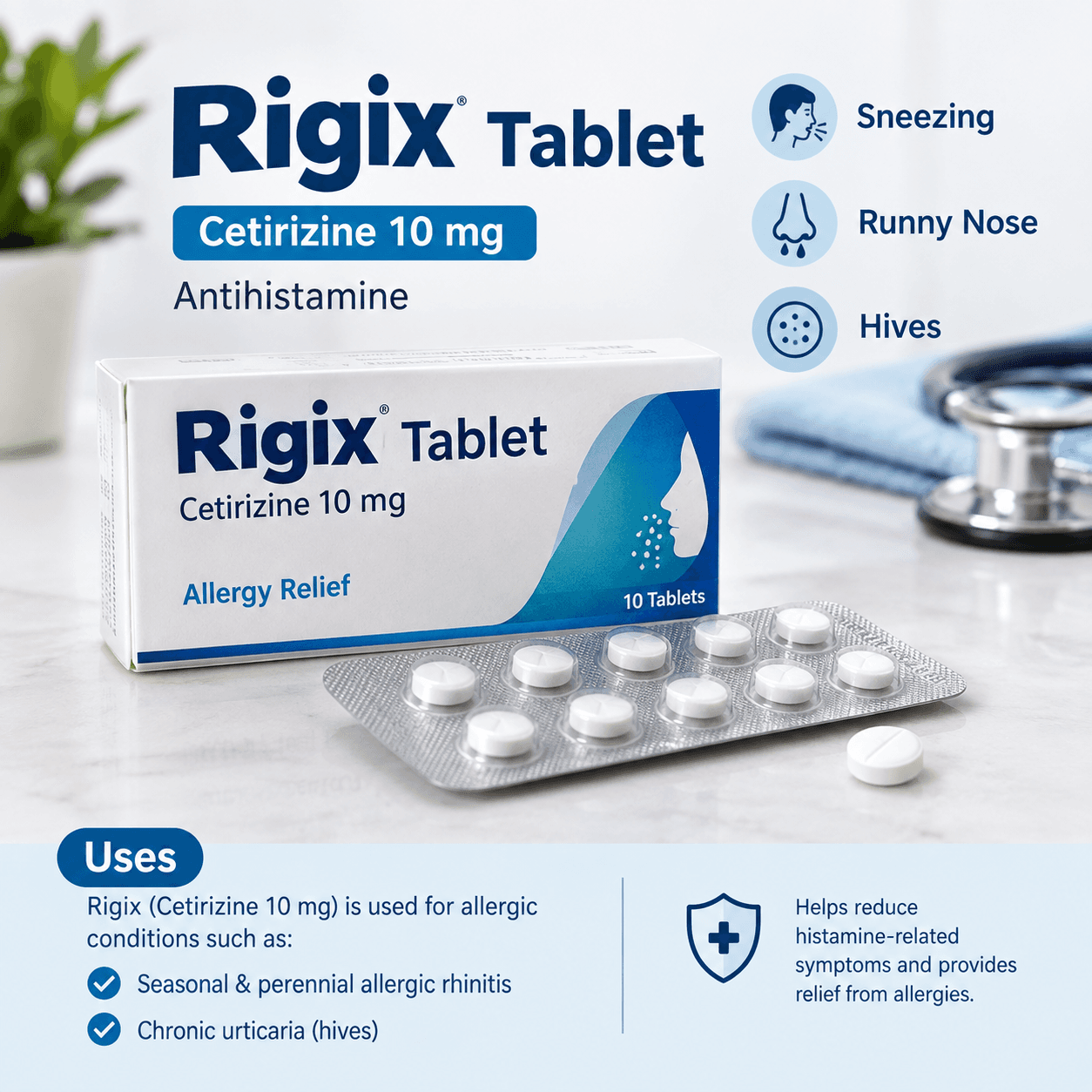
Rigix tablets commonly contain cetirizine hydrochloride, an antihistamine used to relieve allergy symptoms such as sneezing, a runny nose, itchy eyes and hives. Check the ingredient and strength on your pack before taking it: cetirizine can cause sleepiness, and kidney problems may require a different dose.
This guide is educational, not advertising for any company’s product. Compare suitable options with a pharmacist rather than choosing by brand name alone.
Quick Information
| Information | Details |
|---|---|
| Generic name | Cetirizine hydrochloride; confirm on the pack |
| Brand names | Rigix; Zyrtec is another cetirizine brand in some markets. Local availability varies. |
| Drug class | Second-generation H1 antihistamine |
| Main uses | Allergic rhinitis and urticaria, meaning hives |
| Available forms | Cetirizine comes as tablets and oral liquids; brand ranges vary |
| Common strengths | Tablets commonly contain 10 mg; check liquid concentrations separately |
| Route | By mouth |
| Prescription / OTC | Confirm locally in Pakistan; availability without a prescription does not establish suitability |
| Common side effects | Sleepiness, tiredness, dry mouth, headache and dizziness |
Introduction — What is Rigix?
Rigix is a brand name, whereas cetirizine is the active ingredient that provides the allergy relief. The distinction matters when buying a replacement or checking whether another medicine contains the same drug.
Read the strip, not just the box. If the ingredient is different, this guide does not apply.
Cetirizine is not an antibiotic, steroid or painkiller. It controls certain allergy symptoms but does not remove their underlying cause, and an unexplained rash still needs assessment even if itching improves after a tablet.
How it works and when relief starts
During an allergic response, the body releases histamine, a chemical that contributes to itching, sneezing, watery discharge and raised skin welts. Cetirizine blocks histamine at H1 receptors, reducing those effects.
Relief often starts within an hour. Its effect usually lasts around a day, which explains once-daily dosing for many adults.
It causes less sedation than older antihistamines, but “less sedating” does not mean everyone stays alert. It also does not open narrowed airways during an asthma attack or reliably clear severe nasal blockage.
Uses: which symptoms may improve?
Sneezing, runny nose and itchy eyes
Cetirizine can help allergic rhinitis, the nose symptoms caused by triggers such as pollen, house-dust mites or animal dander. Repeated sneezing with clear discharge and itchy eyes is more suggestive of allergy than fever with body aches.
Not every dusty-day cough is allergic. In Pakistani cities, smoke and traffic pollution may irritate airways without producing symptoms that an antihistamine will adequately control.
For persistent nasal blockage, ask whether a nasal treatment would be more appropriate instead of repeatedly adding tablets.
Hives and associated itching
Hives are raised, itchy welts that often change position or disappear while new ones develop elsewhere. Cetirizine can reduce the itching and swelling, including in chronic urticaria when a clinician recommends ongoing treatment.
A useful check is to photograph a welt and note when it appeared. Individual welts usually fade within 24 hours; spots that remain fixed, hurt or leave bruises deserve medical review rather than automatic allergy treatment.
Itching that needs a different approach
Cetirizine may ease some allergic itching, but it does not treat scabies, fungal infections or the underlying inflammation of eczema. Itching without an obvious rash can also have non-allergic causes.
Relief is not a diagnosis. Seek assessment for widespread persistent itching, particularly with jaundice, weight loss or a newly started medicine.
Dose and how to take it
For adults with normal kidney function, a usual labelled cetirizine dose is 10 mg once daily. This is general information, not a personal prescription; some people need a lower dose or a different schedule.
The exact dose depends on age, condition, formulation, kidney function and medical history. Confirm it with your doctor or pharmacist.
Children need age-appropriate instructions. Do not turn an adult dose into a child’s dose by guessing a tablet fraction, and use an oral syringe for liquids rather than a kitchen spoon.
Practical points:
- Take it with or without food, using water.
- Follow the prescribed schedule at a consistent time.
- Evening dosing may suit someone who becomes sleepy, but next-morning impairment is still possible.
- Swallow tablets as the leaflet directs. Ask before crushing, chewing or splitting; a visible line does not always guarantee equal doses.
- Do not increase the dose because relief is incomplete. Specialists sometimes use different regimens for hives, but these require supervision.
If you are unsure whether you already took today’s tablet, check your medicine record before taking another. A simple phone reminder can prevent accidental repeat doses.
Side effects: what to watch for
Common and less common problems
Sleepiness, tiredness, dry mouth, headache and dizziness can occur. Some people experience nausea or diarrhoea. Start cautiously when you do not yet know your response, especially if you drive a motorcycle or operate machinery.
Do not push through drowsiness. Avoid driving and ask about alternatives if it affects work, study or balance. Water and sugar-free gum may help dry mouth; persistent symptoms deserve review.
Less common problems include agitation, difficulty passing urine or a fast heartbeat. Arrange medical advice if these appear, particularly after starting treatment or changing the dose.
Symptoms requiring urgent help
Stop taking the medicine and seek emergency care for swelling of the tongue or throat, difficulty breathing, collapse, or a rapidly worsening reaction. These can indicate a serious allergy, including a reaction to the medicine itself.
An antihistamine does not replace adrenaline for anaphylaxis, a severe allergic reaction. If an adrenaline auto-injector has been prescribed, follow the emergency plan and obtain urgent medical help.
Warnings and precautions
Tell the pharmacist about existing conditions before purchasing, even when the medicine is available without a prescription.
- Kidney disease: Cetirizine is cleared largely through the kidneys. Reduced function can increase exposure, so dose adjustment or avoidance may be necessary.
- Liver disease: Mention it, particularly if kidney function is also impaired; do not assume the standard dose is suitable.
- Older age: Kidney function, falls risk and other sedating medicines matter more than age alone.
- Children: Product age limits and liquid strengths differ. An adult tablet is not automatically suitable for a young child.
- Pregnancy: Cetirizine can be used during pregnancy when appropriate, but confirm that treatment fits your symptoms and medical history.
- Breastfeeding: Cetirizine is often a suitable option. Ask for advice and watch the baby for unusual sleepiness or poor feeding.
- Urinary retention or epilepsy: Discuss difficulty emptying the bladder, prostate problems or a seizure history before use.
- Heart conditions: Mention heart disease, unexplained fainting or palpitations, especially when taking several medicines.
Allergy skin testing needs planning. Antihistamines can interfere with results, so follow the testing clinic’s instructions about when to stop rather than choosing a gap yourself.
Drug interactions and everyday combinations
The main practical concern is added sleepiness. Alcohol, sleeping tablets, benzodiazepines, opioid pain medicines and sedating cough mixtures can impair alertness further when combined with cetirizine.
Check every active ingredient. A “night-time” cold product may already contain an antihistamine, even when the front label mainly advertises cough or flu relief.
Do not routinely combine cetirizine with another oral antihistamine unless a clinician directs it. Take photographs of all prescription medicines, OTC remedies, vitamins and herbal products to the pharmacy; sedating supplements also deserve attention.
Food does not usually require special restrictions. Alcohol is best avoided, particularly while assessing drowsiness. Coffee does not reliably reverse medicine-related impairment and should not be used to make driving seem safe.
Who should not use it?
Do not take cetirizine if you have previously had an allergic reaction to cetirizine, hydroxyzine, related piperazine medicines or an ingredient in the formulation.
Severe kidney failure may make a product unsuitable; restrictions depend on kidney function and the approved label. Obtain individual advice rather than using a relative’s prescription.
Age restrictions also apply. Do not give an adult formulation to a child below its labelled age range without explicit clinical instructions.
Overdose: act before symptoms worsen
Too much cetirizine may cause marked sleepiness, agitation, confusion, tremor, a fast heartbeat or difficulty passing urine. Children may initially become restless rather than sleepy.
Seek urgent advice after a suspected overdose, especially involving a child, an unknown amount or another sedating medicine. Do not wait for symptoms to develop.
If the person is difficult to wake, has a seizure or struggles to breathe, use the local emergency service or go to the nearest emergency department. Take the packaging and remaining medicine. Do not induce vomiting or let the affected person drive.
Missed dose: do not double up
Take a forgotten dose when you remember unless it is nearly time for the next scheduled dose. In that case, skip it and resume your usual schedule.
Never double the next dose without medical advice. If timing is unclear, ask a pharmacist, particularly when kidney disease or a child’s treatment is involved.
How long is it used, and can you stop?
Brief exposure-related symptoms may need short-term treatment. Seasonal allergies can require treatment during the relevant season, while persistent hives sometimes need longer use with periodic review.
Review the reason for continuing. If symptoms persist despite correct use, or hives recur for more than six weeks, seek assessment rather than renewing indefinitely without a plan.
Cetirizine does not normally need a routine taper after occasional use. However, the FDA has warned about rare, severe itching after stopping long-term daily cetirizine or levocetirizine, typically after months or years of use.
If intense itching develops within days of stopping, contact a clinician and explain the timing, especially if that type of itching was absent before treatment. Do not assume this means addiction or create your own restart-and-taper schedule.
Storage in Pakistan’s heat and humidity
Follow the temperature limit printed on the pack. Keep tablets in their original blister, away from sunlight, damp bathrooms and kitchen steam.
Cars become dangerously hot. Do not leave medicine on a dashboard or in a parked vehicle, even when the blister looks unchanged afterwards.
Store all formulations out of children’s sight and reach. For liquids, check any after-opening expiry instructions and keep the measuring device clean. Ask a pharmacy about safe disposal of expired or unwanted medicine; do not share leftovers.
Forms and strengths: check before measuring
Cetirizine is commonly supplied as 10 mg tablets. Oral liquids are also available; a commonly encountered concentration is 1 mg/mL, equivalent to 5 mg/5 mL, but the actual bottle must be checked.
Drops can differ in concentration. Never transfer a millilitre dose from one product to another without checking both labels.
The Rigix range available locally may not include every cetirizine formulation. Do not assume a capsule, cream or injection sold under a similar-sounding name contains the same ingredient.
Brand comparison without the sales pitch
Rigix and Zyrtec are examples of cetirizine brands, although Zyrtec availability and packaging vary by country. Neither name alone tells you which product best fits your situation.
For either option, confirm the ingredient, strength, dosage form, expiry, intact packaging and a legitimate pharmacy source. Excipients and cost can differ, which matters for allergies, swallowing needs or household budgets.
A shared ingredient does not by itself establish identical bioavailability or make every formulation interchangeable. Ask a pharmacist or clinician before switching, particularly between tablets, liquids and drops. Check current prices locally; online listings may refer to different pack sizes.
Common misconceptions
- Myth: It cures a cold. Truth: It treats allergy symptoms, not the virus causing a cold.
- Myth: Every itchy rash is an allergy. Truth: Infections, infestations and other illnesses may itch too.
- Myth: “Non-drowsy” guarantees safe driving. Truth: Cetirizine can still reduce alertness.
- Myth: Two tablets must work better. Truth: Extra doses can increase adverse effects; any higher-dose regimen needs clinical direction.
- Myth: Symptom relief means the trigger is harmless. Truth: Reduced itching does not make a suspected food or medicine allergy safe to re-expose yourself to.
Patient FAQ
Can I take Rigix on an empty stomach?
Yes, cetirizine can generally be taken with or without food. If it upsets your stomach, taking it after food may feel more comfortable.
Will Rigix make me sleepy the next morning?
It can. Night-time dosing does not guarantee full alertness the next day, so judge your response before driving, riding a motorcycle or doing hazardous work.
Is it useful for a sore throat or fever?
It does not treat fever or a throat infection. Allergy-related nasal drainage may improve, but fever, significant throat pain or difficulty swallowing needs a different assessment.
Can I use it as a sleeping tablet?
No. Drowsiness is a side effect, not a reason to use cetirizine for insomnia. Persistent sleep problems deserve assessment rather than repeated antihistamine use.
Can I take it every day?
Daily use can be appropriate for ongoing allergies or hives. Review persistent symptoms, kidney function concerns and side effects with a clinician rather than continuing without reassessment.
Is it addictive?
Cetirizine is not considered addictive. Rare severe itching after stopping prolonged daily use is a recognised safety issue, however, and should be discussed with a clinician.
Can a child take half my tablet?
Do not guess. Suitability depends on the child’s age, kidney function, required dose and whether that tablet can be divided accurately; a measured liquid may be preferable.
What if one tablet does not control my hives?
Do not immediately take another. Record symptoms and seek advice; persistent hives may need a supervised treatment adjustment or assessment for a different cause.
Can I take it during pregnancy or breastfeeding?
Cetirizine is often an acceptable option, but confirm suitability and dose with your doctor or pharmacist. During breastfeeding, report unusual infant sleepiness or poor feeding.
What should I check when comparing prices?
Compare the same ingredient, strength, formulation and pack size. Buy from a legitimate pharmacy and check expiry and packaging integrity; the cheapest listing may not be an equivalent product.
Sources
- NHS: “About cetirizine,” “How and when to take cetirizine,” and related cetirizine safety pages.
- US National Library of Medicine, DailyMed: Cetirizine hydrochloride tablet product labelling.
- US FDA: 2025 Drug Safety Communication warning about rare but severe itching after stopping long-term cetirizine or levocetirizine.
These sources support cetirizine guidance; check the supplied Pakistani product leaflet for brand-specific instructions.
Important Medical Disclaimer
This article is for general educational purposes only and is not a substitute for advice from a qualified doctor or pharmacist. Always consult your doctor/pharmacist before using any medicine, changing a dose, or starting treatment.
Related reading
If this article on Rigix Tablet Uses: Allergy Relief, Dose and Safety was helpful, explore these related guides for more practical information on similar topics.
- Nims Tablet Uses: Pain Relief, Dose and Liver Safety — Learn what Nims tablets may treat, how to check the ingredient, and when to stop. Practical guidance on dosing, liver risks and safer pai…
- Ascard Tablet Overview: Uses, Dosage and Safe Use Tips — Understand what Ascard contains, why doctors prescribe it, and how to avoid bleeding risks, missed-dose mistakes and unsafe tablet substi…
- betnelan tablet uses in urdu — بیٹنیلان ٹیبلٹ کس لیے استعمال ہوتی ہے؟ اگر آپ کے ڈاکٹر نے آپ کو Betnelan Tablet لینے کا کہا ہے اور آپ سوچ رہے ہیں کہ آخر یہ دوا ہے کیا، ت…
- Tegral tablet uses in urdu — Tegral Tablet Uses in Urdu — مکمل معلومات، استعمال، خوراک اور احتیاط جب کسی شخص کو ڈاکٹر Tegral Tablet استعمال کرنے کا مشورہ دیتا ہے تو ا…
- i’m a 30-year-old working mom. how do olay moisturizers perform compared to l’oréal’s skincare line? — Olay vs L'Oréal: Which One Actually Wins for Busy 30-Somethings? Okay so picture this. It's 7 AM. Coffee's already gone cold because some…
- trimetabol syrup uses in urdu — ٹرائی میٹابول شربت (Trimetabol Syrup) کے استعمال — مکمل اور آسان اردو رہنمائی تعارف بھوک نہ لگنا ایک ایسا مسئلہ ہے جس کا سامنا چھوٹے بچوں…