Nims Tablet Uses: Pain Relief, Dose and Liver Safety
Learn what Nims tablets may treat, how to check the ingredient, and when to stop. Practical guidance on dosing, liver risks and safer pain relief.
By Dr. Amina Rahman, PharmD12 min read
Reviewed by Medical Review Team ·
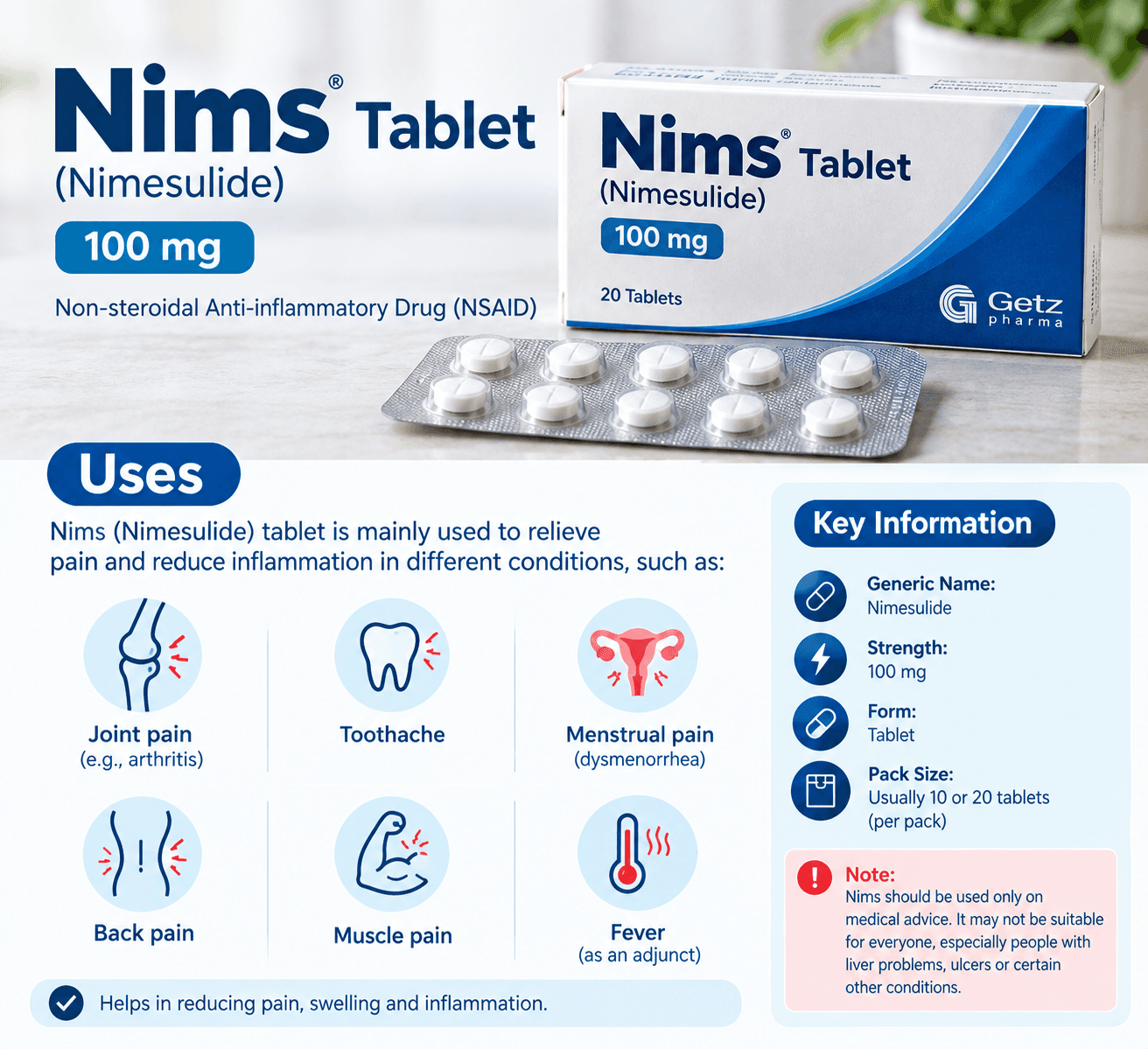
Nims tablets commonly contain nimesulide, a non-steroidal anti-inflammatory drug (NSAID) used for short-term acute pain and period pain when a clinician considers it appropriate. Check the ingredient on your strip: nimesulide can cause serious liver injury and is not a routine choice for fever or ongoing daily pain.
This guide is educational, not advertising for any company’s product. Compare generic options with a pharmacist rather than choosing by brand recognition alone.
Quick Information
| Information | Details |
|---|---|
| Generic name | Usually nimesulide; confirm on your pack |
| Brand name(s) or class options | Nims is the searched brand; generic NSAID alternatives include ibuprofen and naproxen, which are not equivalent substitutes |
| Drug class | Non-steroidal anti-inflammatory drug, or NSAID |
| Main uses | Selected short-term acute pain and primary period pain |
| Available forms | Tablets; other nimesulide formulations vary by market |
| Common strengths | 100 mg tablets are common; verify your strip |
| Route | Oral for tablets |
| Prescription / OTC | Treat as prescription-only; confirm Pakistan-specific status locally |
| Common side effects | Nausea, vomiting, diarrhoea and stomach discomfort |
Introduction — What is Nims?
The active ingredient matters most. If your Nims pack lists nimesulide, the guidance below applies; if it lists another ingredient or a combination, ask a pharmacist to identify it first.
Nimesulide reduces pain and inflammation, but its liver risks have led to restrictions or non-approval in several countries. European regulators restrict systemic use to second-line treatment, meaning another suitable treatment should normally be considered first. These restrictions do not establish Pakistani prescribing rules, but they explain why casual repeat use is unsafe.
It is not an antibiotic. Pain relief does not prove that the underlying problem has healed.
How it works and when relief starts
Nimesulide reduces the production of prostaglandins, chemicals involved in pain and inflammation. It acts through cyclo-oxygenase enzymes, with a preference for COX-2, but this does not make it free from stomach, kidney or cardiovascular risks.
Relief is not immediate. Some people notice improvement within the first few hours after an oral dose, although food, formulation and the cause of pain affect the response. Do not take an extra tablet because relief seems slow.
Uses: where a doctor may consider it
Short-term acute pain
A clinician may consider nimesulide for selected episodes of recent pain, such as a painful muscle injury or dental pain, after weighing safer alternatives and individual risks. It is not automatically appropriate for every sprain, toothache or backache.
The cause still needs attention. Tooth pain with facial swelling needs dental assessment; back pain with leg weakness or loss of bladder control needs urgent medical care, not stronger self-medication.
Primary period pain
Nimesulide may relieve primary dysmenorrhoea: menstrual cramps without an identified underlying pelvic disorder. However, other treatments often have a better-established place in routine care.
Seek assessment for new, unusually severe period pain, fainting, fever, possible pregnancy or very heavy bleeding. Repeatedly covering these symptoms can delay diagnosis.
What it should not routinely treat
Do not use it as an everyday treatment for chronic arthritis or recurring headaches. European restrictions exclude painful osteoarthritis from systemic nimesulide indications.
It is also unsuitable for self-treating fever or flu-like illness. In Pakistan, unexplained fever may be dengue; NSAIDs can increase bleeding risk and should be avoided when dengue is suspected.
Dose and how to take it
The exact dose depends on age, condition, formulation and medical history; confirm it with your doctor or pharmacist. Do not copy a relative’s prescription or assume every tablet contains the same amount.
For context, European restricted prescribing information for eligible adults describes 100 mg twice daily after meals, using the lowest effective dose for the shortest time, with a maximum treatment course of 15 days. This is not a recommendation to start treatment, and your Pakistani product’s authorised instructions must be checked. Fifteen days is a ceiling, not a target.
Swallow a conventional tablet with water. Food may reduce stomach discomfort, but it does not prevent ulcers or liver injury. Do not crush, chew or split it unless the leaflet or pharmacist confirms that your particular formulation allows this.
Children are different. Nimesulide is contraindicated below 12 years in European product information; do not calculate a child’s dose by cutting an adult tablet. Adolescents also need clinician-directed assessment.
If you miss a dose, follow the guidance below rather than doubling. Stop and seek advice if warning symptoms develop, even after the first few doses.
Side effects: recognise the important patterns
Common and less common effects
Nausea, vomiting, diarrhoea and stomach discomfort can occur. Dizziness, itching or a rash are also possible. A pharmacist can help assess mild symptoms, but persistent vomiting or worsening abdominal pain should not be dismissed as ordinary indigestion.
Stop and seek urgent assessment
Stop nimesulide and obtain prompt medical advice for loss of appetite, unusual exhaustion, persistent nausea, upper abdominal pain, dark urine or yellow eyes or skin. These can signal liver injury. Do not wait for jaundice before acting.
Seek emergency care for:
- Vomiting blood, passing black tar-like stools or collapsing.
- Breathing difficulty or swelling of the lips, tongue or throat.
- Blistering or peeling skin, especially with mouth sores.
- Chest pain, sudden weakness or difficulty speaking.
- Markedly reduced urine, severe swelling or breathlessness.
Serious liver injury can occur during a short course. A previously trouble-free experience does not guarantee that another course will be safe.
Warnings and precautions
Pregnancy needs a separate decision. Do not self-medicate with nimesulide during pregnancy or while trying to conceive. NSAIDs carry fetal kidney and amniotic-fluid risks from around 20 weeks, and nimesulide is contraindicated in the third trimester. Breastfeeding is also a contraindication in European product information; request a suitable alternative.
Older adults face greater risks of bleeding and kidney complications, particularly when several medicines are involved. Previous ulcers, high blood pressure, heart disease, inflammatory bowel disease or a bleeding disorder must be disclosed before treatment.
Kidneys need adequate circulation. Vomiting, diarrhoea, fasting with poor fluid intake or prolonged heat exposure can cause dehydration, making an NSAID more hazardous. After a hot day outdoors, address dizziness and reduced urine rather than automatically taking a pain tablet.
Existing liver disease is a major warning. Tell the prescriber about hepatitis, abnormal liver tests, substantial alcohol use and any previous reaction to nimesulide.
Drug interactions: check every packet
Do not combine nimesulide with another NSAID, such as ibuprofen, naproxen, diclofenac or pain-relief doses of aspirin. Different brand names can hide medicines from the same class.
Important combinations needing review include:
- Blood thinners and antiplatelets: warfarin, apixaban, clopidogrel and prescribed aspirin can increase bleeding concerns.
- Steroids and some antidepressants: oral corticosteroids and selective serotonin reuptake inhibitors can add to gastrointestinal bleeding risk.
- Blood-pressure medicines and diuretics: ACE inhibitors, angiotensin receptor blockers and water tablets may combine with NSAIDs to impair kidney function, especially during dehydration.
- Lithium, methotrexate and ciclosporin: NSAIDs can increase toxicity or kidney-related complications.
Avoid alcohol. Do not add paracetamol, another painkiller or potentially liver-harming medicines without professional review; European nimesulide information specifically warns against other analgesics and hepatotoxic substances.
Include vitamins, herbal remedies and bodybuilding products in the check. “Natural” does not rule out liver injury, and an unlabelled herbal mixture cannot be reliably screened. Do not independently stop essential prescribed medicines; ask which pain treatment fits them.
Who should not use nimesulide?
Major contraindications in European product information include:
- Liver impairment or previous nimesulide-related liver injury.
- Active or recurrent stomach ulcers, gastrointestinal bleeding or other active bleeding.
- Severe kidney impairment, severe heart failure or severe clotting disorders.
- Previous aspirin/NSAID reactions, including wheezing, hives or facial swelling.
- Age below 12 years, third-trimester pregnancy or breastfeeding.
- Fever or flu-like symptoms.
- Alcoholism or concurrent exposure to potentially liver-damaging substances.
This is not a complete screening checklist. If any item applies, do not take another tablet while waiting to clarify suitability. If fever or flu-like symptoms develop during treatment, stop and contact the prescriber.
Overdose: what to do now
Too much nimesulide may cause nausea, vomiting, stomach pain or drowsiness. More severe poisoning can involve bleeding, kidney injury or breathing problems; early symptoms do not reliably show how serious the exposure is.
Get emergency help immediately after a suspected overdose, particularly if a child has swallowed tablets. Do not induce vomiting or give home remedies. Take the strip and any other medicine packets, and report the approximate amount and time taken. Do not wait for symptoms.
Missed dose: never make up with two
If prescribed on a regular schedule, take the missed dose when remembered unless it is nearly time for the next one. In that case, skip it. Never double without medical advice.
If prescribed only when needed, there is no missed dose to replace. Follow the prescribed spacing and maximum amount.
How long is it used, and can you stop?
Nimesulide is for short-term treatment. Under European restrictions, a course must not exceed 15 days, but many painful conditions need fewer days or another approach entirely.
No taper is normally required. Stop when instructed or when no longer needed under an as-needed prescription; this is not an antibiotic course that must be completed despite resolved pain. Persistent or returning pain needs reassessment, not repeated pharmacy refills. Frequent short courses are still repeated exposure.
Storage and disposal
Follow the temperature limit on the pack. Keep tablets in their original packaging, away from moisture, direct sunlight and children; a hot car, bathroom shelf or kitchen windowsill is unsuitable.
Check the expiry date. Do not use tablets from damaged strips or packets with unreadable identification. Ask a pharmacy about local disposal arrangements rather than sharing leftovers or flushing them.
Forms and strengths: read beyond “100 mg”
A 100 mg tablet is a common nimesulide presentation, but do not assume that it is the only strength or the exact product supplied. Granules and topical preparations exist in some markets; their availability and directions differ.
For the strip in your hand, check the generic ingredient, strength per tablet, dosage form, manufacturer and expiry. A combination product needs a separate safety review. Never convert tablet instructions into spoonfuls or assume that a gel and an oral tablet are interchangeable.
Brand comparison: compare treatments, not popularity
This guide stays generic rather than listing unverified Pakistani brands. The useful comparison is suitability, not which name is most familiar.
| Option | Potential role | Main limitation |
|---|---|---|
| Nimesulide | Selected short-term pain when clinically justified | Specific liver concerns and restricted indications |
| Ibuprofen | Commonly used for pain, inflammation and period cramps | Still carries stomach, kidney, heart and pregnancy risks |
| Naproxen | Another option for selected inflammatory pain or cramps | Can cause ulcers, bleeding and kidney problems |
These are alternatives to discuss, not medicines to combine. The same generic ingredient does not guarantee identical formulation or bioavailability, meaning how much medicine reaches the bloodstream. Ask a clinician or pharmacist before switching products.
Common misconceptions worth correcting
- Myth: “After food means it cannot harm me.” Food may ease discomfort; it does not cancel bleeding or liver risks.
- Myth: “A stomach-protection capsule makes it safe.” Acid suppression does not protect the liver, kidneys or heart.
- Myth: “Pain relief means the infection has gone.” Nimesulide does not treat a dental abscess or bacterial infection.
- Myth: “Two different brands give stronger, safer relief.” They may duplicate nimesulide or combine two NSAIDs.
A useful household habit is to photograph both sides of every medicine strip before a pharmacy visit. Count ingredients, not tablets. A single cold-and-flu tablet may contain several drugs, so “I only took one other pill” is not enough information for an interaction check.
Patient FAQ
Is Nims an antibiotic?
No. If the ingredient is nimesulide, it is an anti-inflammatory pain medicine, not treatment for a bacterial infection.
Can I take Nims for a toothache?
A clinician may consider it for selected acute pain. Swelling, fever, difficulty opening your mouth or trouble swallowing needs urgent dental assessment.
Is it suitable for headache or fever?
Do not make it your routine headache treatment, and avoid it for fever or flu-like illness. Sudden severe headache needs urgent assessment.
Should I take it before or after food?
European oral product information advises after meals. Follow your verified leaflet and prescription; food does not remove serious risks.
Can I take it with paracetamol?
Do not add paracetamol yourself. Nimesulide has liver-specific precautions, and combined pain treatment requires review of all ingredients and doses.
Can I drive after taking it?
Avoid driving or operating machinery if you feel dizzy, sleepy or unsteady. Check your response before attempting safety-critical activities.
Is Nims addictive or a sleeping tablet?
It is neither an opioid nor a sleeping medicine and is not considered habit-forming. Sleepiness is not a reason to use it.
Can pregnant or breastfeeding patients use it?
Do not self-use. Pregnancy stage matters, and breastfeeding is a contraindication in European information. Ask for an appropriate alternative.
What if I already took one tablet?
Do not panic or repeat it automatically. Check the ingredient and contact a pharmacist, especially with pregnancy, liver disease or interacting medicines. Warning symptoms need urgent care.
What is the price in Pakistan?
Prices vary by manufacturer, pack size and pharmacy. Check a licensed pharmacy for current pricing, intact packaging and expiry; price alone does not establish suitability.
Sources
- European Medicines Agency: Nimesulide-containing medicinal products for systemic use referral, including restricted indications and treatment duration.
- European Medicines Agency: Nimesulide referral and associated product information, including contraindications and liver warnings.
- US Food and Drug Administration: Drug Safety Communication on avoiding NSAIDs at 20 weeks of pregnancy or later unless specifically advised.
- World Health Organization: Dengue and severe dengue fact sheet, including advice to avoid NSAIDs because of bleeding risk.
European restrictions provide safety context; confirm the authorised Pakistani product information with a pharmacist.
Important Medical Disclaimer
This article is for general educational purposes only and is not a substitute for advice from a qualified doctor or pharmacist. Always consult your doctor/pharmacist before using any medicine, changing a dose, or starting treatment.
Related reading
If this article on Nims Tablet Uses: Pain Relief, Dose and Liver Safety was helpful, explore these related guides for more practical information on similar topics.
- Ascard Tablet Overview: Uses, Dosage and Safe Use Tips — Understand what Ascard contains, why doctors prescribe it, and how to avoid bleeding risks, missed-dose mistakes and unsafe tablet substi…
- betnelan tablet uses in urdu — بیٹنیلان ٹیبلٹ کس لیے استعمال ہوتی ہے؟ اگر آپ کے ڈاکٹر نے آپ کو Betnelan Tablet لینے کا کہا ہے اور آپ سوچ رہے ہیں کہ آخر یہ دوا ہے کیا، ت…
- trimetabol syrup uses in urdu — ٹرائی میٹابول شربت (Trimetabol Syrup) کے استعمال — مکمل اور آسان اردو رہنمائی تعارف بھوک نہ لگنا ایک ایسا مسئلہ ہے جس کا سامنا چھوٹے بچوں…
- Solid Dosage Formulation Principles — Binders, disintegrants, and compression science for tablet development.
- Adverse Drug Reaction Reporting Systems — Pharmacovigilance fundamentals for students and practicing pharmacists.
- Nexum tablet uses in urdu — نیکسم — معدے کی تیزابیت اور جلن کے بارے میں مکمل رہنمائی سینے میں جلن، کھٹی ڈکاریں، یا صبح اٹھتے ہی معدے میں تیزابیت کا احساس — یہ شکایات…