What is difference between exudate and transudate fluid.
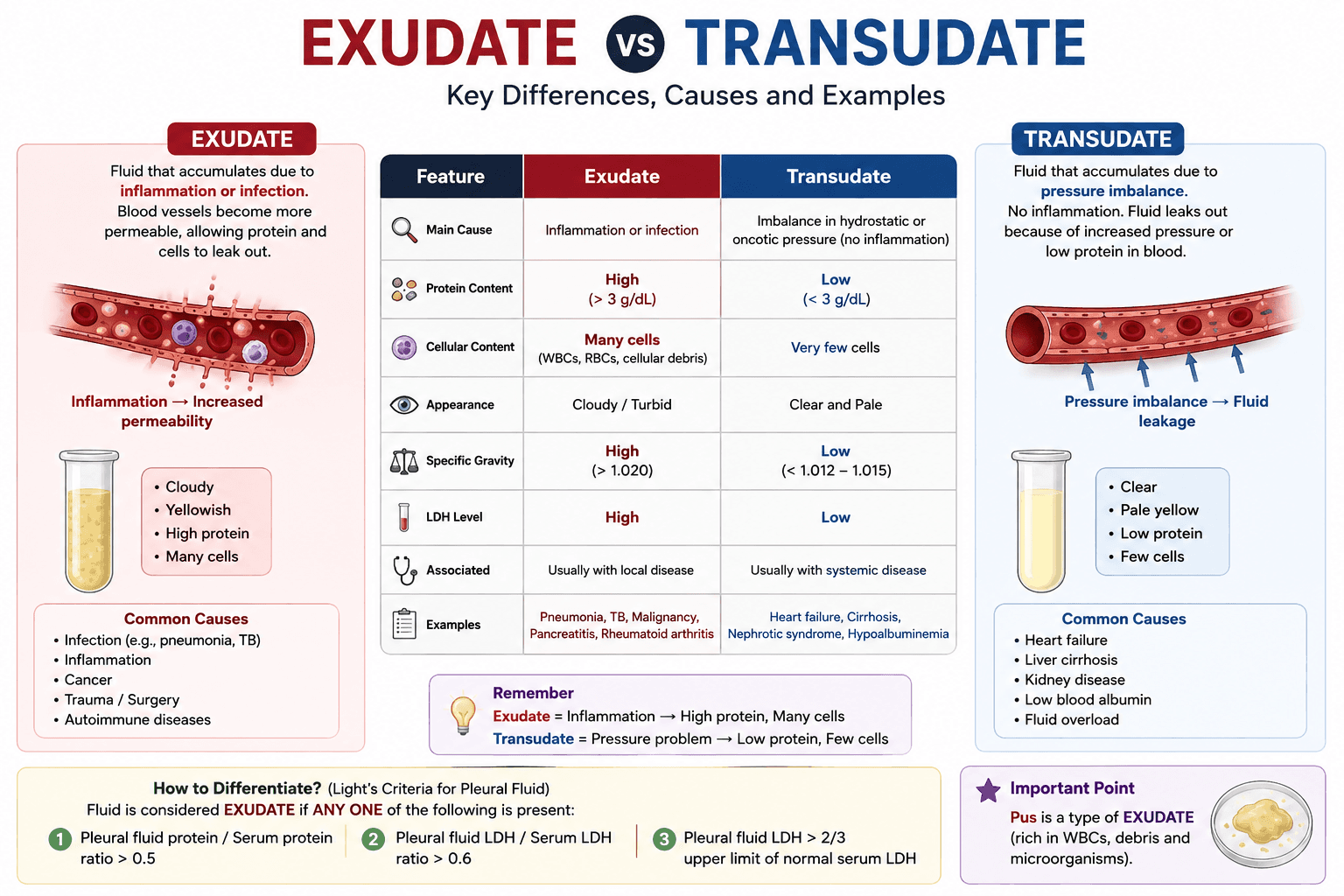
Exudate and Transudate Exudate and transudate are two types of fluid that can accumulate in body tissues or body cavities. They are different mainly in their cause, protein content, and cellular content. 1. Exudate
By Dr. Amina Rahman, PharmD5 min read
EXUDATE AND TRANSUDATE - COMPLETE NOTES
Introduction
Body cavities (such as the pleural cavity, peritoneal cavity, and pericardial cavity) normally contain a small amount of fluid that serves as lubrication. When the amount of this fluid increases abnormally, it is called an effusion. Effusion is of two types: Exudate and Transudate. These two differ in their cause, composition, and clinical significance.
1. EXUDATE
Definition:
Exudate is a fluid that forms due to inflammation, infection, or tissue injury. In this process, the permeability of blood vessels increases, allowing proteins, cells, and other components to leak out along with the fluid.
Mechanism (How It Forms):
When inflammation or infection occurs in the body, inflammatory mediators (such as histamine and bradykinin) are released. These mediators cause gaps to form in the walls of blood vessels, increasing their permeability. As a result, plasma proteins, white blood cells, and cellular debris leak out of the capillaries and accumulate in the tissue or cavity.
Common Causes:
- Bacterial or viral infection (such as pneumonia)
- Tuberculosis
- Cancer/malignancy
- Trauma or injury
- Post-surgery
- Autoimmune diseases (such as rheumatoid arthritis, lupus)
- Pulmonary embolism
Characteristics:
- High protein content, usually more than 3 g/dL
- High white blood cell count
- Cellular debris is present
- Appearance is cloudy or turbid
- High specific gravity, usually more than 1.020
- Fluid can clot because fibrinogen is present
- High LDH (Lactate Dehydrogenase) level
- Glucose level may be reduced because bacteria and cells consume glucose
Example:
Pleural fluid caused by pneumonia is usually an exudate. Similarly, exudate can also form due to TB or cancer.
2. TRANSUDATE
Definition:
Transudate is a fluid that forms due to an imbalance of pressure within blood vessels. It does not involve inflammation or infection.
Mechanism (How It Forms):
There are two basic reasons transudate forms. The first is an increase in hydrostatic pressure, such as in heart failure, where blood is not pumped properly and pressure builds up within the vessels. The second is a decrease in pressure, caused by a deficiency of albumin protein. Albumin normally keeps fluid retained within the blood vessels; if its level drops, fluid begins to leak out and accumulate in tissue or a cavity. In both situations, the structure of the blood vessel wall remains normal — the pressure mechanism is disrupted.
Common Causes:
- Congestive heart failure
- Liver cirrhosis
- Nephrotic syndrome (kidney disease)
- Hypoalbuminemia (low blood albumin)
- Malnutrition
Characteristics:
- Low protein content, usually less than 3 g/dL
- Very few white blood cells
- No cellular debris
- Appearance is clear or pale yellow
- Low specific gravity, usually less than 1.012
- Fluid does not clot because fibrinogen is absent
- Low LDH level
- Glucose level is normal
Example:
Pleural fluid caused by heart failure is usually a transudate. Similarly, transudate also forms in liver cirrhosis and kidney disease.
LIGHT'S CRITERIA
This criteria is used to classify pleural fluid as exudate or transudate. If even of the following three conditions is met, the fluid is considered an exudate.
The first condition is that the ratio of pleural fluid protein to serum protein is greater than 0.5. The second condition is that the ratio of pleural fluid LDH to serum LDH is greater than 0.6. The third condition is that pleural fluid LDH is greater than two-thirds (2/3) of the upper normal limit of serum LDH.
If none of these three conditions are met, the fluid is considered a transudate.
COMPARISON TABLE
| Feature | Exudate | Transudate |
|---|---|---|
| Cause | Inflammation, infection, injury | Pressure imbalance, no inflammation |
| Mechanism | Increased vascular permeability | Increased hydrostatic pressure or decreased pressure |
| Protein content | High, more than 3 g/dL | Low, less than 3 g/dL |
| Cell count | High, many WBCs | Low, very few cells |
| Appearance | Cloudy, turbid | Clear, pale yellow |
| Specific gravity | High, more than 1.020 | Low, less than 1.012 |
| LDH level | High | Low |
| Clotting | Clots (fibrinogen present) | Does not clot |
| Glucose level | Often reduced | Usually normal |
| Common causes | Pneumonia, TB, cancer, trauma | Heart failure, cirrhosis, kidney disease |
IMPORTANT ADDITIONAL POINTS
Pus is a type of exudate that contains large numbers of dead white blood cells, bacteria, and cellular debris.
Pleural effusion can be of either type, depending on the underlying cause. If the cause is heart failure, the fluid will be a transudate. If the cause is infection or pneumonia, the fluid will be an exudate.
Ascites (accumulation of fluid in the abdomen) can also be of either type. In liver cirrhosis, the ascites is usually a transudate, whereas in peritonitis or cancer, it is usually an exudate.
In clinical practice, Light's Criteria is considered the most reliable method for differentiating fluid types, particularly in the case of pleural fluid.
Opium Alkaloids and Their Chemical Structures: A Complete…
Related reading
If this article on What is difference between exudate and transudate fluid. was helpful, explore these related guides for more practical information on similar topics.
- The "7 Minutes After Death" Claim — What's Actually True? — The "7 Minutes After Death" Claim — What's Actually True? A few weeks ago a classmate sent me a video that had been going around — the on…
- Shock: Types, Causes, Pathophysiology and Stages Explained — Shock: Types, Causes, Pathophysiology and Stages Explained (Complete Pharm D Notes) Introduction Shock is of the most important topic…
- write a note on granuloma and write down 3 causes of granuloma in details — How Patients Find the Right Doctor Today Finding the right doctor used to mean asking a neighbor, calling your insurance company,…
- Understanding Drug–Drug Interactions in Clinical Pharmacy Practice — A practical overview of clinically significant interactions.
- HPLC Method Validation in Pharmaceutical Analysis — ICH-aligned validation parameters for assay and impurity methods in QC laboratories.