The "7 Minutes After Death" Claim — What's Actually True?
The "7 Minutes After Death" Claim — What's Actually True? A few weeks ago a classmate sent me a video that had been going around — the one that says when a person dies, their brain stays alive for seven minutes, quietly
By Dr. Khalid Mehmood, MD9 min read
The "7 Minutes After Death" Claim — What's Actually True?
A few weeks ago a classmate sent me a video that had been going around — the that says when a person dies, their brain stays alive for seven minutes, quietly replaying their whole life like a film reel before the lights finally go out. It's the kind of thing that gives you chills. It's also, if you actually dig into where it comes from, mostly not true — at least not in the neat, exact way it's usually told.
I wanted to actually find out what's real here, because as a Pharm D student this isn't just internet trivia to me. Understanding what happens to the brain during cardiac arrest is something we touch on constantly — resuscitation drugs, timing of CPR, organ donation ethics, all of it circles back to this exact question of when, biologically, does a person actually stop.
So let's go through it properly.
Death isn't a light switch
The first thing that surprised me when I started reading into this is that doctors don't really treat death as single moment anymore. We tend to picture it that way — heart stops, and that's it, done. But physiologically it's closer to a fading process than a switch being flipped off.
There's a difference between clinical death (the heart stops beating properly, breathing stops) and biological death (the point where cells throughout the body, including brain cells, have broken down beyond any possible recovery). Clinical death can sometimes be reversed — that's literally what CPR and a defibrillator are trying to do in those first minutes. Biological death can't be reversed. And the gap between the two isn't instant; it plays out over minutes, not milliseconds.
📝 That distinction alone is worth remembering for exams, because students often use "clinical death" and "brain death" interchangeably, and they're not the same thing at all. Brain death is a formal, specific clinical diagnosis — a whole protocol, not just "the heart stopped."
What the brain is actually doing right after the heart stops
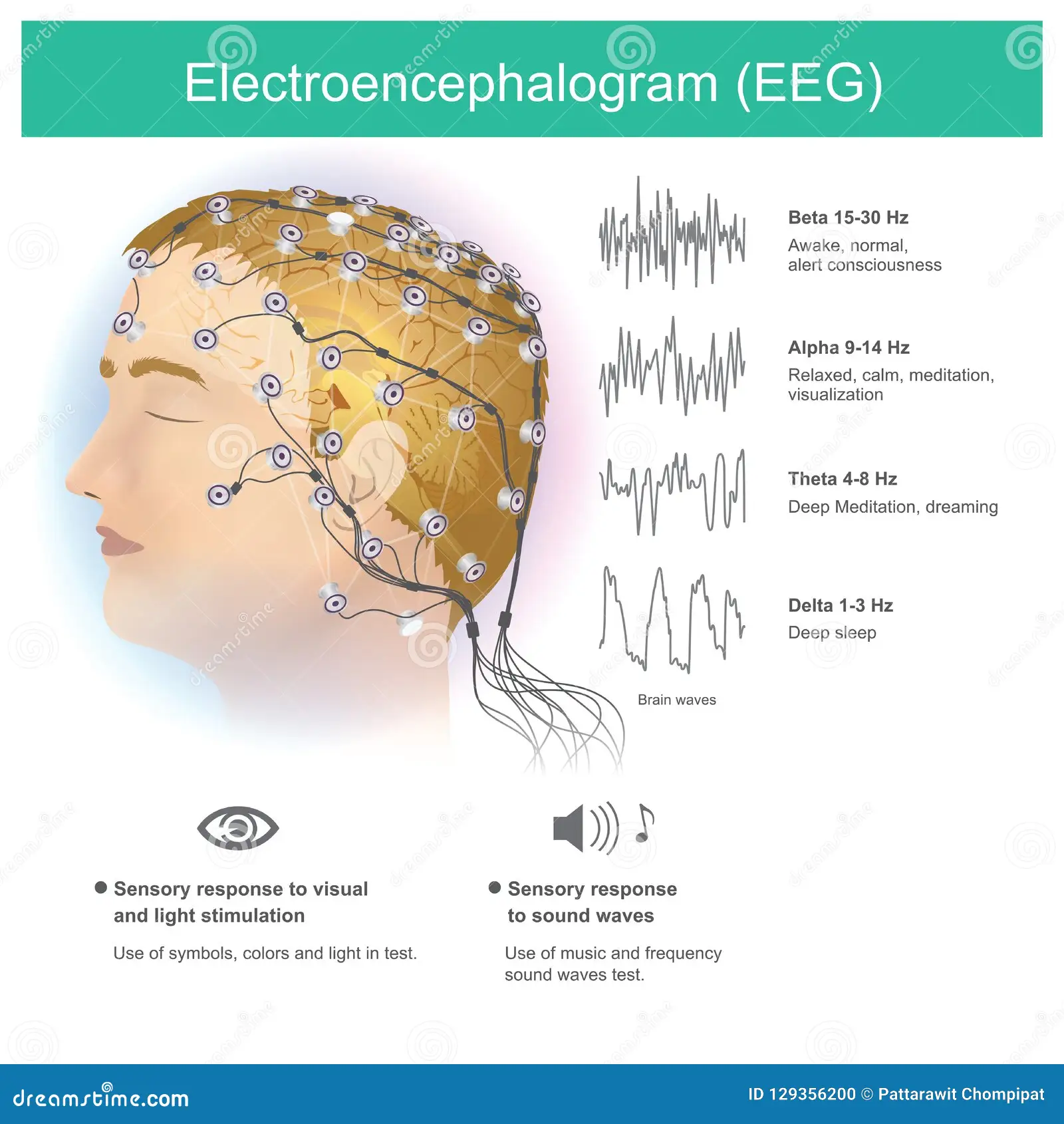
When blood stops reaching the brain, a person loses consciousness fast — within about 10 to 20 seconds. If you watch the EEG (the machine that reads the brain's electrical activity) during this window, it usually shows the activity dropping off sharply, eventually flattening out completely. A flat EEG has long been of the classic signs doctors look for in deep coma or death.
But here's the part that actually has some real science behind it, even if it's gotten wildly exaggerated online: in a small number of documented cases, researchers have caught brief, unexpected bursts of organized brain activity happening right around the time the heart stops — not a slow fade, but a kind of last surge. well-known case, published in 2022, involved an 87-year-old patient who was already hooked up to EEG monitoring for an unrelated reason (epilepsy) when he suffered a fatal cardiac arrest during the recording. In the moments around his death, his EEG showed gamma-wave activity — the same type of brain wave pattern that's usually linked, in living people, to memory recall and focused awareness.
That's genuinely interesting. It's also just case. patient, recorded somewhat by accident, does not equal a proven law of biology that applies to every human being who dies.
⚠️ This is exactly where the internet tends to run away with the story — turning "we recorded something unusual in patient" into "everyone experiences a 7-minute movie of their life." Those are two very different claims, and the first has real evidence behind it.
So where did "seven minutes" specifically come from?
As far as I could trace it, the number seems to come mostly from a widely shared media account — a report describing a patient in a Canadian ICU whose brain activity reportedly continued for about seven minutes after life support was withdrawn. It got picked up, retold, dramatized, and eventually turned into the version everyone's heard, complete with made-up detail about what supposedly happens minute by minute (seeing a loved one's face in minute one, and so on). None of that minute-by-minute breakdown has any scientific backing. It's storytelling that got mistaken for science.
💡 If you ever see a claim broken down like "minute 1: this happens, minute 2: that happens" for something as unmeasurable as post-death consciousness — that's a strong sign you're reading folklore dressed up as fact, not a real study.
Why any of this actually matters clinically
This isn't just a spooky trivia fact — it connects to real decisions in medicine. If the brain doesn't switch off instantly, that raises genuine, serious questions:
- How long should a resuscitation team keep attempting CPR before it's truly futile?
- How do we understand the near-death experiences that some cardiac arrest survivors report — the sense of leaving their body, seeing light, replaying memories?
- How do we set ethical, medically sound timing protocols for organ donation after circulatory death, so that donation happens death is truly and irreversibly confirmed?
These are the actual research questions driving this field (often called resuscitation science), and people like Dr. Sam Parnia have spent years studying cardiac arrest patients specifically to try to answer them properly, instead of relying on anecdote.
A simple way to picture the timeline
Heart stops (cardiac arrest)
        ↓
Blood flow to brain stops
        ↓
Consciousness lost (~10–20 seconds)
        ↓
EEG activity drops sharply — in some
documented cases, a brief surge occurs first
        ↓
If circulation isn't restored: irreversible
brain damage begins (roughly 4–6 minutes)
        ↓
Progression toward biological death
Notice that the 4–6 minute window here is a completely different concept from the "7 minutes" myth. This is about how long the brain can survive without oxygen before real damage starts — it's the number resuscitation teams actually care about and train around, not a countdown of remaining consciousness.
Where students usually get confused
I'll be honest, I mixed some of these up myself before writing this out properly:
- Treating "brain death" and "clinical death" as the same thing — they're not; can sometimes be reversed, the other cannot.
- Assuming that if EEG shows some activity, the person must be "aware" of something — EEG tells you electricity is moving, not what, if anything, is being experienced.
- Repeating the "7 minutes" number as if it's a settled scientific fact, when really it traces back to anecdotal report that went viral.
A quick comparison, since these terms get tangled together
| Term | What it means | Can it be reversed? |
|---|---|---|
| Clinical death | Heart stops beating effectively, breathing stops | Sometimes, with prompt CPR |
| Brain death | Formal diagnosis of complete, irreversible loss of all brain function | No |
| Biological death | Irreversible breakdown of cells throughout the body | No |
Questions people usually ask me about this
Is the 7-minutes claim actually true? Not as a fixed rule that applies to everyone — it's traced to limited, anecdotal reporting, not a solid confirmed study.
But does something happen in the brain after the heart stops? Yes, apparently — a small number of documented cases show brief bursts of organized activity, including gamma waves, right around the time of cardiac arrest. Real, but rare and limited evidence.
Does that mean a dying person can still hear or think? Honestly, nobody knows for sure yet. Electrical activity on an EEG isn't the same as proof of conscious experience. Researchers are careful not to claim more than the data actually shows.
How long can the brain go without oxygen before real damage happens? Generally somewhere around 4 to 6 minutes without restored blood flow, though it can shift depending on things like body temperature and the person's overall health.
Why does this myth spread so easily? Because it's comforting, in a strange way — the idea of a gentle final "life review" instead of just nothing. That emotional pull travels faster than the more careful, limited scientific version ever will.
Before you close this tab — the short version
- Death happens as a process, not an instant switch.
- Clinical death, brain death, and biological death are three different things — don't blur them together.
- Consciousness fades within about 10–20 seconds of the heart stopping.
- A few documented cases show brief bursts of organized brain activity (gamma waves) right after cardiac arrest — real, but limited evidence, not a universal rule.
- Irreversible brain damage from lack of oxygen typically begins somewhere in the 4–6 minute range.
- The specific "7 minutes" figure is a popularized claim from anecdotal reporting — not an established scientific fact, and it shouldn't be quoted as in academic or clinical writing.
Sources I actually pulled this from
- Vicente, R., et al. (2022). Enhanced Interplay of Neuronal Coherence and Coupling in the Dying Human Brain. Frontiers in Aging Neuroscience — the case report on gamma-wave activity in a dying patient.
- Parnia, S., et al. — published research on cardiac arrest, resuscitation science, and recalled experiences around death (the AWARE studies).
- General cardiac arrest and brain hypoxia timelines, consistent with standard resuscitation medicine references (e.g., American Heart Association guidance on cardiac arrest and CPR).
This is written for general learning — for Pharm D students and curious readers alike. It isn't medical, legal, or clinical advice. And that "7 minutes" number specifically? Treat it as a story people liked telling, not a biological fact.
Related reading
If this article on The "7 Minutes After Death" Claim — What's Actually True? was helpful, explore these related guides for more practical information on similar topics.
- Define neoplasia. Discuss in detail the features of malignant tumors. — Neoplasia — Definition Neoplasia is an abnormal, uncontrolled and excessive proliferation of cells that continues even after the original…
- What is difference between exudate and transudate fluid. — Exudate and Transudate Exudate and transudate are two types of fluid that can accumulate in body tissues or body cavities. They are diffe…
- Understanding Drug–Drug Interactions in Clinical Pharmacy Practice — A practical overview of clinically significant interactions.
- HPLC Method Validation in Pharmaceutical Analysis — ICH-aligned validation parameters for assay and impurity methods in QC laboratories.
- Plant-Derived Alkaloids: Is Kratom Itself an Alkaloid? — From isolation to therapeutic application — a structured review for pharmacy curricula.
- Medication Therapy Management in Community Practice — How structured MTM visits improve outcomes and expand the pharmacist's clinical role.