How LOD and LOQ is determined & Describe sensitivity of a method ?
dits? See our FAQ or pricing.
By Dr. Amina Rahman, PharmD4 min read
Introduction
Anytime a new analytical method is developed for a drug — whether it's an HPLC method for a tablet or a UV method for checking impurities — one of the first questions that comes up is: how small an amount of this substance can the method actually detect and measure reliably? That's exactly what LOD and LOQ answer. They're two of the most important parameters in method validation, and every Pharm D student runs into them repeatedly, both in coursework and in the lab.
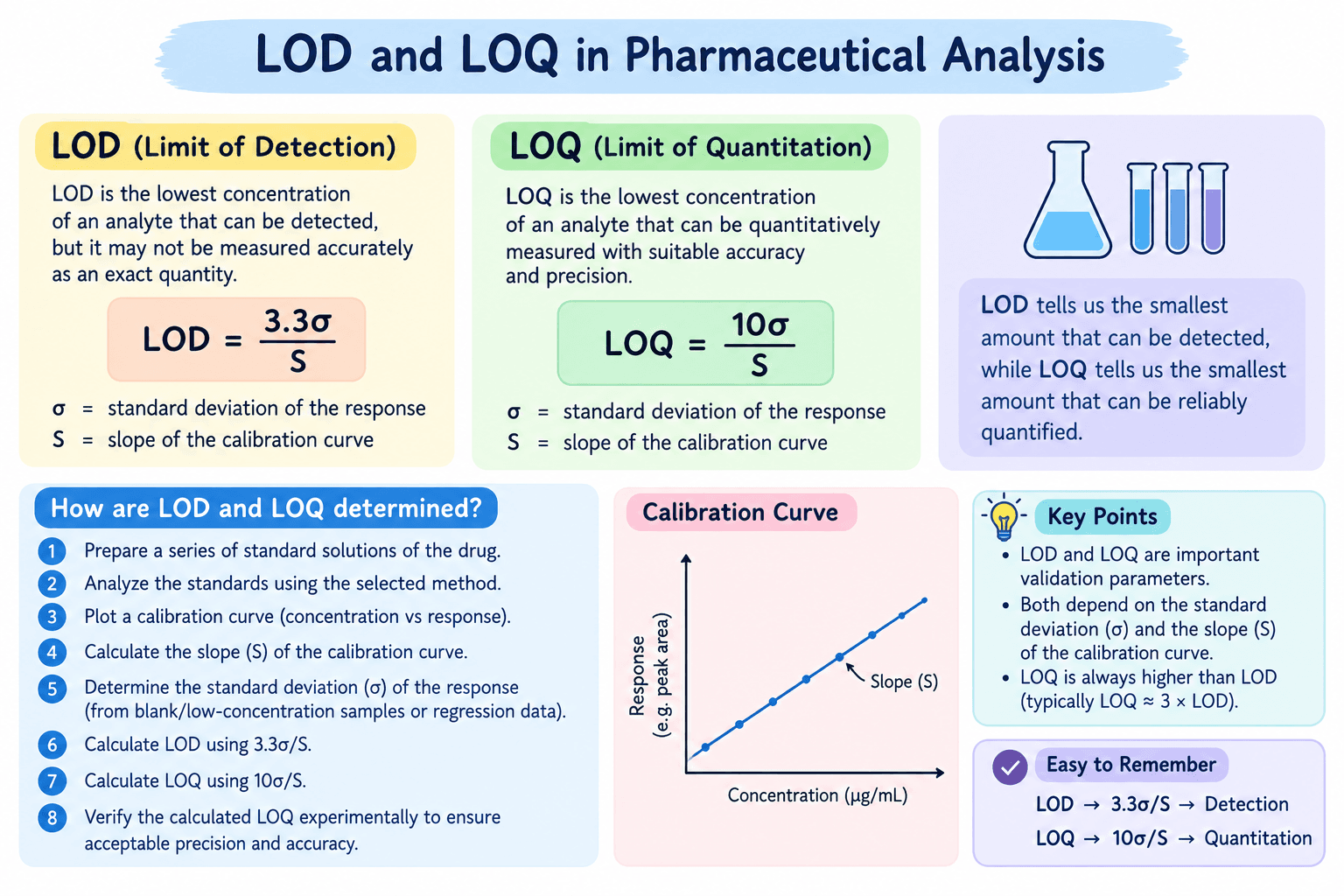
1. Limit of Detection (LOD)
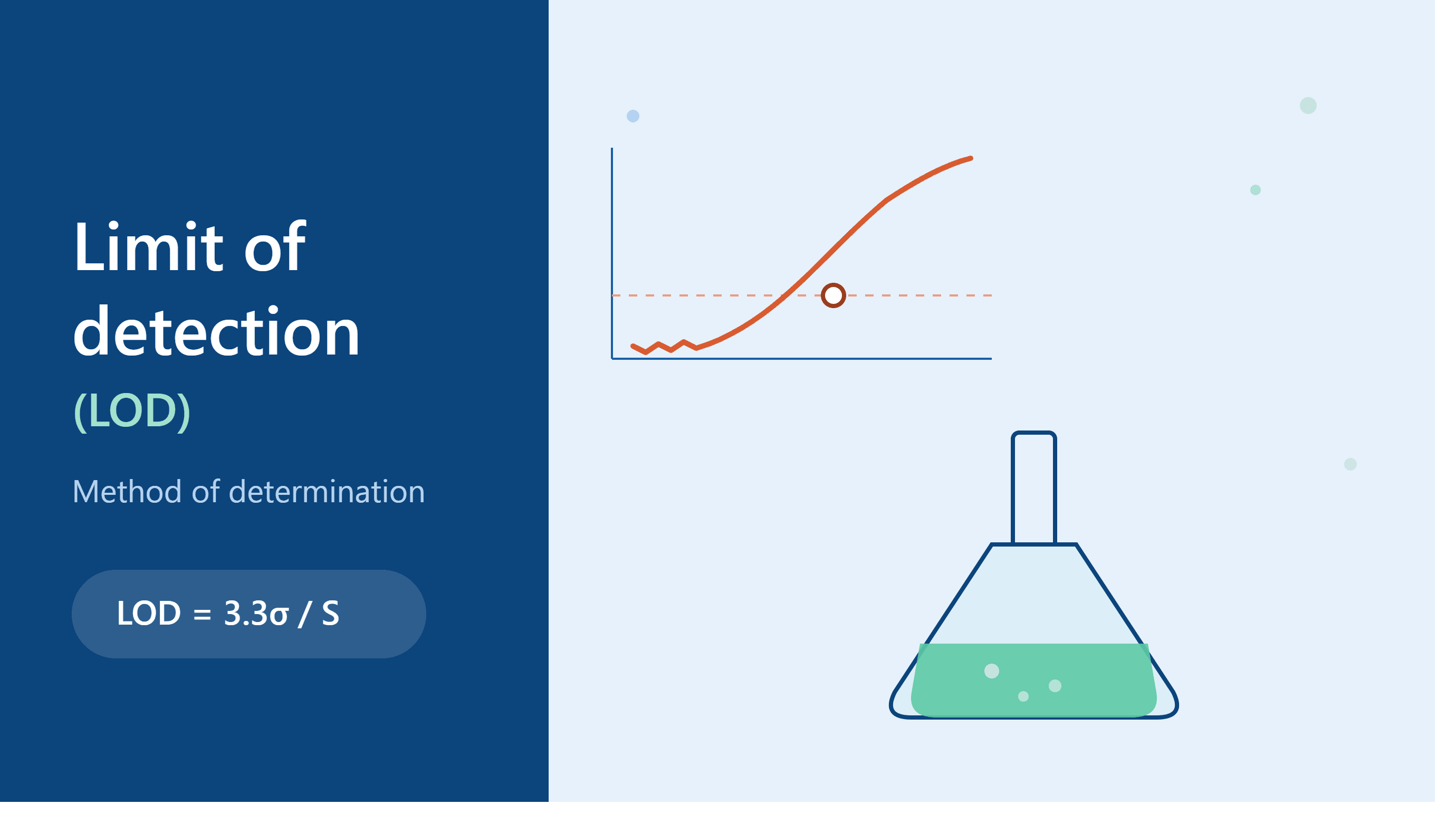
LOD is the lowest concentration of an analyte that can be detected, but it may not be measured accurately as an exact quantity.
A commonly used formula is:
Where:
- σ (sigma) = standard deviation of the response
- S = slope of the calibration curve
2. Limit of Quantitation (LOQ)
LOQ is the lowest concentration of an analyte that can be quantitatively measured with suitable accuracy and precision.
The commonly used formula is:
Where:
- σ = standard deviation of the response
-
S = slope of the calibration curve
Important Differences
Parameter LOD LOQ Definition Smallest detectable amount Smallest reliably quantifiable amount Signal-to-noise ratio ~3:1 ~10:1 Formula (calibration method) 3.3 × σ/S 10 × σ/S Purpose Confirms presence of analyte Confirms accurate measurement of analyte Value comparison Lower value Always higher than LOD  Sensitivity of an Analytical Method
Sensitivity is the ability of an analytical method to detect small changes in the concentration of an analyte and produce a corresponding change in the analytical response.
In simple words, a sensitive method gives a noticeable change in response even when the concentration changes only slightly.
How is sensitivity determined?
Sensitivity is commonly determined from the calibration curve.
- Prepare standard solutions of the analyte at different concentrations.
- Measure the analytical response for each standard.
-
Plot a calibration curve:
- X-axis → concentration of analyte
- Y-axis → analytical response
- Calculate the slope of the calibration curve.
The slope is calculated as:
Where:
- S = sensitivity (slope)
- ΔY = change in analytical response
- ΔX = change in analyte concentration
Interpretation
- Steeper slope → higher sensitivity
- Smaller slope → lower sensitivity
For example, if a small increase in drug concentration produces a large increase in detector response, the analytical method is considered more sensitive.
FAQ
Is LOQ always higher than LOD? Yes. Detecting that something is present requires far less sensitivity than measuring it accurately, so LOQ is always the higher value.
Which method is preferred for LOD/LOQ determination? The calibration curve method (based on slope and standard deviation) is generally preferred because it's more statistically robust and reproducible than visual or purely instrument-based methods.
Do LOD and LOQ change if the instrument changes? Yes, both values are specific to the method, instrument, and even the analyst's technique in some cases, which is why they must be redetermined whenever a method is transferred or significantly modified.
Why is the number 3.3 used for LOD and 10 for LOQ? These multipliers come from statistical confidence levels — roughly 99% confidence for LOD and a higher precision threshold for LOQ — and are standard values recommended in ICH validation guidelines.
Are LOD and LOQ required for every analytical method? They're specifically required for methods intended to detect or quantify impurities, degradation products, or trace-level substances. For assay methods measuring the main active ingredient at much higher concentrations, they're less critical but may still be reported.
Related readingIf this article on How LOD and LOQ is determined? was helpful, explore these related guides for more practical information on similar topics.
- Limit of Detection (LOD): Method of Determination Explained Simply — How Is the Limit of Detection (LOD) Actually Determined? When an analytical method is validated — an HPLC assay, a UV method, even a simp…
- i'm a skincare beginner. Are Nivea and Garnier Good Starting Brands? — Nivea focuses on hydration and skin barrier protection, while Garnier targets brightness and uneven skin tone. Here is how a beginner sho…
- write a note on granuloma and write down 3 causes of granuloma in details — How Patients Find the Right Doctor Online Today Finding the right doctor used to mean asking a neighbor, calling your insurance company,…
- i’m a 30-year-old working mom. how do olay moisturizers perform compared to l’oréal’s skincare line? — Olay vs L'Oréal: Which One Actually Wins for Busy 30-Somethings? Okay so picture this. It's 7 AM. Coffee's already gone cold because some…
- What is difference between exudate and transudate fluid. — Exudate and Transudate Exudate and transudate are two types of fluid that can accumulate in body tissues or body cavities. They are diffe…
- Opium Alkaloids and Their Chemical Structures: A Complete Guide — Introduction Opium is one of the oldest medicines known to humans, and it is also the starting point for one of the most important drug c…