Heart's Blood Pumping Volume per Minute: Formula and Calculation (Cardiac Output)
دل ایک منٹ میں کتنا خون پمپ کرتا ہے؟ دھڑکن اور فی دھڑکن خون کی مقدار سے حساب سمجھیں، عام حد جانیں اور رپورٹ کے ساتھ خطرے کی علامات بھی پہچانیں۔
By Dr. Khalid Mehmood, MD12 min read
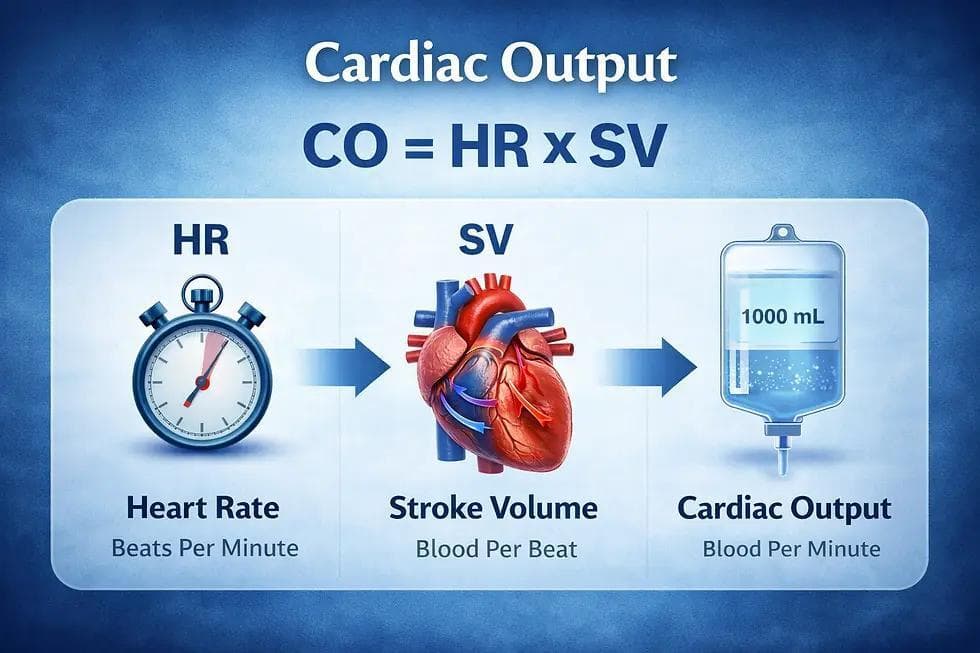
The formula for the heart's blood pumping volume per minute is: Number of beats per minute $\times$ Blood ejected per beat. For example, at 70 beats per minute and 70 milliliters of blood per beat, the result will be 4,900 milliliters, or 4.9 liters per minute; the calculation cannot be completed using the pulse alone.
In medicine, this volume is called cardiac output. The name sounds heavy, but the concept is straightforward: how much blood is the heart sending forward in minute? This is not a medicine. This article does not promote any brand or declare any company's products as the best; if a medication substitute is needed, consult a pharmacist.
Quick Information: What is Needed for the Calculation?
| Information | Details |
| Medical Name | Cardiac Output |
| Simple Meaning | Blood ejected from ventricle of the heart in minute |
| Basic Formula | Beats per minute $\times$ Blood ejected per beat |
| Result Unit | Milliliters per minute or liters per minute |
| General Resting Range in Adults | Approximately 4 to 8 liters per minute; variations depend on conditions |
| Essential Information | Heart rate and stroke volume (blood per beat) |
| Primary Use | Helps understand the condition of the heart and circulation |
| Home Limitation | Cannot be fully calculated using just a pulse, blood pressure, or a finger oximeter |
How to Solve the Formula Step by Step?
First, write down the heart rate. Next, you need the volume of blood pumped from the heart with each beat, which is typically obtained from a medical measurement; guessing this value is incorrect. The calculation is easy, but the real difficulty lies in having accurate information.
Suppose an examination records a heart rate of 80 beats per minute and a stroke volume of 60 milliliters per beat. Multiply the two, then divide by thousand to convert milliliters into liters:
$80 \times 60 = 4,800$ milliliters per minute.
$4,800 \div 1,000 = 4.8$ liters per minute.
Be sure to write down the unit. Writing just "4.8" will not clarify whether the reference is to liters or another scale; when sending an image of a report, its unit and title should be visible alongside the number.
Another precaution comes into play: do not calculate current cardiac output by multiplying last month's stroke volume by today's fever-driven pulse, as illness, dehydration, and medication can alter both components.
Where Does the Blood Ejected per Beat Come From?
The lower chambers of the heart are called ventricles. Before each heartbeat, they fill with blood, and upon contraction, a portion of it is pumped out; the chamber does not empty completely. It is this ejected volume that needs to be calculated.
To understand this, consider another relationship: Blood in ventricle after filling − Blood remaining after contraction = Blood ejected per beat. In a hypothetical example, if there were 120 milliliters initially and 50 milliliters remaining afterward, the difference would be 70 milliliters.
In general conversation, reference is usually made to the blood flowing from the left ventricle toward the body. The volumes of the right and left sides of the heart are not added together; in normal, steady circulation, the average flow on both sides remains approximately equal.
Does a Faster Pulse Mean More Blood Pumping?
Not necessarily. During walking or exercise, a healthy heart typically beats faster and pumps more blood each time to meet the increasing demand of the muscles. Resting calculations are different.
However, during a very rapid heart rate, the heart may have less time to fill. Dehydration, bleeding, or heart weakness can also reduce the stroke volume with each beat, even if the pulse feels fast.
Therefore, 100 beats and 40 milliliters yield 4 liters per minute, while 70 beats and 70 milliliters yield 4.9 liters. Both examples illustrate the math. The pulse alone does not make the final determination.
What Is a Normal Volume?
For resting adults, approximately 4 to 8 liters per minute is considered a general educational range. Height, weight, age, pregnancy, fever, exercise, and the measurement method all affect the result; therefore, a single number does not apply to everyone.
Children are a different matter. Their heart rates are typically faster than those of adults, but because their bodies are smaller, comparing them to adult per-minute volumes can be misleading. Discuss a child's report with a pediatric specialist.
To compare based on body size, doctors may also look at the cardiac index: cardiac output divided by body surface area. In adults, its general range is roughly 2.5 to 4 liters per minute per square meter, though the reference range on the report always takes precedence.
A number alone does not constitute a diagnosis. Even a seemingly normal volume can be insufficient for the needs of a severely ill person.
How Are Pumping Percentage and Blood Pressure Different from This?
The "pumping 60%" written on a report usually refers to the ejection fraction: what percentage of the blood in the filled ventricle was pumped out in a single beat. It does not mean 60 liters or that the body is receiving 60% of its blood. Keep the distinction in mind.
If 120 milliliters of blood filled the ventricle and 72 milliliters were pumped out, the ejection fraction is 60%. To find the per-minute volume, you still need the heart rate; the percentage alone is not enough.
Blood pressure indicates the pressure inside blood vessels, not the direct volume of flowing blood. Vascular resistance and elasticity also alter pressure, so a proper blood pressure reading does not prove a proper cardiac output in every case.
Some forms of heart failure can occur despite a normal ejection fraction. Do not ignore shortness of breath or swelling simply because a good percentage is observed.
How Is This Volume Measured in a Hospital?
Cardiac output can be estimated using an ultrasound of the heart (an echocardiogram) based on blood flow and heart structure. Cardiac output is not necessarily written on every echocardiogram report. Asking about it is entirely appropriate.
In method, the cross-sectional area of the left ventricular outflow tract and the distance traveled by blood during a single heartbeat are used. Even a small measurement error can change the result, so do not draw definitive conclusions by picking a few numbers from the report yourself.
In intensive care, measurements are performed for certain patients using a specialized catheter and temperature changes. Do not assume this is necessary for every patient; inserting a catheter into the body carries risks such as infection, bleeding, or rhythm disturbances.
Standard ultrasound does not use radiation. However, specialized evaluations performed via a transesophageal route (down the food pipe) involve different preparations and precautions.
What Is the Other Formula Calculated Using Oxygen?
In the Fick principle, the calculation works as follows: Body's oxygen consumption per minute $\div$ Difference in oxygen content between arterial and mixed venous blood. This estimates how much blood flow was necessary to deliver the required oxygen.
For example, if consumption is 250 milliliters per minute and the difference is 50 milliliters of oxygen per liter of blood, the result will be 5 liters per minute. Matching the units is essential.
The percentage from a finger pulse oximeter cannot replace this difference. Total oxygen content in the blood is also affected by hemoglobin, while a mixed venous sample is not a substitute for routine arm blood; do not try this calculation at home.
When Do Doctors Use This Calculation?
Knowing cardiac output can be useful around heart failure, severe circulatory failure, certain valve diseases, and major surgeries. The goal is not just to generate a number, but to understand whether adequate blood is reaching the organs.
Not every patient requires this measurement. Doctors make decisions by combining pulse, blood pressure, urine output, mental status, skin condition, and relevant tests; it is unnecessary to request an expensive test over a minor discrepancy.
A high cardiac output is not always a sign of a strong heart. Severe anemia, hyperthyroidism, or certain severe infections can increase flow, but the body remains under disease-related stress. Treatment targets the underlying cause.
Which Symptoms Should Prompt Stopping Calculations and Seeking Help?
Do not sit down to calculate numbers on paper when experiencing chest pressure, severe shortness of breath, or fainting. Even if a home device shows a proper number, the importance of serious symptoms is not diminished; evaluate the patient's condition first.
Chest pain, especially spreading to the arm, jaw, or back—seek immediate evaluation.
Severe shortness of breath at rest, blue lips, or frothy cough are emergency symptoms.
Sudden confusion, fainting, cold sweats, and extreme weakness require immediate help.
Clearly reduced urine output accompanied by worsening health should not be delayed.
Call a local ambulance or available rescue service. Do not drive yourself in cases of severe dizziness or chest pain; bring a list of medications and available reports, but do not let searching for them delay departure.
What Precautions Are Necessary Before Changing Medications?
There is no single universal pill to increase cardiac output. Some medications slow the heart rate, some reduce vascular resistance, and some remove excess fluid; benefits depend on the patient's underlying illness and condition.
Do not suddenly stop heart medications because a slow pulse is observed. Certain beta-blocker medications provide long-term benefits in selected patients, even if the pulse initially appears slow; seek immediate medical contact if dizziness, fainting, or unusual weakness occurs.
The correct dosage depends on age, condition, drug formulation, and medical history; consult your doctor or pharmacist. Do not double up on your own to make up for a missed dose, and if you accidentally take extra medication, provide its name, strength, timing, and quantity to get immediate advice.
Do not just name a brand at the pharmacy. Show the active ingredient, strength, and release type on the strip; crushing or chewing certain extended-release pills is inappropriate.
When Can Over-the-Counter Items and Water Become a Problem?
Certain nasal decongestants for colds and high-caffeine beverages can increase heart rate or blood pressure. Pain relievers like ibuprofen and diclofenac can cause fluid retention or strain the kidneys in heart failure; show your complete list beforehand.
Traditional or herbal remedies are not necessarily safe either. If a new medication or powder has been started alongside unusual palpitations, swelling, or dizziness, inform your physician, even if the vendor called it natural.
Dehydration in hot weather can genuinely affect blood flow. However, telling a heart or kidney patient that "not enough blood is being pumped" and forcing them to drink multiple glasses can be harmful; if a prescribed fluid limit has been given, stick to that plan.
How Do Pregnancy, the Elderly, and Chronic Illnesses Change Things?
During pregnancy, blood requirements and cardiac output generally increase. Do not view this change as a disease in itself, but sudden severe shortness of breath, chest pain, or fainting still require immediate evaluation during and after pregnancy.
In the elderly, or in patients with kidney or liver disease, the balance of medication, fluids, and electrolytes requires extra caution. The suitability of medication during breastfeeding must also be evaluated separately. Do not use another family member's prescription.
When comparing old and new reports, check whether both were done at rest or if was done during an illness. In cases of irregular heartbeat, an average across multiple beats may be needed rather than a single measurement.
What Information Should Be Kept Ready When Showing a Report?
Showing a circled number can leave the picture incomplete. The full page, the date of the examination, the pulse at that time, and symptoms help the doctor understand the result much better; keep mobile photos clear.
Ask: Was the volume measured directly or estimated?
Clarify: Is the number cardiac output, cardiac index, or ejection fraction?
Provide: A list of all medications, over-the-counter items, and recent changes.
Report: Changes in breathing, swelling, urination, or daily activity tolerance.
Calculating the formula every day is not necessary. If your physician has instructed home monitoring, record weight, pulse, or blood pressure in that exact order, without setting your own treatment targets.
Common Misconceptions and Corrections
| Misconception | Correct Fact |
| Knowing the pulse is enough to get the answer. | The stroke volume (blood per beat) is also required. |
| Higher volume is always better. | The body's needs and underlying disease background must be considered. |
| Pumping percentage is the per-minute output. | They are two different measurements. |
| The outputs of both ventricles are added together. | Routine calculations use the flow from side. |
| A good oxygen percentage proves proper heart flow. | Oxygen percentage does not reveal blood volume per minute. |
Frequently Asked Questions
Can cardiac output be calculated at home?
If reliable, contemporaneous stroke volume is available, the math can be done. Standard home devices do not provide this volume; do not change medications based on an estimated result.
Should 70 milliliters be assumed for everyone?
No. The quantity given in an educational problem is used, whereas in a real patient, this volume changes constantly. Do not take an example as your own report.
What will cardiac output be if the pulse is 72?
The answer is incomplete without additional information. If the stroke volume is also known, multiply it by 72; the pulse alone neither proves nor rules out disease.
Does low blood pressure necessarily indicate low cardiac output?
Not necessarily, because vascular resistance also changes blood pressure. However, if accompanied by fainting, confusion, or cold sweats, urgent medical help is required.
Does a standard echo report always contain this number?
No. The purpose and method of the examination can vary; if the ejection fraction is written, do not call it cardiac output. Seek clarification from your physician if needed.
Is a high volume after exercise dangerous?
An increase in volume during exercise is expected in a healthy body. Stop exercising and seek medical help if you experience chest pain, dizziness, or unusual shortness of breath.
Can drinking coffee improve a low volume?
Do not use it as a treatment. An increased heart rate is no guarantee of improved effective flow, and coffee can worsen anxiety or rhythm disturbances in some people.
Can heart disease exist despite a good pumping percentage?
Yes. The percentage can remain normal despite issues with ventricular filling, valves, or blood vessels; the cause of persistent symptoms must be investigated separately.
References
StatPearls: Cardiac Output Physiology; Basic Equations and Measurement Methods.
Guyton and Hall Textbook of Medical Physiology: Chapters on Cardiac Output and Venous Return.
American Heart Association: Patient Educational Guidance on Ejection Fraction and Heart Failure.
Important Medical Disclaimer
This content is for educational purposes and does not substitute for professional medical advice from a qualified doctor or pharmacist. Always consult your doctor or pharmacist before using any medication, dosage, or treatment.