What Is RTPA? Stroke Benefits, Risks and Pharm-D Notes
Learn how rtPA dissolves dangerous blood clots, when it can improve stroke recovery, and which bleeding risks and dosing distinctions clinicians must know.
By Oliver Grant, MRPharmS12 min read
Reviewed by Medical Review Team ·

RTPA, usually written rtPA, means recombinant tissue plasminogen activator: a clot-dissolving medicine, classically alteplase, used in selected medical emergencies. It can improve health by restoring blood flow through a blocked vessel, potentially reducing disability after an ischemic stroke or treating certain other life-threatening clots, but it carries a serious bleeding risk.
This is emergency treatment, not a wellness injection. These Pharm-D study notes are educational and do not advertise any company's product; compare treatment options with a pharmacist and the treating specialist, not by brand name.
Quick Answer / Overview
Alteplase is an injectable fibrinolytic, also called a thrombolytic. It breaks down fibrin, the protein mesh supporting a blood clot. Treatment requires a hospital team, diagnostic assessment and monitoring; it is never appropriate for self-administration to treat suspected stroke.
Its benefit depends on the diagnosis, timing and bleeding risk. A blocked brain artery and bleeding into the brain can cause similar symptoms, yet thrombolysis may help the former and dangerously worsen the latter.
Possible stroke is an emergency. Sudden facial drooping, arm weakness, speech difficulty, visual loss or severe imbalance requires immediate emergency assistance. Record when the person was last known to be well. Do not give aspirin, food or drink while awaiting assessment.
IMPORTANT — Do not wait for symptoms to settle. Temporary improvement does not exclude a stroke or remove the need for urgent evaluation.
Key Definitions: Read the Abbreviations Correctly
- Recombinant: manufactured using biotechnology to produce a therapeutic protein.
- tPA: tissue plasminogen activator, a naturally occurring enzyme involved in clot breakdown.
- rtPA: recombinant tPA; in clinical shorthand, this often specifically means alteplase.
- Plasminogen: the inactive precursor of plasmin, a clot-digesting enzyme.
- Fibrinolysis: breakdown of fibrin within a clot.
- Ischemic stroke: brain injury caused by interrupted blood supply, usually from an arterial blockage.
- Hemorrhagic stroke: brain injury caused by bleeding rather than an obstructing clot.
- Reperfusion: restoration of blood flow to tissue deprived of oxygen.
Terminology can be loose. Tenecteplase and reteplase are modified recombinant tPA medicines, but an order reading “RTPA” is not sufficiently specific for safe dispensing or administration.
Mechanism: How rtPA Dissolves a Clot
Alteplase promotes conversion of plasminogen to plasmin, particularly when these molecules are associated with fibrin. Plasmin then breaks down the fibrin network, helping the obstructing clot dissolve and allowing blood flow to return.
The sequence is straightforward:
Alteplase + fibrin-associated plasminogen
 ↓
 Plasmin formation
 ↓
 Fibrin breakdown
 ↓
 Clot dissolution and possible reperfusion
Reperfusion is not guaranteed. Clot size, location, treatment delay and the amount of already injured tissue influence the outcome; reopening a vessel cannot reliably reverse tissue damage that has become permanent.
“Fibrin-selective” does not mean “bleeding-proof.” Alteplase can impair protective clotting elsewhere, including at recent surgical wounds or puncture sites. Bleeding into injured brain tissue is the complication clinicians particularly fear during stroke thrombolysis.
Unlike an anticoagulant, rtPA actively accelerates clot breakdown. Anticoagulants primarily reduce further clot formation or extension; they do not provide the same rapid fibrinolytic action.
Pharmacokinetics and Pharmacodynamics: Why Monitoring Continues
Alteplase is cleared rapidly, predominantly through the liver, and its initial plasma half-life is a few minutes. This helps explain why systemic regimens generally combine an initial administration with an infusion rather than relying on small injection.
The effects last longer. A short plasma half-life does not mean that hemostasis—the body's ability to stop bleeding—immediately returns to normal when the infusion ends.
Tenecteplase has a longer circulating half-life and greater resistance to plasminogen activator inhibitor-1, an endogenous inhibitor. Its pharmacology supports single-bolus administration in relevant protocols, but this convenience does not make it interchangeable with alteplase milligram for milligram.
For revision, separate three concepts: drug clearance, duration of altered clotting and required clinical observation. They are related, not identical.
Indications: Where Treatment Can Improve Outcomes
Acute ischemic stroke
In eligible patients, timely intravenous thrombolysis can improve the chance of a better functional outcome. The aim is to save threatened brain tissue before injury becomes irreversible, not merely to make an imaging abnormality disappear.
Brain imaging comes first. Usually, urgent noncontrast computed tomography excludes intracranial hemorrhage; other imaging may help identify large-vessel occlusion or select patients whose treatment timing is uncertain.
Many stroke protocols consider thrombolysis within 4.5 hours of symptom or last-known-well time in eligible patients. Selected people with wake-up stroke or later presentation may qualify through advanced imaging pathways. These are specialist decisions, and regulatory labeling can differ from guideline-supported practice.
Mechanical thrombectomy removes a clot through an endovascular procedure. It may be needed for a large-vessel blockage, including when thrombolysis is unsuitable; eligible intravenous treatment should not unnecessarily delay thrombectomy assessment or transfer.
Pulmonary embolism and myocardial infarction
Systemic thrombolysis may be used for pulmonary embolism causing hemodynamic instability, such as shock. Most stable pulmonary embolisms are treated with anticoagulation instead because routine thrombolysis exposes patients to bleeding without a favorable benefit–risk balance.
Certain ST-elevation myocardial infarctions may also warrant fibrinolysis when timely primary percutaneous coronary intervention is unavailable and contraindications are absent. Local cardiac pathways determine the agent and accompanying antithrombotic treatment.
Occluded central venous access devices
Alteplase also has an intracatheter role in restoring function to selected blocked central venous access devices. This involves a different presentation, dose and administration process from systemic emergency thrombolysis.
REMEMBER — Same molecule, different medication pathway. A catheter-clearance order must never be converted into a stroke or pulmonary embolism regimen by assumption.
Important Differences: Alteplase, Tenecteplase and Other Options
Names can sound deceptively similar. Check the full generic name before checking the vial count.
| Medicine or intervention | Main distinction | Practical implication |
|---|---|---|
| Alteplase | Recombinant tPA with rapid clearance | Stroke treatment commonly uses a bolus followed by infusion |
| Tenecteplase | Modified tPA with longer half-life | Single-bolus protocols exist; indication-specific doses differ |
| Reteplase | Modified tPA used in certain myocardial infarction settings | Not a routine substitute for stroke thrombolysis |
| Anticoagulants | Reduce clot formation and extension | Not equivalent to emergency fibrinolysis |
| Mechanical thrombectomy | Physically retrieves an arterial clot | Requires specialist assessment and procedural access |
Approvals and preferred stroke agents vary by country and institution. Do not assume that a locally available tenecteplase presentation, or a myocardial infarction dosing chart, is suitable for a stroke order.
A generic name alone does not establish interchangeability between presentations or biological products. Any substitution needs product verification and clinician authorization.
Dosage and Administration: Learn the Regimen, Verify the Order
Dose is indication-specific. The following is a standard educational example, not permission to administer treatment without a stroke protocol.
For adult acute ischemic stroke, the established alteplase regimen is 0.9 mg/kg intravenously, to a maximum total dose of 90 mg. Ten percent of the total dose is given as an initial bolus over minute, followed by the remainder over 60 minutes.
Do not reuse this regimen for pulmonary embolism, myocardial infarction or catheter clearance. Tenecteplase also has its own indication-specific dosing; it is not substituted using the alteplase calculation.
Always confirm the dose, indication, eligibility, preparation instructions and local protocol with the treating doctor and pharmacist.
Before preparation, verify:
- The exact generic name, formulation and intended route.
- A reliable body weight and the maximum permitted total dose.
- Whether the stated amount is the total dose, bolus or infusion remainder.
- The supplied diluent and final concentration specified by the product label.
- Pump programming, line arrangements, start time and independent double-check requirements.
Follow product-specific storage and reconstitution instructions. Biological medicines should not be prepared from memory, and a diluent or mixing method suitable for presentation may be unsuitable for another.
STICKY NOTE — Prevent double counting. For alteplase stroke dosing, the initial bolus is part of the calculated total dose, not an extra amount added afterward.
Contraindications and Precautions: Who May Not Be Eligible?
Bleeding risk drives selection. Active internal bleeding, intracranial hemorrhage and certain recent intracranial procedures or serious head injuries are major concerns. Recent surgery, bleeding disorders and suspected aortic dissection can also change or preclude treatment.
Eligibility lists differ by indication. A precaution in life-threatening pulmonary embolism cannot automatically be interpreted using the same balance as a stroke exclusion criterion.
For intravenous stroke thrombolysis, commonly used blood-pressure requirements are below 185/110 mmHg before treatment and below 180/105 mmHg afterward for the first 24 hours. Clinicians must use the current institutional protocol rather than treat these numbers as the entire eligibility assessment.
Recent anticoagulant exposure needs precise review: identify the drug, last dose, kidney function and relevant laboratory results. A normal international normalized ratio does not reliably exclude clinically important activity from a direct oral anticoagulant.
Age alone does not answer eligibility. Pregnancy, baseline disability, seizure at presentation and mild symptoms require individualized assessment; apparently mild symptoms may still be disabling, particularly if they affect speech, vision or dominant-hand function.
Side Effects and Monitoring: When Treatment Must Stop
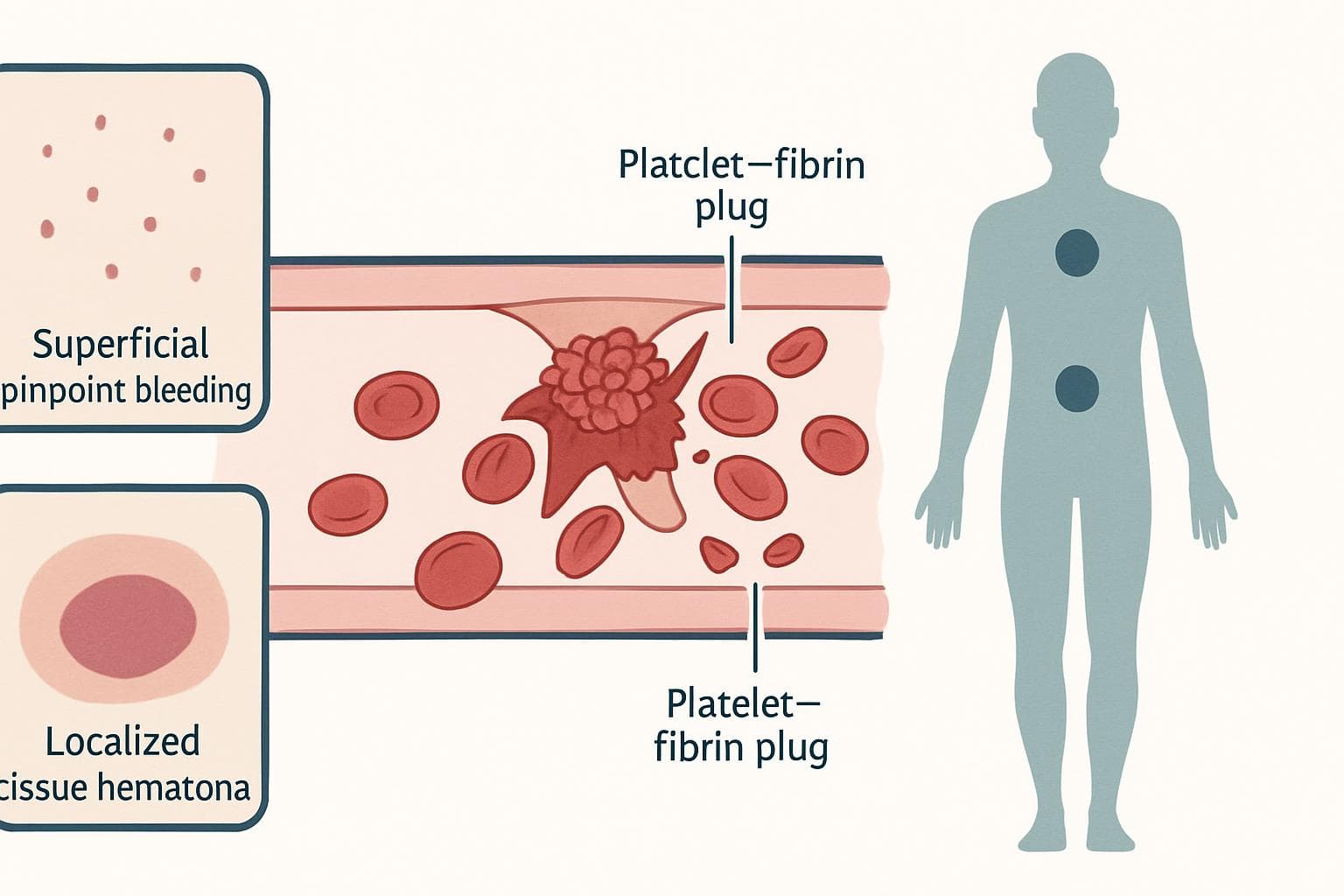
Bleeding is the principal risk. It may appear at an intravenous site, in urine or stool, within internal tissues, or inside the skull. Intracranial bleeding can cause death or severe disability.
During and after treatment, teams monitor neurological status, blood pressure, puncture sites and signs of systemic bleeding. Unnecessary invasive procedures and intramuscular injections are generally avoided because they create additional bleeding sites.
Report sudden deterioration immediately. Severe new headache, vomiting, worsening weakness, reduced consciousness or abrupt blood-pressure elevation during stroke treatment requires urgent assessment for intracranial hemorrhage. If alteplase is still infusing, clinicians stop it and activate the emergency evaluation and bleeding-management pathway.
Another important reaction is orolingual angioedema, meaning swelling of the tongue, lips or mouth. This can obstruct breathing, and risk is increased in patients taking an angiotensin-converting enzyme inhibitor. Stop an infusion and obtain urgent airway assessment if suspected.
Stopping a completed bolus is impossible. After tenecteplase, recognition and emergency management still matter even though there is no infusion left to discontinue.
Pharmacy Practice: Build a Reliable Treatment Timeline
A useful pharmacist contribution is reconstructing events, not simply calculating milligrams. Distinguish last known well, symptom discovery, hospital arrival and treatment time; these are four different timestamps, especially for someone who wakes with weakness.
Ask focused medication questions. “Do you take a blood thinner?” is less reliable than checking prescriptions, medicine strips, electronic records and caregiver information for warfarin, heparins or direct oral anticoagulants.
Document exactly what was given. During transfer between hospitals, record the thrombolytic name, total dose, bolus time, infusion status and any complications to reduce the risk of duplicate administration or a mistaken restart.
Following intravenous stroke thrombolysis, antiplatelet and anticoagulant medicines are generally withheld during the first 24 hours, with follow-up brain imaging before initiation under the stroke protocol. This rule should not be copied blindly into myocardial infarction pathways, where accompanying antithrombotic treatment differs.
IMPORTANT — Bring the medicine list, not a home remedy. Aspirin, extra anticoagulant tablets or an unprescribed injection can complicate assessment without replacing emergency reperfusion treatment.
Quick Pharm D Notes
- Definition: rtPA is recombinant tissue plasminogen activator; alteplase is the classic example.
- Classification: fibrinolytic enzyme and thrombolytic medicine.
- Mechanism: activates plasminogen to plasmin, which breaks down fibrin.
- Examples: alteplase; modified tPA agents include tenecteplase and reteplase.
- Clinical significance: selected emergency reperfusion, with separate intracatheter applications for alteplase.
- Major toxicity: bleeding, particularly symptomatic intracranial hemorrhage in stroke treatment.
- Distinctive adverse effect: orolingual angioedema, especially with concurrent ACE-inhibitor exposure.
- Exam distinction: fibrin selectivity reduces neither assessment requirements nor bleeding risk to zero.
Common Mistakes and Confusions
Do not call rtPA a routine preventive medicine. It treats selected existing clots; longer-term prevention usually involves other medicines and management of the underlying cause.
A normal initial brain scan does not rule out early ischemic stroke. Its immediate purpose often includes excluding hemorrhage, while the clinical examination and additional investigations establish the treatment pathway.
Finally, improvement does not prove success. Patients still require observation, swallowing assessment, appropriate follow-up imaging and rehabilitation planning even when speech or strength improves soon after thrombolysis.
FAQ
Is RTPA the same as alteplase?
Often, yes, in everyday stroke terminology. Technically, rtPA describes recombinant tissue plasminogen activator, while alteplase is a specific medicine. Verify the actual generic name on every order.
Can rtPA completely reverse a stroke?
Sometimes recovery is substantial, but complete reversal is not guaranteed. Benefit depends on treatment timing, the affected vessel, viable brain tissue and complications.
Can someone receive rtPA after waking with symptoms?
Possibly. Unknown-onset or wake-up stroke may qualify through specialist imaging-based pathways. Do not assume either automatic eligibility or automatic exclusion.
Is rtPA a blood thinner?
People sometimes use that phrase, but “clot-dissolving medicine” is more accurate. It acts differently from antiplatelet medicines such as aspirin and anticoagulants such as apixaban.
Is tenecteplase safer than alteplase?
There is no universal answer across all indications and patients. Both can cause serious bleeding; agent selection depends on current evidence, approved use, dosing and local protocols.
What happens if rtPA cannot be given?
Care continues urgently. Depending on the diagnosis, options may include thrombectomy, anticoagulation, coronary intervention or supportive stroke care. Ineligibility for thrombolysis does not mean that nothing can be done.
Last-Minute Revision
- Confirm ischemia versus hemorrhage before stroke thrombolysis.
- Record last-known-well time accurately; discovery time is not necessarily onset.
- Match the drug, presentation and dose to the indication.
- Short plasma half-life does not eliminate subsequent bleeding risk.
- Watch for intracranial bleeding and tongue or lip swelling.
- Continue monitoring and secondary-prevention planning after early improvement.
References
Use current versions; labels and guidelines can change.
- US FDA/DailyMed: Activase (alteplase) prescribing information; mechanism, stroke dosing, contraindications and warnings. Available through DailyMed.
- US FDA/DailyMed: TNKase (tenecteplase) and Cathflo Activase (alteplase) prescribing information; distinct indications, preparation and administration.
- American Heart Association/American Stroke Association: acute ischemic stroke guidance and professional resources at Professional Heart Daily.
- European Stroke Organisation: guidance on intravenous thrombolysis and tenecteplase at ESO guidelines.
Important Medical Disclaimer
This article is for general educational purposes and is not a substitute for advice from a qualified doctor or pharmacist. Always consult your doctor/pharmacist before using any medicine, changing a dose, or starting treatment.
Related reading
If this article on What Is RTPA? Stroke Benefits, Risks and Pharm-D Notes was helpful, explore these related guides for more practical information on similar topics.
- Define Hemorrhage: Detailed Pharm-D Notes and Safety — Understand hemorrhage through classification, mechanisms, morphology, clinical signs, and medicine-related risks, with clear exam notes a…
- Ascard Tablet Overview: Uses, Dosage and Safe Use Tips — Understand what Ascard contains, why doctors prescribe it, and how to avoid bleeding risks, missed-dose mistakes and unsafe tablet substi…
- Medication Therapy Management in Community Practice — How structured MTM visits improve outcomes and expand the pharmacist's clinical role.
- Define Hypoxia in Detail: A Pharm-D Study Notes Guide — Understand hypoxia through oxygen delivery, its four major types, diagnostic clues and treatment principles, with practical Pharm-D revis…
- Adverse Drug Reaction Reporting Systems — Pharmacovigilance fundamentals for students and practicing pharmacists.
- Is Buspar an SNRI? Buspirone Explained for Anxiety Care — Buspirone is not an SNRI. Review its mechanism, delayed anxiety relief, dosing principles, interactions, and practical counseling points…