
How AI-Powered Clinical Documentation Can Reduce Administrative Burden in Healthcare
How AI-Powered Clinical Documentation Can Reduce Administrative Burden in Healthcare AI-powered clinical documentation is changing how clinicians spend the hours around each visit. Instead of typing notes after clinic,
By Dr. Amina Rahman, PharmD10 min read
Reviewed by Medical Review Team ·
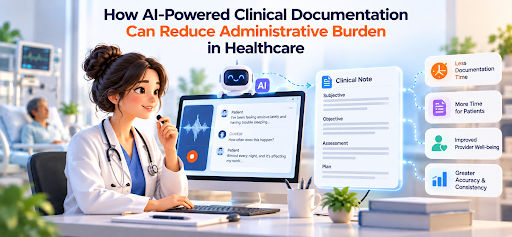
AI-powered clinical documentation is changing how clinicians spend the hours around each visit. Instead of typing notes after clinic, physicians review drafts generated from the conversation itself.
The promise is less charting, less burnout, and more attention on patients. This guide maps where administrative time actually goes, what the 2026 evidence shows, which burdens AI removes, and how to roll it out without new risk.
Where the Administrative Hours Actually Go in a Clinician's Day
Administrative burden in healthcare rarely comes from task. It accumulates across the visit note, order entry, inbox messages, prior authorization paperwork, coding queries, and chart review before the next patient. For ambulatory clinicians, much of this work spills into evenings, which informatics teams call work outside of work or, more bluntly, pajama time.
The visit note is the single largest slice, but it is still a slice. A clinician might spend part of the day writing notes and another large part answering portal messages, reconciling medications, and reviewing outside records. That distinction matters, because a documentation tool can remove the work it actually touches.
This is why health systems that already use AI capabilities inside the EHR tend to see the clearest picture of where time leaks. Their audit logs show minutes per note, minutes in the inbox, and after-hours activity for every clinician. That baseline becomes the yardstick for judging whether any documentation tool truly lowers the administrative load.
What AI-Powered Clinical Documentation Does During and After a Visit
AI-powered clinical documentation combines speech recognition, large language models, and EHR integration to turn a clinical conversation into a structured, reviewable record.
The clinician stays the author of record. The software handles capture and first drafting, and the clinician edits, approves, and signs, which keeps clinical judgment and legal accountability where they belong.
Ambient Capture and Draft Notes
With the patient's consent, a phone or workstation microphone listens to the visit. Clinical voice AI models transcribe the dialogue, separate speakers, and filter small talk from clinically relevant content. Shortly after the visit ends, a draft note appears in the format the clinician prefers, such as SOAP, a specialty template, or a problem-based note.
Behind that draft sits clinical natural language processing that maps everyday phrases to medical concepts. When a patient says their chest feels tight on the stairs, the model can file it under the history of present illness as exertional chest tightness. Most tools let clinicians click any sentence to hear the source audio, which speeds verification.
Structured Data, Coding, and Downstream Tasks
The more valuable systems go beyond prose. They push discrete data such as problems, medications, allergies, and orders into the right EHR fields, which depends on reliable EHR integration built on FHIR and HL7 standards. Without that integration, clinicians copy text between windows, and much of the promised time savings quietly disappears.
Many platforms also draft plain-language after-visit summaries, referral letters, and suggested diagnosis and procedure codes based on the documented encounter. Coding support pairs well with AI-assisted medical billing workflows, because well-documented visits support accurate evaluation and management levels and reduce queries from coding teams days after the patient has gone home.
What the 2025 to 2026 Evidence Says About Time and Burnout
The strongest real-world evidence so far comes from a large multisite study across five academic health systems. Clinicians given access to an AI scribe spent 16 fewer minutes on documentation per 8 scheduled patient hours. Clinicians who used the scribe on most of their visits saved considerably more, while occasional users saw little change, which makes usage intensity a key variable.
Time is half of the story, because burnout responds even when the minutes saved look modest. In a multicenter quality improvement study, the share of clinicians reporting burnout fell from 51.9% to 38.8% after 30 days of ambient scribe use. Clinicians also reported lower note-related cognitive load and more undivided attention on patients during visits.
One finding deserves attention from every operations leader: after-hours EHR time did not fall significantly in the large multisite analysis. Researchers suggest that saved minutes get reabsorbed by inbox messages, test results, and note review. The gains were also largest in primary care and among advanced practice clinicians, where documentation loads run heaviest.
Five Burdens It Removes, and Two It Does Not
The first burden AI removes is blank-page drafting, the slow work of composing a note from memory hours after the visit. The second is cognitive juggling during the encounter, where clinicians split attention between the patient and the keyboard. Removing both lets clinicians listen fully, which patients notice and often mention in their feedback.
The third burden is secondary writing: patient instructions, referral letters, and work notes that repeat what was already said in the room. The fourth is coding friction, since drafts that capture medical decision-making support accurate visit levels. The fifth is recall error, because a note built from the conversation does not depend on end-of-day memory.
Two burdens remain largely untouched. The first is the inbox, where patient portal messages, refill requests, and result notifications keep growing regardless of how notes are written. The second is chart review, meaning the time spent reading prior records before and during visits. Separate AI tools address both, but a visit scribe alone will not.
Naming these limits up front protects the program. When leaders promise that an ambient scribe will end pajama time, clinicians feel misled the inbox still waits at night. Framing it as a tool that removes note writing and mental load sets realistic expectations and keeps adoption high through the first difficult months.
The Risks That Can Quietly Add Burden Back
Every AI draft must be reviewed, and that review is itself a new task. In 2026 quality evaluation of physician-reviewed AI notes, omissions appeared in 18% of notes and hallucinations in 11.5%, although most errors were minor. Left unmanaged, the risks below can turn a time-saving tool into a new source of rework and liability.
Silent omissions: Missing details are harder to spot than wrong ones, so reviewers need a habit of checking plans, medications, and follow-up items against what was said.
Review fatigue: After dozens of clean drafts, clinicians start skimming, which is exactly when a fabricated medication or diagnosis can slip into the signed record.
Consent gaps: Several states now require patient disclosure or consent before recording, and a missing consent script at check-in creates legal exposure for the organization.
Data handling and HIPAA exposure: Audio, transcripts, and drafts are protected health information, so retention periods, encryption, and business associate agreements must be confirmed in writing.
Copy-forward contamination: An error in signed note can be pulled into later notes, referrals, and summaries, spreading inaccurate history across the chart.
Loss of the patient's own words: Polished summaries can strip out the patient's narrative and nuance, which clinicians may need when revisiting a difficult diagnosis.
Teams building or customizing their own documentation layer can reduce several of these risks at the design stage. Choosing HIPAA-ready application architecture with audit trails, sentence-level links to source audio, and configurable retention rules makes safe review faster, and it gives compliance teams the evidence they need when regulators or patients ask questions.
Beyond Physicians: What Nursing Documentation Needs
Most published evidence covers outpatient physicians, yet nurses carry a large share of hospital documentation. Their work has a different structure. It is shift-based, spans several patients at once, gets interrupted constantly, and lives mostly in flowsheets with discrete fields rather than narrative notes. A tool designed for a short clinic visit does not map cleanly a long shift.
Early nursing deployments focus on turning bedside conversations into flowsheet values such as pain scores, assessments, and intake, which nurses then confirm. The pattern that works is co-design: nurses help define which fields the AI fills, what it must never infer, and how edits are tracked. Without that ownership, adoption among nursing staff tends to stall quickly.
A Rollout Plan That Protects the Time Savings
Adoption is no longer the hard part, since 81% of physicians now report using AI in their practice, and documentation is among the most common uses. The hard part is sustaining value after the novelty fades. That depends on choosing the right model for your organization and measuring results with the same rigor you would apply to any clinical intervention.
Buying an Ambient Scribe or Building a Custom Documentation Layer
Buying an established scribe is fastest for standard ambulatory specialties on a major EHR. Building, or extending a vendor product with a custom layer, makes sense when specialty templates, data ownership rules, or nursing workflows fall outside what off-the-shelf tools handle. Many organizations start with an independent healthcare AI consulting assessment before signing a multi-year contract.
EHR fit: Confirm the tool writes discrete data into your EHR rather than pasting text, since manual transfer erases much of the time saved.
Specialty coverage: Test drafts in your highest-volume specialties, because note quality varies widely between primary care, surgery, pediatrics, and behavioral health.
Data ownership: Clarify who owns audio, transcripts, and derived data, and whether the vendor may use them to train future models.
Customization depth: Check whether templates, terminology, and note styles can be configured per clinician without a support ticket for every change.
Total cost of ownership: Compare per-clinician subscriptions against build and maintenance costs over three years, including integration, training, and security reviews.
Exit path: Make sure notes, configurations, and audit logs can be exported cleanly if you switch vendors or bring the capability in-house.
Metrics to Track From Day One
Capture a baseline at least six weeks before go-live, then compare the same measures afterward against a group that has not yet adopted the tool. Pairing EHR log data with short clinician surveys tells both the time story and the experience story, and leaders need both to justify renewing or expanding the program.
Documentation time per 8 patient hours: This normalized EHR measure lets you compare clinicians with different schedules and is the most direct signal of time saved.
Work outside of work: Track after-hours and weekend EHR minutes separately, since this is where burnout lives and where gains are often smallest.
Usage intensity: Measure the share of eligible visits where each clinician uses the tool, because benefits rise sharply among frequent users.
Edit rate and unedited notes: Watch both heavy editing, which signals weak drafts, and zero editing, which can signal review fatigue.
Same-day note closure: Faster note completion improves care coordination and billing cycles, and it is easy to pull from existing EHR reports.
Burnout and cognitive load pulse: A two-minute survey at baseline, 30 days, and 90 days shows whether the experience gains hold over time.
Quick Answers to Common Questions
Is AI-powered clinical documentation HIPAA compliant?
It can be, but compliance depends on the vendor and the deployment, not the technology itself. Look for a signed business associate agreement, encryption in transit and at rest, clear audio retention limits, role-based access, and audit logs. Also confirm whether patient data is used for model training and how state recording consent rules are handled.
Does it replace human medical scribes?
For many outpatient practices, it replaces most of what human scribes did at a fraction of the cost, and it scales to clinicians who never had a scribe. Some high-volume specialties still pair AI drafting with a human reviewer or virtual assistant, especially where orders, procedures, and complex coding need real-time support during the visit.
How long before teams see results?
Clinicians usually report lower cognitive load within the first few weeks, and burnout improvements have been measured after a month of use. Time savings in EHR logs take longer to stabilize as clinicians tune templates and build review habits over the first few months. Organizations that provide structured training and peer champions reach steady usage noticeably faster.
Conclusion
AI-powered clinical documentation will not erase every administrative task in healthcare, but it removes the most draining one: building the note from scratch. Healthcare software development that integrates AI documentation tools with existing EHR systems can further streamline clinical workflows.
The evidence shows real gains in documentation time and burnout, especially for frequent users. Organizations that pair the technology with strong review habits, clean EHR integration, and honest metrics will turn those early gains into lasting relief for clinicians.
Important Medical Disclaimer
This article is for general educational purposes and is not a substitute for advice from a qualified doctor or pharmacist. Always consult your doctor/pharmacist before using any medicine, changing a dose, or starting treatment.