Strophanthus, Gentian, Quassia and Sarsaparilla: Safe Uses
Understand these four medicinal plants, which parts are used, what evidence supports their uses, and why strophanthus is unsafe for self-treatment.
By Dr. Amina Rahman, PharmD13 min read
Reviewed by Medical Review Team ·
Strophanthus, gentian, quassia and sarsaparilla are medicinal plant materials:
strophanthus contains powerful heart-active glycosides, gentian and quassia are traditional bitters, and sarsaparilla contains steroidal saponins with largely unproven therapeutic benefits. They are not all roots: the classic pharmacy materials are strophanthus seeds, gentian underground parts, quassia wood and sarsaparilla roots; strophanthus is unsafe for self-treatment.
This guide is educational, not advertising for any company’s product. Compare any proposed preparation with a pharmacist rather than choosing by brand claims.
These are pharmacognosy materials, meaning natural substances studied for their identity, constituents and medicinal significance. They are not four interchangeable herbal medicines.
The plant part matters. A root powder cannot automatically substitute for a seed extract, even when the seller uses the same plant name, because the chemical content and safety may differ substantially.
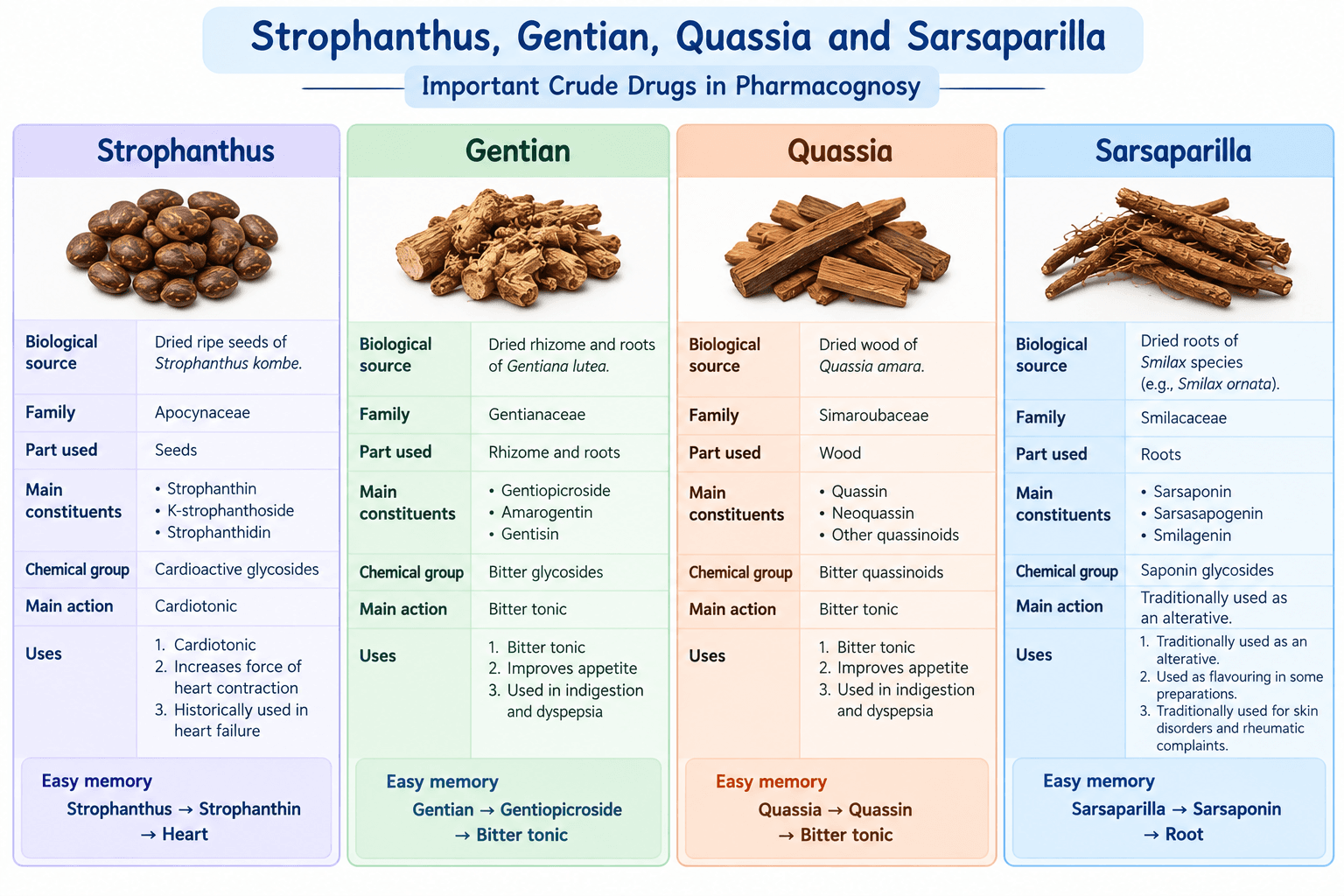
Strophanthus, Gentian, Quassia and Sarsaparilla — Complete Table
| Feature | Strophanthus | Gentian | Quassia | Sarsaparilla |
|---|---|---|---|---|
| Biological source | Dried ripe seeds of Strophanthus kombe | Dried rhizome and roots of Gentiana lutea | Dried wood of Quassia amara | Dried roots of Smilax species |
| Family | Apocynaceae | Gentianaceae | Simaroubaceae | Smilacaceae |
| Part used | Seeds | Rhizome and roots | Wood | Roots |
| Main constituents | Strophanthin, K-strophanthoside, strophanthidin | Gentiopicroside, amarogentin, gentisin | Quassin, neoquassin, other quassinoids | Sarsaponin, sarsasapogenin, smilagenin |
| Chemical group | Cardioactive glycosides | Bitter glycosides | Bitter quassinoids | Saponin glycosides |
| Main action | Cardiotonic | Bitter tonic | Bitter tonic | Traditionally used as an alterative |
| Uses | 1. Cardiotonic 2. Increases force of heart contraction 3. Historically used in heart failure | 1. Bitter tonic 2. Improves appetite 3. Used in indigestion and dyspepsia | 1. Bitter tonic 2. Improves appetite 3. Used in indigestion and dyspepsia | 1. Traditionally used as an alterative 2. Used as flavouring in some preparations 3. Traditionally used for skin and rheumatic complaints |
| Easy memory | Strophanthus → Strophanthin → Heart | Gentian → Gentiopicroside → Bitter tonic | Quassia → Quassin → Bitter tonic | Sarsaparilla → Sarsaponin → Root |
Strophanthus: seeds, not a household root remedy
Strophanthus belongs to the Apocynaceae family. Classical sources include Strophanthus kombe and Strophanthus gratus, whose seeds contain cardenolide cardiac glycosides. These compounds affect heart contraction and electrical activity.
S. gratus is a source of ouabain, also called g-strophanthin; S. kombe contains glycosides commonly discussed under k-strophanthin. These names do not describe identical preparations. The seeds are elongated and may retain a characteristic hairy appendage, but appearance alone cannot establish safety or authenticity.
Gentian: bitter root and rhizome
Gentian usually refers to the dried underground parts of Gentiana lutea, family Gentianaceae. These include the root and rhizome, an underground stem. Important constituents include bitter secoiridoid glycosides such as gentiopicroside and amarogentin.
Dried pieces are typically yellowish-brown, with longitudinal wrinkles. Gentian’s intense bitterness explains its traditional use for temporary appetite loss and mild digestive complaints. Never taste an unidentified root to identify it.
Quassia: medicinal wood
Quassia commonly refers to wood from Quassia amara or Picrasma excelsa, family Simaroubaceae. These are traditionally called Surinam quassia and Jamaica quassia, respectively.
The pale wood contains intensely bitter quassinoids, including quassin and neoquassin. It has a history as a bitter digestive preparation and insecticidal material. An insecticide preparation is not suitable for drinking, even if its plant name looks familiar.
Sarsaparilla: roots from Smilax species
Medicinal sarsaparilla comes from certain Smilax species, including Smilax ornata, family Smilacaceae. The material consists of long roots containing steroidal saponins, compounds that can produce foam in water.
Identity is especially important in Pakistan. “Indian sarsaparilla” often means Hemidesmus indicus, a different plant. A local name, translated label or similar-looking root does not prove that a product contains Smilax.
How they work — and what remains uncertain
Strophanthus glycosides inhibit the sodium–potassium ATPase, a cell-membrane pump. This alters calcium handling in heart cells and can strengthen contraction, but it can also disturb conduction and trigger life-threatening arrhythmias, meaning abnormal heart rhythms.
The safety margin is narrow. Historical medicinal use does not make raw seeds or homemade extracts safe substitutes for modern cardiac treatment.
Gentian and quassia stimulate bitter-taste pathways and may influence digestive secretions. That rationale supports their traditional classification as bitters; it does not establish reliable treatment for persistent indigestion, reflux or unexplained weight loss.
Sarsaparilla saponins have shown biological effects in laboratory research. Those findings do not establish that a root preparation improves human hormone levels, treats infection or “cleans the blood.”
There is no dependable onset time covering these products. Species, preparation and intended effect differ, and unsupported promises of relief within minutes should raise concern.
Uses — traditional practice versus proven treatment
Temporary appetite loss and mild indigestion
Gentian has a European traditional-use herbal monograph for temporary appetite loss and mild dyspeptic complaints, such as fullness and flatulence. Traditional-use recognition is not equivalent to strong clinical-trial evidence.
A clinician may consider an appropriate gentian preparation after checking the symptoms and the patient’s history. Persistent appetite loss needs assessment, especially with weight loss, swallowing difficulty, repeated vomiting or black stools.
Quassia also has a history as a bitter tonic. Evidence supporting routine patient use is limited, so it should not replace investigation or established treatment.
Historical heart treatment
Strophanthus helped shape the history of cardiac-glycoside medicines. That is its central educational importance here. Raw botanical products have no place in self-managing heart failure, palpitations or chest discomfort.
Do not replace prescribed heart medicines with it.
Skin, joint and “blood-purifying” claims
Sarsaparilla has been used traditionally for skin complaints, rheumatic symptoms and conditions once described as requiring blood purification. These historical uses do not establish clinical effectiveness.
It is not a proven treatment for psoriasis, arthritis or sexually transmitted infections. Neither sarsaparilla nor quassia should replace properly selected antimicrobial or antiparasitic treatment.
Dose and how to take — why no universal dose fits
The exact dose depends on age, condition, formulation and medical history; confirm it with a doctor or pharmacist. There is no safe shared teaspoon, drop count or capsule schedule for these four materials.
Adults: if a clinician recommends a suitable non-strophanthus product, follow that specific label. Confirm the botanical name, plant part, extract concentration, frequency and maximum duration. Do not transfer instructions from a tea to a concentrated tincture.
Children: do not calculate a dose by halving an adult amount. Safety information is insufficient for many preparations, and young children with poor appetite need assessment of feeding, growth and possible illness.
Some gentian products direct use before meals. Follow the actual preparation’s instructions rather than assuming that every bitter should be taken on an empty stomach; stop if it causes burning or pain.
Do not crush tablets or open capsules unless the pharmacist confirms that this is appropriate. Homemade strophanthus preparations should never be taken.
Side effects — what should make you stop?
Digestive irritation is a practical concern. Depending on the preparation, gentian, quassia or sarsaparilla may cause nausea, abdominal discomfort or loose stools. Reliable frequency estimates are unavailable for many herbal products.
Stop the preparation if symptoms begin or clearly worsen after a dose. Persistent vomiting, severe abdominal pain or blood in vomit or stools needs urgent medical assessment, not a different herbal mixture.
Allergic reactions are possible. Facial swelling, wheezing, throat tightness or collapse requires emergency help.
Strophanthus exposure is different: vomiting, weakness, dizziness, visual disturbance, fainting or an unusually slow, fast or irregular heartbeat may indicate cardiac-glycoside poisoning. Do not wait for every symptom to appear.
Warnings and precautions
Pregnancy and breastfeeding: avoid self-treatment with these botanicals. Adequate safety evidence is lacking for many preparations, and traditional use does not establish safety for a developing baby or breastfed infant.
Older adults: multiple medicines, dehydration and underlying heart problems make adverse effects harder to predict. Bring the full medicine list, including powders and drops, to the pharmacist.
Kidney, liver or heart disease: do not experiment with concentrated extracts. Limited product-specific information means that a safe dose adjustment often cannot be provided, particularly when several ingredients are mixed together.
Stomach ulcers or troublesome reflux: gentian and other bitters may worsen symptoms; gentian should be avoided with gastric or duodenal ulcers. Burning after a dose is not evidence that the product is “working.”
Never use wild-collected gentian without expert identification. Poisonous plants can be confused with medicinal roots, and a photograph or shopkeeper’s reassurance cannot replace verified identification.
Drug interactions — disclose herbs as medicines
The clearest high-risk concern is strophanthus. Combining cardiac-glycoside exposure with digoxin or medicines affecting heart rhythm or electrolytes can be dangerous. Potassium loss from some diuretics or laxative misuse can increase cardiac-glycoside toxicity risk.
For gentian, quassia and sarsaparilla, clinical interaction data are limited. That means uncertainty, not proof of compatibility. Ask a pharmacist to review prescribed medicines, painkillers, vitamins and other supplements before adding a preparation.
Check tinctures for alcohol content. Avoid combining alcohol with a product that causes dizziness or stomach irritation, and do not use alcohol-containing remedies for children.
Food does not neutralize a toxic botanical. Mixing strophanthus into milk, honey or tea cannot make it safe.
Who should not use these preparations?
- Nobody should self-treat with strophanthus seeds or homemade extracts.
- Avoid any preparation containing a plant or excipient that previously caused an allergic reaction.
- Avoid gentian with gastric or duodenal ulcers.
- Do not use unidentified roots, unlabelled mixtures or non-medicinal quassia insecticide products.
- Children, pregnant or breastfeeding people, and patients with significant illness should not self-start these products without a specific professional assessment.
These restrictions are not interchangeable. Each plant needs its own safety check.
Overdose — when to seek emergency help
Suspected strophanthus ingestion needs immediate medical assessment, even before symptoms develop. Take the container or a safely sealed sample with you. Report the approximate amount, time of exposure and all regular medicines.
Do not induce vomiting. Do not give another herbal remedy to counteract it.
For collapse, seizures, breathing difficulty or severe palpitations, call the locally available ambulance service; Rescue 1122 operates in many parts of Pakistan. Do not drive yourself if faint or dizzy.
Missed dose — never compensate with extra
If you forget a dose of a professionally recommended product, follow its leaflet or ask the pharmacist. Never double without medical advice. Missing an optional herbal preparation is generally less concerning than taking an excessive catch-up amount.
How long is it used?
Use an agreed review point, not an open-ended course. Gentian’s traditional-use guidance advises medical review when symptoms persist beyond two weeks; worsening symptoms need earlier attention.
There is no established general long-term course for quassia or sarsaparilla. Do not keep restarting them for recurring symptoms without investigating the cause.
These herbs do not have a recognized routine tapering requirement. However, never stop prescribed cardiac medicines because you have started or stopped a herbal product.
Storage — protect against heat and moisture
Follow the manufacturer’s storage instructions. In Pakistan’s hot weather, avoid leaving products in parked cars, beside cooking areas or in direct sunlight. Keep dried materials sealed and away from bathroom moisture.
Store everything out of children’s reach, preferably locked away. Keep the original label, discard mouldy or expired material, and ask a pharmacy about disposal rather than sharing leftovers.
Forms and strengths — check what the number means
Products may contain cut plant material, powder, dry extract, liquid extract or tincture. Sarsaparilla-flavoured drinks are not automatically medicinal Smilax preparations.
A milligram figure is not enough. Powder weight and extract weight describe different things, while a multi-herb syrup may not disclose enough information to compare its components meaningfully.
Historical injectable strophanthin medicines are not equivalent to herbal drops. Do not infer safety or modern availability from an old pharmacognosy textbook.
Brand comparison — compare identity before price
No brand is preferred here. Compare products by verified botanical identity, plant part, extraction details, complete ingredient list, batch number, expiry date and manufacturer information.
Ask the pharmacist to check applicable DRAP enlistment or registration details for the product category. Regulatory listing does not prove every advertising claim.
Two packs labelled “sarsaparilla” may contain different species; two gentian extracts may have different concentrations. That is why a cheaper bottle is not necessarily an equivalent replacement, and why switching needs a label review.
Common misconceptions
- Myth: All four materials are roots. Truth: strophanthus is classically a seed drug and quassia a wood drug.
- Myth: Natural bitters are harmless. Truth: plant products can irritate the stomach, be misidentified or contain toxic constituents.
- Myth: Steroidal saponins raise testosterone. Truth: the chemical description does not mean sarsaparilla acts like testosterone or a prescribed steroid.
- Myth: More bitterness means better quality. Truth: taste cannot establish identity, purity or dose.
Patient FAQ
Can I take all four together?
No safe standard combination is established. Combining them adds uncertainty, and strophanthus must not be included in self-treatment.
Is gentian violet the same as gentian root?
No. Gentian violet is a synthetic dye with antiseptic uses, not a Gentiana lutea preparation. Never swallow it as a herbal tonic.
Can gentian help a child who will not eat?
Do not self-prescribe it. A child’s appetite needs assessment alongside growth, feeding habits and symptoms, rather than treatment with adult bitters.
Is sarsaparilla a blood purifier?
“Blood purifier” is not a defined clinical treatment. It does not explain which condition is being treated or demonstrate that the product helps.
Can quassia treat intestinal worms?
Do not rely on it. Suspected worm infection needs an appropriate assessment and a proven treatment selected for the likely parasite.
Can I take these during pregnancy or breastfeeding?
Avoid self-treatment. Discuss the actual product and symptom with a qualified clinician because safety evidence is insufficient for many preparations.
Can I drive after taking a herbal tonic?
Do not drive if dizzy, weak or unwell. After strophanthus exposure, these symptoms need urgent assessment rather than simply waiting to feel better.
Are homeopathic strophanthus drops automatically safe?
No. Concentrations vary, and mother tinctures or low dilutions may contain active plant constituents. Show the full label to a pharmacist.
Will I become dependent on gentian or sarsaparilla?
Dependence is not an established typical effect. Nevertheless, repeatedly needing a tonic may hide an untreated digestive, nutritional or other medical problem.
How should I check the price in Pakistan?
Ask a licensed pharmacy for current prices after confirming species, preparation and pack size. Comparing bottle prices alone can be misleading.
Sources
- European Medicines Agency: Gentianae radix, herbal monograph and assessment documents covering traditional uses and safety: https://www.ema.europa.eu/en/medicines/herbal/gentianae-radix
- Royal Botanic Gardens, Kew: Plants of the World Online, for botanical identities and plant families: https://powo.science.kew.org/
Important Medical Disclaimer
This article is for general educational purposes only and is not a substitute for advice from a qualified doctor or pharmacist. Always consult your doctor/pharmacist before using any medicine, changing a dose, or starting treatment.
Related reading
If this article on Strophanthus, Gentian, Quassia and Sarsaparilla: Safe Uses was helpful, explore these related guides for more practical information on similar topics.
- Plant-Derived Alkaloids: Is Kratom Itself an Alkaloid? — From isolation to therapeutic application — a structured review for pharmacy curricula.
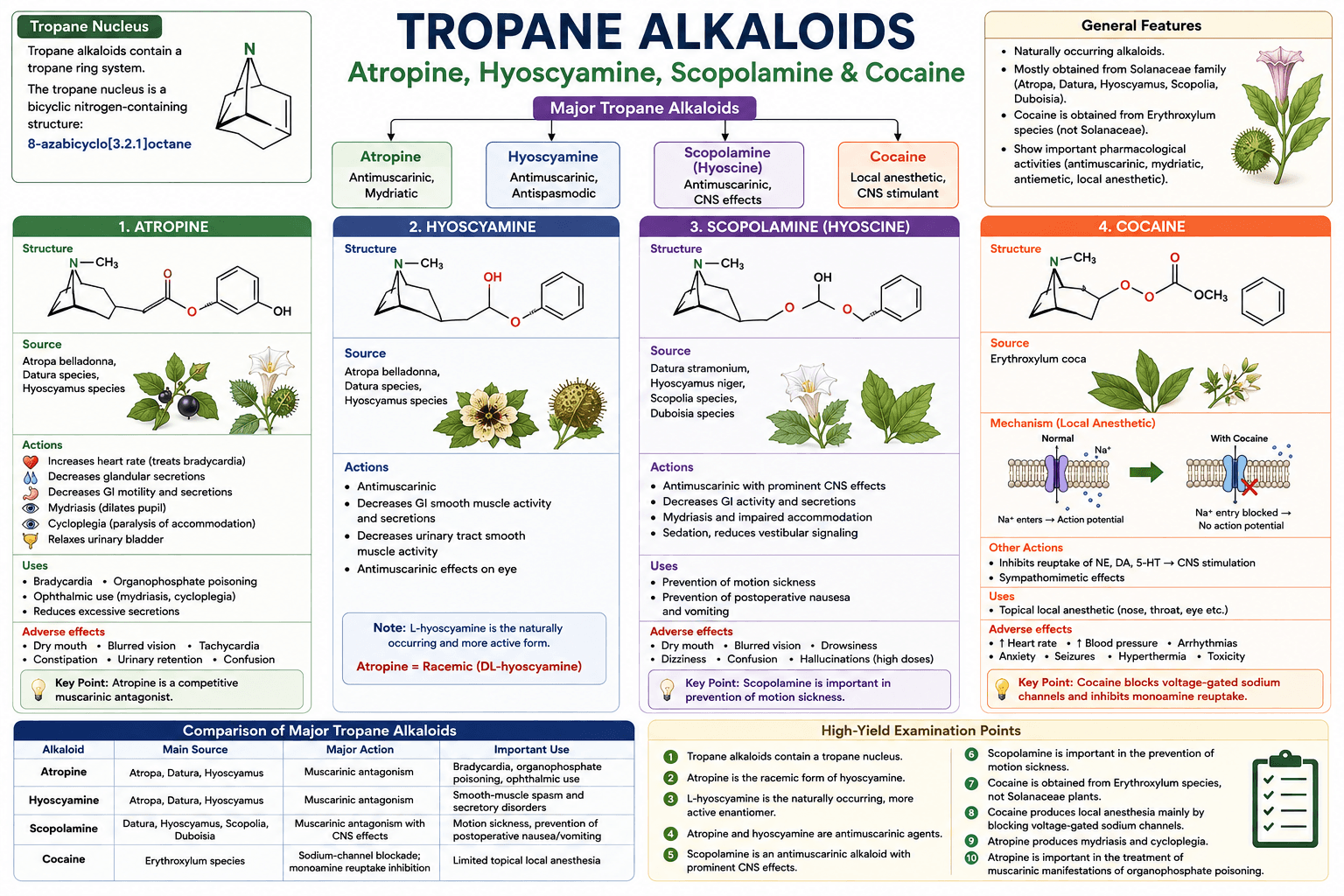
- Tropane Alkaloids: Atropine, Hyoscyamine, Scopolamine & Cocaine — Tropane alkaloids are a group of naturally occurring alkaloids that contain a characteristic tropane ring system in their chemical struct…
- Celbex Tablet Uses: Check the Ingredient and Use Safely — Check Celbex’s active ingredient before use, then learn about celecoxib pain relief, stomach and heart risks, interactions, and when to s…
- Nims Tablet Uses: Pain Relief, Dose and Liver Safety — Learn what Nims tablets may treat, how to check the ingredient, and when to stop. Practical guidance on dosing, liver risks and safer pai…
- Ascard Tablet Overview: Uses, Dosage and Safe Use Tips — Understand what Ascard contains, why doctors prescribe it, and how to avoid bleeding risks, missed-dose mistakes and unsafe tablet substi…
- Gravinate Syrup Uses, Dosage Guidance and Side Effects — Learn when Gravinate syrup helps nausea and travel sickness, how to check the bottle strength, and which symptoms need care rather than a…