I'm a Skincare Beginner. Is Nivea Actually a Good Starting Brand, or Should I Just Go Straight to Garnier?
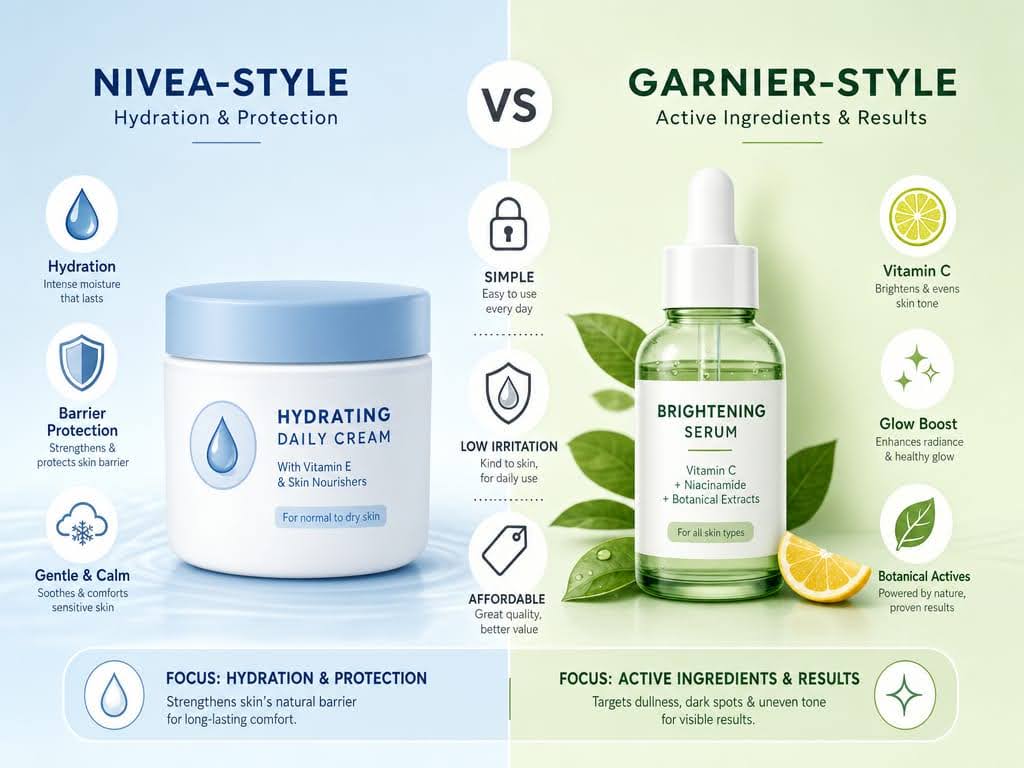
Nivea focuses on hydration and skin barrier protection, while Garnier targets brightness and uneven skin tone. Here is how a beginner should actually choose.
By Sarah Chen, MSc6 min read
Reviewed by Medical Review Team ·
Nivea vs Garnier for Beginners: Which One Should You Actually Start With?
You're standing in the skincare aisle, no clue what your skin type even is, and two familiar names are staring back at you — Nivea and Garnier. If that's you right now, relax, that's basically everyone's starting point. These two brands just approach "beginner skincare" from completely different angles. Let's actually break it down so you're picking something on purpose instead of just grabbing whatever's cheapest.
Quick Answer
Nivea — hydration and barrier support, mostly hands-off. Really hard to mess up. Good if your skin reacts to everything or you genuinely don't know your skin type yet.
Garnier — hydration plus some mild actives, like niacinamide and vitamin C. A little more to manage, but you'll see results faster. Good if you're dealing with dullness, oiliness, or uneven tone.
Neither one's "better" honestly — they're just solving different beginner problems.
Terms Worth Knowing First
- Humectant — pulls water into your skin. Glycerin's the classic example.
- Occlusive — seals moisture in by forming a barrier on top. Think petrolatum-type ingredients.
- Active ingredient — does more than just moisturize. Actually changes something — tone, texture, oil levels.
- Niacinamide — vitamin B3. Calms redness, evens tone, backs up your skin barrier.
- Vitamin C — an antioxidant, brightens skin, helps fade dark spots over time.
- Patch test — small amount of product on your inner forearm or jawline, wait 24-48 hours, check for a reaction before going full-face.
- Skin barrier — the outer layer keeping moisture in and irritants out.
Quick thing worth remembering — hydrating and treating aren't the same thing. A moisturizer keeps skin comfortable. An active tries to actually change something. Beginners mix these up constantly.
What Actually Makes a Brand Beginner-Friendly
Three things, really, and none of them are "how popular the brand is":
- Simplicity — can you use it alone, without needing three other products backing it up?
- Low irritation risk — is your face going to turn into a science experiment or not?
- Practicality — can you keep buying it without your budget crying?
A beginner routine genuinely only needs two things — a cleanser and a moisturizer. Actives are optional until you actually understand your skin a bit better.
Where Nivea Fits In
Nivea's core moisturizers run on pretty simple logic — hydrate, seal, don't mess with anything else. Most formulas pair a humectant like glycerin with an occlusive ingredient to lock that moisture in place. No exfoliation push, no brightening agenda, just steady hydration while your skin does its thing.
That passivity is honestly the whole selling point. Hard to mess up a product that isn't trying to change anything about you.
One catch though — several classic Nivea lines are fragranced. Most people are totally fine with this, but if your skin already leans reactive, fragrance is usually the first thing worth ruling out.
Where Garnier Fits In
Garnier's beginner-friendly lines — mostly the vitamin C and niacinamide ranges — ease people into actives without throwing them in the deep end. Neither ingredient counts as harsh by active-ingredient standards, which is exactly why they show up in entry-level formulas. But they do more than just hydrate — brightening, evening tone, gently supporting the barrier.
Because these lines contain actives, patch-testing genuinely matters here. "Less is more" isn't a suggestion, it's basically a requirement.
The trade-off — stacking two or three active-based Garnier products on day one is a classic beginner mistake. It's not that the brand's harsh, it's that any active-based routine punishes impatience pretty fast.
Side-by-Side
| Category | Nivea | Garnier |
|---|---|---|
| Core approach | Hydration and barrier support, mostly passive | Hydration plus mild actives |
| Best fit | Normal to dry skin, low sensitivity | Oily, combination, or uneven tone |
| Irritation risk | Fragrance is the main variable | Lower fragrance risk, but active-related risk if overused |
| Reading required | Almost none | Some — know what you're layering |
| Price | Very budget-friendly | Budget to mid-range |
| Hardest to mess up | Yes | Only if you pace yourself |
The Simple Decision Path
Standing in the aisle, unsure? Ask yourself: does your skin react easily, or do you not know your skin type at all? Go Nivea — fragrance-free, no actives, just observe for two weeks.
Dealing with oily skin, or patchy/dull tone? Go Garnier — pick one single-active product, niacinamide or vitamin C, every other day to start.
An Easy Way to Remember This
Three beginner criteria — Simplicity, Low irritation, Practicality. Think "SLP" — Start, Look, Pace. Start with one product, look at how your skin actually reacts, pace how fast you add anything new.
Where This Actually Matters
Three real situations this helps with:
- Building your first-ever routine — deciding what to buy before you understand your own skin.
- Budgeting for skincare — both brands are drugstore-priced, so cost isn't really the deciding factor, fit is.
- Troubleshooting irritation — knowing whether a reaction probably came from fragrance (Nivea-style) or an active (Garnier-style) helps you undo the mistake faster.
Mistakes People Make Constantly
- Skipping the patch test, even on stuff that seems "gentle."
- Introducing more than one new product at once, so you genuinely can't tell what caused a reaction.
- Assuming "natural" or "fragrance-free" means zero risk. It lowers risk. Doesn't erase it.
- Overusing actives because "more equals faster results" — daily overuse in week one is the most common slip-up.
- Judging a product after three days. Barrier adjustment and visible change both take longer than that.
Spending more doesn't automatically mean safer, by the way. Price is often about marketing and packaging, not actual formulation quality.
FAQ
Can I mix Nivea and Garnier?
Yeah — a common move is a Garnier active product followed by a Nivea moisturizer to seal it in. Just don't introduce both at the same time, stagger it.
How long until I see results?
Nivea-type hydration effects usually show within days. Garnier's tone-related actives generally need a few weeks of consistent, correctly-paced use.
Do I need a full routine on day one?
Nope. A cleanser and a moisturizer already counts as a complete beginner routine.
What if I react to both brands?
Stop everything, go back to a plain fragrance-free moisturizer for a few days. If it doesn't settle, that's a conversation for a dermatologist, not another guess.
What age should I start using actives like niacinamide or vitamin C?
No fixed age really — depends more on your skin's tolerance and concerns than a number. Ease in gradually no matter your age.
Is fragrance always bad in a moisturizer?
Not for everyone — most people tolerate fragranced products just fine. It's simply the first thing worth removing if your skin's already reactive.
Quick Recap
Nivea = simple, rich, passive hydration — good for reactive or unidentified skin types. Garnier = mild actives (niacinamide, vitamin C) — good for oily, combination, or dull/uneven skin. Patch test every new product, 24-48 hours, one at a time. Give any product two full weeks before judging it. If skin reacts, simplify — don't add more trying to fix it.
References: American Academy of Dermatology (aad.org) — general guidance on skincare basics, patch testing, and ingredient tolerance. U.S. Food and Drug Administration (fda.gov/cosmetics) — cosmetics labeling and ingredient information.
This article is for general educational purposes and isn't a substitute for personalized advice from a dermatologist, especially for existing skin conditions, pregnancy, or breastfeeding.